WELCOME TO KINGHOME
Get A Free Quote
We will get back to you within 8 hours

WELCOME TO KINGHOME
We will get back to you within 8 hours
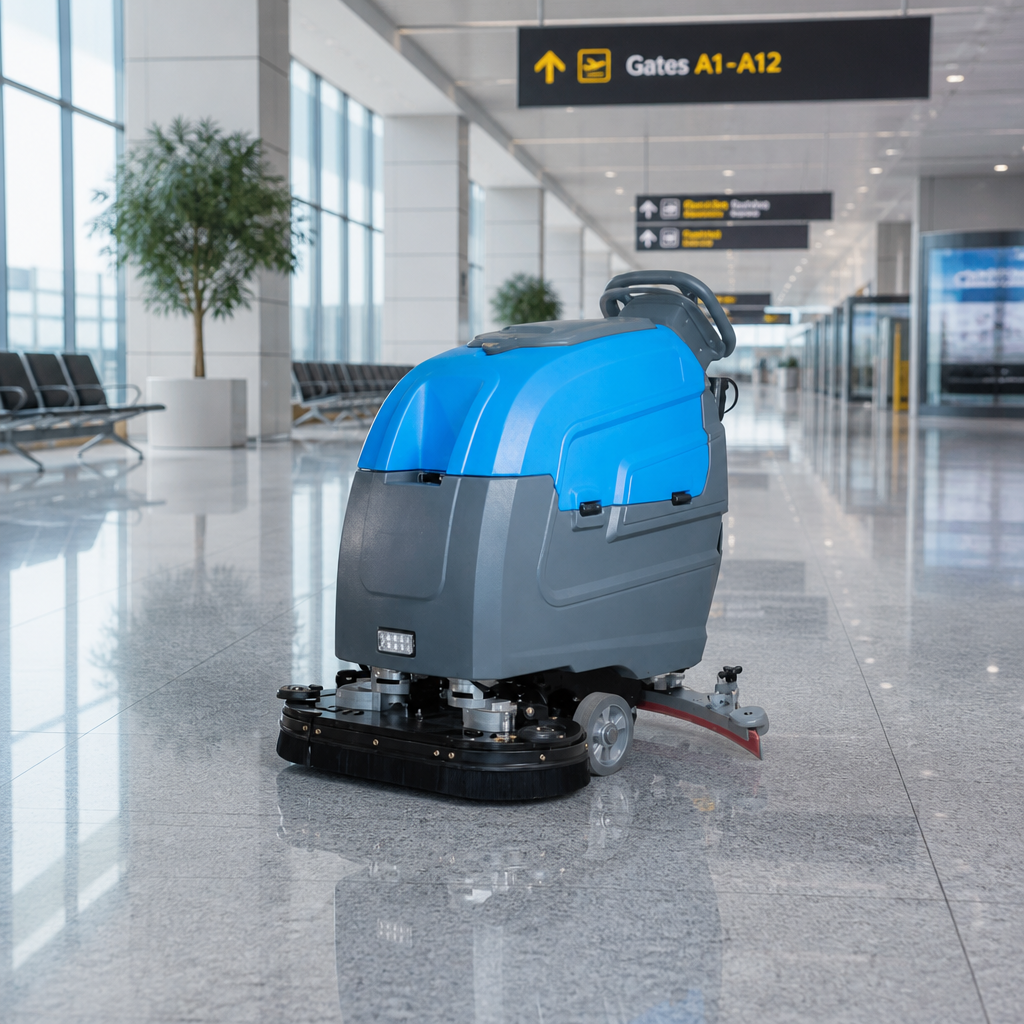
Measure floor scrubber productivity by dividing the accepted cleaned area by the total time needed to complete a defined route. For daily scheduling, include preparation, travel, turns, obstacles, water handling, edge work, inspection, and machine care—not just the minutes when the brushes are running. Count each area once, even when it needs overlapping or repeated passes.
The most useful result is effective productivity: the area completed to an agreed cleaning standard within a clearly stated time boundary. That makes route measurements useful for facility managers and cleaning contractors comparing equipment, adjusting work schedules, or checking a supplier demonstration.
Theoretical area performance describes coverage calculated from working width and travel speed. It does not establish how quickly an operator will finish a furnished commercial floor. Kärcher’s warehouse-cleaning guidance distinguishes theoretical coverage from practical performance and identifies interruptions, non-straight travel, narrow areas, and turning space as relevant factors. Its warehouse planning allowances should not be treated as a universal correction factor for every building.
Manufacturer estimates also need their calculation basis checked. For example, Tennant’s T300 brochure, marked 10/23, separates “Theoretical Max” from “Estimated Coverage.” Its footnote states that estimated coverage uses practical-speed and empty/fill-time assumptions from the 2004 ISSA Cleaning Times handbook. That explains the published estimate; it does not show that the figure includes your facility’s elevator waits, manual edges, inspection, or storage journey.
Keep these measurements separate:
| Measurement | What it describes | How to use it |
|---|---|---|
| Theoretical coverage | Working width multiplied by travel speed | Understand the basis of a specification |
| Manufacturer-estimated coverage | Coverage under the supplier’s stated assumptions | Compare only after checking those assumptions |
| Measured route productivity | Accepted area divided by elapsed time within a declared boundary | Plan the actual cleaning route |
| Labor productivity | Accepted area divided by total person-hours | Compare staffing requirements |
Do not compare a brush-running-only demonstration with a complete daily cleaning cycle and describe the difference as an equipment saving.
A useful comparison starts with the same job, not merely the same building.
Create an anonymized route map showing the cleaning zones, travel direction, excluded areas, narrow passages, doors, elevators, water points, approved wastewater-disposal points, and machine storage location. Give each zone an identifier so timing notes can be matched to the map.
Record the following before each trial:
Choose the cleaning setup for the floor and soil before comparing speed. Kärcher’s guidance explicitly connects the mechanical process and cleaning tool to the floor covering and contamination. A faster pass with an unsuitable brush or chemical is not an acceptable productivity improvement.
Where compatibility has not been established, check the machine, flooring, and chemical instructions and complete a representative small-area trial before timing the full route. Inspect the result after drying where residue or finish changes are relevant.
Agree on the acceptance standard in advance. Depending on the site, this may include removal of the specified soil, completion of assigned edges, acceptable water recovery, and no unacceptable residue or new visible surface damage. Record pre-existing stains, etching, scratches, or wear separately; a routine cleaning trial should not be judged as a restoration treatment.
Visual acceptance does not establish slip resistance, disinfection, or long-term finish performance.
For a complete daily-cycle measurement, start when the operator begins the required preparation at the storage or service point. Finish when the route has passed inspection and the machine has been returned and serviced as required by its instructions.
Use the following worksheet to capture the work without hiding supporting tasks.
| Activity | Record | Timing treatment |
|---|---|---|
| Preparation | Checks, accessories, initial filling, chemical preparation, route controls | Include if performed for this cleaning cycle |
| Travel and access | Storage journey, doors, elevator travel and waits | Include within the declared boundary |
| Scrubbing | Cleaning passes, overlap, turns, obstacle handling | Include all elapsed time |
| Water handling | Service-point travel, recovery-water disposal, refilling, return | Record complete events, not filling alone |
| Edges and detail work | Assigned corners, thresholds, perimeter work, touch-ups | Include when needed for route acceptance |
| Inspection and rework | Checks, missed areas, repeat recovery | Include before accepting the result |
| Close-down | Return, draining, cleaning, and other required machine care | Include in a complete daily-cycle measurement |
| Additional waiting | Access delays, traffic interruptions, drying or charging delays | Identify the cause and whether staff remain occupied |
Give every event a start time, finish time, duration, and short explanation. If an interruption occurs during scrubbing, either leave it inside that interval or split it into a separate event—never count it twice.
If a trial begins with a filled machine positioned at the route entrance, label it as a route-only measurement. Do not compare it directly with a storage-to-storage result.
When preparation or machine care serves several routes, record the shared time once. Either report productivity for the combined shift or explain how that time was allocated.
Use consistent area units and convert minutes to hours:
[ \text{Effective route productivity (m²/h)} = \frac{\text{Accepted cleaned area (m²)}}{\text{Total route time (minutes)} / 60} ]
The numerator is the unique area completed to the agreed standard. Overlap, rinsing, double scrubbing, and rework increase time; they do not increase the measured floor area.
The following is an illustrative calculation, not a KINGHOME project record or a machine-performance claim.
Assume one operator completes a measured 1,200 m² commercial tile route, including its assigned edges. All work passes the agreed inspection. The assumed record includes preparation and close-down, with no additional drying or charging delay.
| Activity | Start | Finish | Minutes |
|---|---|---|---|
| Preparation and initial fill | 20:00 | 20:08 | 8 |
| Travel to route | 20:08 | 20:14 | 6 |
| Scrubbing, turns, and obstacles: section 1 | 20:14 | 20:38 | 24 |
| Travel to service point, drain, refill, and return | 20:38 | 20:50 | 12 |
| Scrubbing, turns, and obstacles: section 2 | 20:50 | 21:15 | 25 |
| Edges and touch-ups | 21:15 | 21:25 | 10 |
| Final inspection | 21:25 | 21:28 | 3 |
| Return and machine care | 21:28 | 21:30 | 2 |
| Total | 20:00 | 21:30 | 90 |
The two-minute close-down entry is an example assumption, not a recommended allowance. Replace every entry with the actual time required at the site.
[ \text{Effective productivity} = \frac{1{,}200}{90/60} = 800\ \text{m²/h} ]
Using only the two scrubbing intervals would give approximately 1,470 m²/h. That describes a narrower measurement, excluding 41 minutes of supporting work. It cannot be used as the complete daily-cycle rate.
Because this example uses one operator, its labor productivity is also 800 m² per person-hour. If another employee handles edges, water, or preparation, add that employee’s working time when calculating labor productivity. Simultaneous work can shorten elapsed completion time without reducing total labor.
The route log should reveal where time goes, rather than attributing every delay to machine capacity.
| Site constraint | What to check | Planning consequence |
|---|---|---|
| Aisles and turning areas | Obstructions, dead ends, turn frequency, usable maneuvering space | A wider cleaning path may not shorten a confined route |
| Doors and thresholds | Clear opening, operating configuration, threshold restrictions | Access may require extra handling or a different route |
| Elevators | Usable space, authorized load, machine operating weight, availability | Transfers and waiting can affect the cleaning window |
| Water and disposal points | Authorized locations, travel distance, service access | Include the complete refill and disposal journey |
| Storage | Distance from the first and last cleaning zones | Include deployment and return time |
| Battery and charging | Actual route demand, approved charging procedure, charger location | Check readiness for the next assigned route |
KINGHOME’s floor scrubber buying guide connects these access, water-handling, storage, runtime, and recovery checks to equipment selection. Use it when a timing trial raises a wider purchasing question.
Keep charging availability separate from hands-on labor. Unattended charging between shifts is not automatically operator working time, but it still affects when the machine can be deployed. If charging interrupts the assigned cleaning window, show that interruption in the availability plan.
Likewise, if inspection finds wet trails or incomplete recovery, record the corrective work and any resulting reopening delay. Do not remove required recovery steps simply to improve the reported rate; Kärcher highlights water recovery as important where warehouse traffic returns to the cleaned floor.
After operators have been familiarized with the equipment, complete an initial timed route and two repeat runs under comparable conditions. This is a practical starting protocol, not a statistical validation standard.
Keep the area, acceptance criteria, preparation boundary, and operating conditions as consistent as practical. Record unavoidable differences instead of presenting the runs as identical.
When comparing alternatives:
For equal-area runs, calculate a combined rate by dividing the total accepted area across the runs by their total elapsed hours. Keep the individual results visible so the combined figure does not conceal variability.
A single demonstration supports a result for that demonstration’s conditions. It does not establish a universal percentage saving across operators, buildings, or floor types.
A useful route report contains the anonymized map, measured area, timing boundary, equipment setup, acceptance criteria, timestamped records, repeat results, and any work left outside the measurement.
Use that evidence to decide whether the priority is a different machine, a revised route, closer service access, operator training, or less rework. Keep total-cost evaluation separate: measured labor time is an input to a cost model, not proof of a financial return by itself.
For a KINGHOME equipment or cleaning-system enquiry, share the route map, floor and finish details, current machine configuration, cleaner documentation, and timing records. These give the discussion a specific basis: completing the required cleaning within the available window, rather than selecting by advertised coverage alone.
 English
 Spanish