Specifications:
- Diameter: 100mm
- Thickness: 10mm
- Particle sizes: 7 total
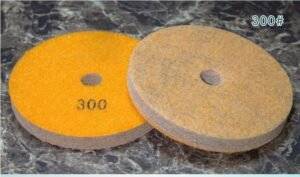
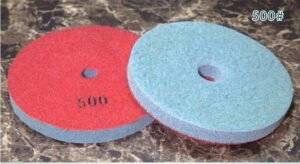
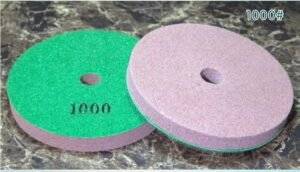
This concrete polishing pad is crafted from high-toughness, high-temperature-resistant premium fibers, super-hard abrasives, and polishing materials via a special process. It features a standardized particle size color system, good flexibility, refined product segmentation, and strong pertinence.
1.Concrete floor polishing process
For polishing industrial floors, warehouses, parking lots (concrete, aggregate hardener, cement self-leveling, epoxy colored sand floors). Compatible with handheld grinders, stone refurbishing machines, or floor grinders.
2.Anisotropic stone surface polishing
Polishes granite, marble, artificial stone (lines, chamfers, arc plates, special-shaped stones). Works with handheld grinders.
3.Laying floor polishing treatment
Polishes floors/steps post-installation (granite, marble, artificial stone, ceramic tiles). Compatible with handheld grinders, stone refurbishing machines, or floor grinders.
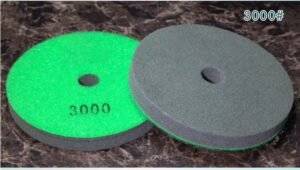
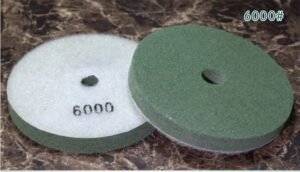
-
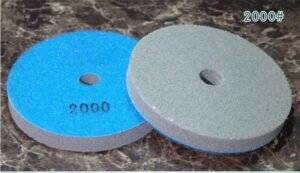
The pad can be mounted on stone refurbishing/floor grinding machines for polishing marble, artificial stone, microcrystalline stone, concrete, and colored sand floors. It replaces steel wool in crystal surface treatments (more convenient, better effect).
-
Key notes:
- Polishing effect depends on ground hardness, flatness, and pre-treatment (harder ground = better effect).
- For concrete floors: After fine grinding, clean/dry → use concrete thin grinding disc → dry polish with sponge pad (3000# for ordinary, 6000# for high-grade floors).
- Wet vs. dry grinding differences:
- Wet grinding: Fine grind with diamond resin disc → wash/dry → dry polish with high-grit thin disc → dry polish with 6000# sponge pad (higher machine speed = better effect).
- Dry grinding: After dry grinding concrete, 500# grit adds shine; 1000# grit reduces efficiency (accelerate grinder speed to avoid heat marks). Once ground brightness is uniform, use 6000# sponge pad.
-
The pad can be paired with floor care chemicals to boost polishing efficiency.


 English
  Spanish