WELCOME TO KINGHOME
Get A Free Quote
We will get back to you within 8 hours

WELCOME TO KINGHOME
We will get back to you within 8 hours
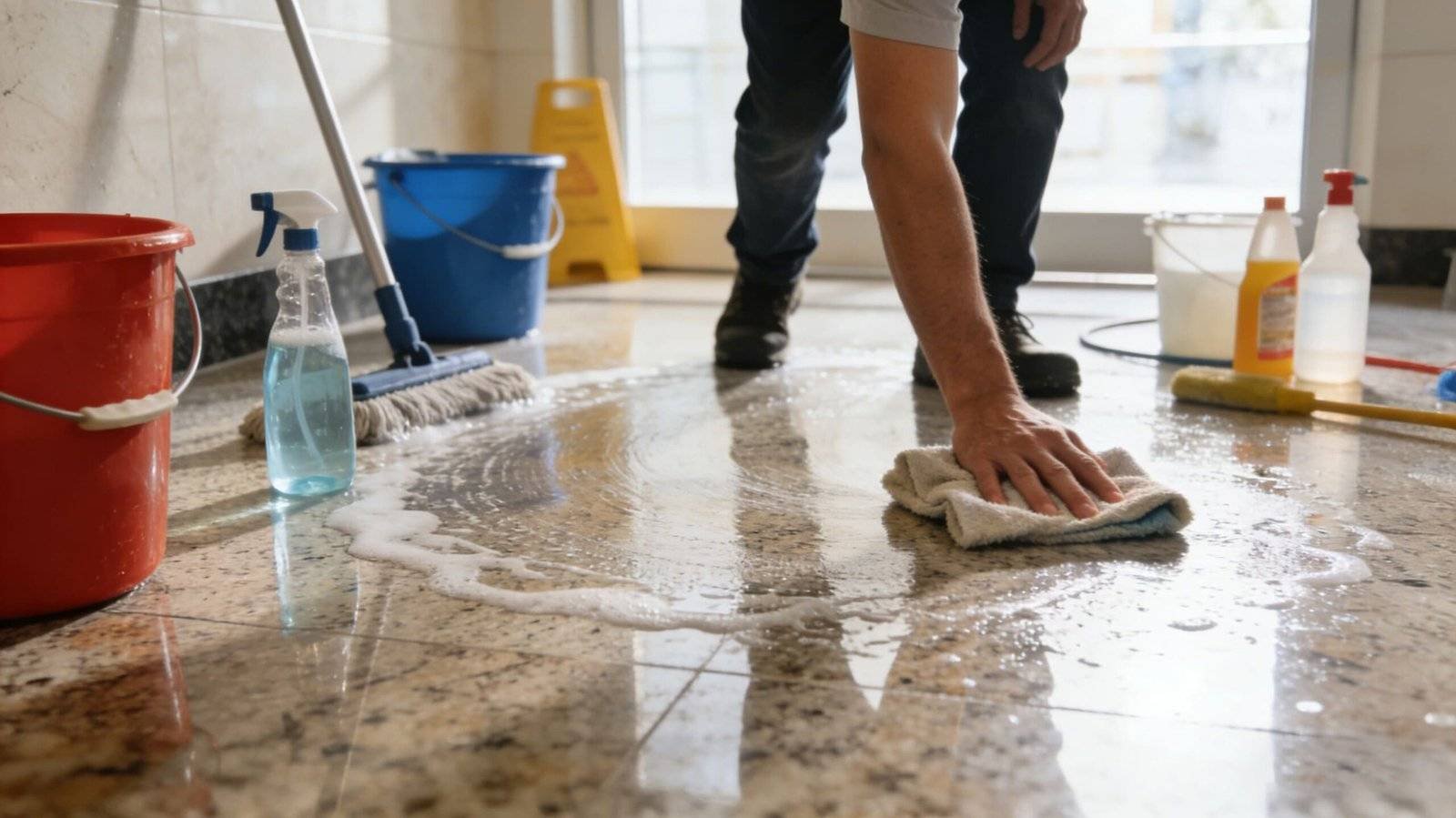
After nearly two decades of maintaining granite installations across hotels, corporate lobbies, and retail centers, I’ve learned that most commercial floor failures trace back to a single, preventable mistake: using the wrong pH in daily cleaning products. That seemingly minor error dissolves protective sealers within months, turning a $70,000 lobby floor into a maintenance nightmare requiring emergency restoration.
The fundamentals of seal-safe granite care aren’t complicated, but they do require understanding the chemistry at work beneath your feet. Granite’s mineral composition—primarily quartz (Mohs 7), feldspars (Mohs 6-6.5), and mica (Mohs 2.5-4)—gives the stone an average hardness of 6.5 on the Mohs scale. This makes it harder than marble but still vulnerable to abrasive particles and chemical attack when improperly maintained.
The protective sealer penetrating those microscopic pores represents your first line of defense against staining, moisture damage, and premature wear. When facility managers ask why their granite floors look dull after just 18 months, I typically find they’ve been using alkaline all-purpose cleaners with pH levels above 10, or worse, acidic bathroom cleaners meant for ceramic tile. Both strip away sealer integrity through entirely different chemical pathways—alkaline products leave residue while acidic formulations dissolve calcium-bearing components outright.
This guide draws on field experience from commercial installations where we’ve documented maintenance protocols, measured performance over multi-year periods, and calculated the real costs of preventive care versus reactive crisis management. You’ll find practical approaches we’ve refined through trial, error, and systematic observation rather than theoretical recommendations.
Granite forms deep underground through slow crystallization of molten magma, creating an interlocking matrix of quartz, feldspar, and mica crystals. That structure delivers excellent compressive strength and abrasion resistance, but it also creates natural porosity—tiny gaps between crystals where liquids can penetrate. Untreated granite typically absorbs 0.4-1.5% of its weight in water, depending on the specific mineral composition and crystal size.
Modern impregnating sealers work by filling those microscopic voids with fluoropolymer or siliconate molecules that bond to the stone’s silica structure. Unlike topical coatings that sit on the surface, these penetrating treatments become part of the stone itself—you can’t see them, feel them, or wear them away through normal foot traffic. What you can do is chemically degrade them through incompatible cleaning products or physically compromise them by forcing water through remaining gaps under pressure.
The sealer’s job extends beyond preventing coffee or wine stains. In commercial environments, it’s primarily protecting against moisture migration from below—humidity rising through the concrete slab, cleaning solution seepage through grout lines, and water vapor trapped between the stone and substrate. When that moisture reaches untreated granite from underneath, it carries dissolved minerals that crystallize as white efflorescence, causes organic growth in humid climates, and gradually weakens the thin-set adhesive bond.
I’ve inspected hundreds of failed granite installations, and the pattern holds consistent: seal degradation almost always precedes visible damage. The floor might look fine for 12-18 months while the protective barrier slowly erodes, then suddenly exhibits rapid deterioration as moisture and contaminants gain direct access to the porous structure. At that point, you’re not maintaining anymore—you’re restoring, at 5-8 times the cost.
Walk through the chemical storage area of most commercial buildings, and you’ll find cleaning products spanning pH 2 to pH 13. Ceramic tile, concrete, VCT, carpet—each material tolerates different chemical environments. Granite and other natural stones occupy a narrow safe zone between pH 6.5 and 7.5, what we call the neutral range.
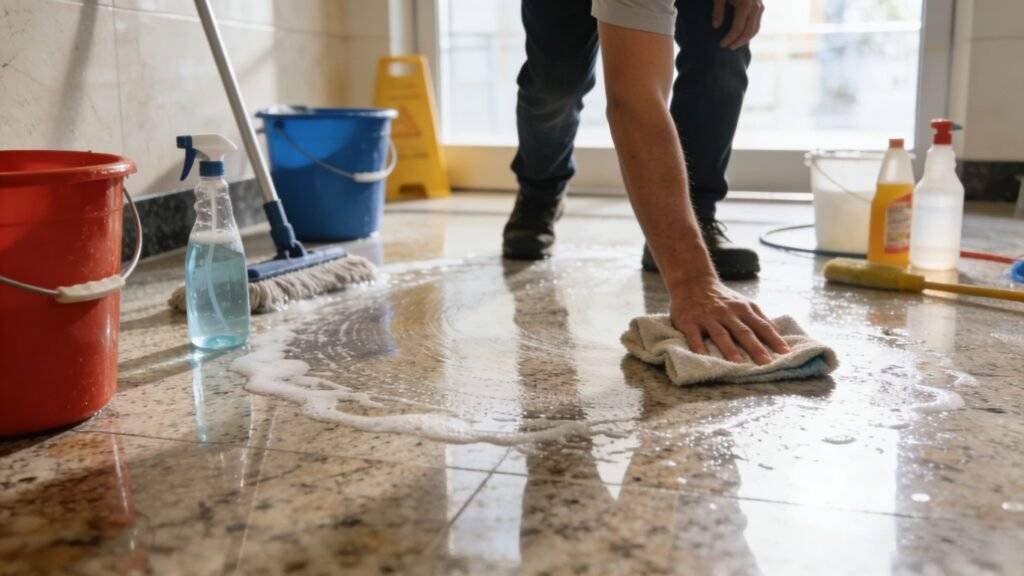
This specificity isn’t arbitrary pickiness. It’s chemistry. Granite contains calcite (calcium carbonate) and plagioclase feldspars (calcium-sodium aluminosilicates) that react with acids through straightforward dissolution reactions. A mildly acidic cleaner at pH 5 might seem harmless, but daily exposure creates cumulative etching that dulls the polished finish and erodes sealer bonds at the molecular level. I’ve measured gloss loss of 40-50% over just one year in facilities using pH 4.5 citrus-based products marketed as “natural stone safe.”
Alkaline cleaners damage differently but just as effectively. At pH levels above 9, they saponify (break down) natural oils and fats, which sounds perfect for cleaning greasy restaurant floors—except they also react with residual calcium compounds to form insoluble calcium carbonate films. That’s the white haze facility managers spend thousands trying to remove, often with acidic strippers that then etch the stone, creating a vicious cycle.
The solution isn’t buying the cheapest pH-neutral product on the shelf. Effective granite cleaners require buffering agents that maintain stable pH even when diluted incorrectly or contaminated with other substances. They need non-ionic surfactants that lift soil without leaving residue. And they must rinse completely, because even neutral-pH residue creates a sticky surface that accelerates resoiling.
Kinghome’s Crystal Shield line addresses these requirements through formulations we’ve tested across diverse water conditions—from the soft water of the Pacific Northwest to Houston’s notoriously hard supply. The Green Shield product handles marble and softer calcium-based stones where even slight acidity causes problems, while their granite-specific formulations tolerate the minor pH variations inevitably encountered in real-world conditions.
Academic discussions of proper granite care tend toward idealistic protocols: “mop gently with diluted cleaner, rinse thoroughly, dry completely.” Try implementing that in a hotel lobby seeing 5,000 guests daily, or a shopping mall where stores open at 9 AM regardless of whether your crew finished mopping. Commercial maintenance exists in the messy intersection of theory and operational reality.
The most destructive element in any commercial granite installation isn’t foot traffic—it’s the abrasive particulate matter that traffic carries. Quartz sand grains blown through entrance doors measure 7 on the Mohs hardness scale, harder than the granite itself. Fine aluminum oxide dust from vehicle brake systems reaches Mohs 9. These particles lodge in microscopic surface irregularities and grind away polish with every footstep, like industrial sandpaper operating 12 hours daily.
I learned this lesson expensively at a Chicago office tower where we’d implemented thorough wet mopping twice daily but skipped consistent dust control. Within eight months, traffic lanes showed visible dulling despite technically perfect chemical maintenance. We added three-times-daily dust mopping in the entrance corridor and watched the degradation rate drop 70% over the next quarter. The time investment—maybe 15 minutes per session—cost far less than premature restoration.
Dust mop selection matters more than most facility managers realize. Untreated cotton mops simply redistribute fine particles. Disposable electrostatic products work but generate ongoing waste and expense. We’ve had best results with 24-inch microfiber mops featuring split-fiber technology that mechanically traps particles rather than relying on chemical treatments that wash out and contaminate floor surfaces.
For wet cleaning, the autoscrubber has become indispensable in spaces larger than 5,000 square feet. Modern machines deliver measured cleaning solution, mechanically agitate with soft brushes (180-220 grit equivalent, never abrasive pads), and vacuum-extract 95%+ of the dirty solution in a single pass. This addresses the biggest failure mode of traditional mopping: leaving excess water that seeps into grout lines, evaporates into mineral deposits, or remains in low spots where it gradually penetrates compromised sealer.
Equipment investment runs $5,000-$8,000 for a quality walk-behind scrubber, but the labor efficiency alone justifies the cost. A trained operator cleans 12,000-15,000 square feet hourly versus 2,500-3,500 with mop and bucket. More importantly, the consistency eliminates the technique variations that plague manual methods—too much solution, insufficient rinsing, incomplete drying. The machine does it the same way every time.
Chemical dilution presents another point of failure. I’ve watched housekeeping staff eyeball cleaner concentration, producing solutions ranging from plain water to near-concentrate depending on who filled the bucket. Automatic dilution systems—either built into autoscrubbers or installed at mop sink locations—eliminate this variable. The proper ratio gets dispensed every time, preventing both inadequate cleaning (too dilute) and residue buildup (too concentrated).
Timing matters less than most protocols suggest. Morning mopping before heavy traffic flows works well in office buildings. Retail environments often clean during off-peak mid-afternoon hours. Hotels might run crews through public spaces at 2 AM. The critical factor isn’t when you clean but ensuring adequate drying time before significant traffic resumes. Granite tolerates damp surface conditions, but walking on wet stone tracks moisture into adjacent areas, defeats the cleaning you just completed, and creates slip hazards that invite liability.
Sealers don’t fail catastrophically—they degrade gradually, and recognizing early warnings prevents expensive emergency intervention. The most reliable diagnostic remains the water absorption test, though I use a modified version of the common recommendation.
Place three tablespoons of room-temperature water on clean, dry granite and time the absorption. Properly sealed granite in good condition should show minimal absorption after 15-20 minutes. Water disappearing in under five minutes indicates failed or severely degraded sealer requiring immediate attention. The 5-15 minute range suggests moderate degradation; plan resealing within the next 60-90 days.
But here’s what the standard test misses: absorption rate varies dramatically by location. High-traffic entrance areas typically show faster failure than low-traffic perimeters. Test multiple locations—I recommend minimum three points spanning high, moderate, and low traffic zones. Document results with location photos and dates. This gives you data-driven resealing schedules rather than guessing based on age alone.
Visual indicators supplement quantitative testing. Look for:
Darkening or “wet look” that persists hours after cleaning: Indicates sealer loss allowing moisture retention in the porous structure. Most common in food service areas exposed to liquids and organic materials.
Water spots or mineral halos around dried puddles: Shows insufficient sealer protection allowing dissolved minerals to penetrate then crystallize on the surface. Particularly common in facilities with hard water (>150 ppm calcium/magnesium).
Increased staining frequency: When previously stain-resistant granite suddenly shows discoloration from coffee, soft drinks, or tracked-in soil, the sealer has lost effectiveness. Compare current staining patterns to historical records.
Rough or gritty texture in high-traffic lanes: Paradoxically, this suggests sealer failure allowing soil to penetrate into surface pores where it can’t be fully removed. Creates progressive texture development.
The key to cost-effective maintenance lies in catching degradation at the “moderate” stage when a single sealer application restores protection. Wait until complete failure, and you’re looking at restoration work—stripping old sealer residues, possibly light honing to remove staining, then resealing. Cost differential: $0.75-$1.25 per square foot for preventive resealing versus $3.50-$5.00 for full restoration.
Crystallization remains one of the most misunderstood processes in commercial stone care, partly because the term gets applied to different treatments and partly because the chemistry sounds intimidating. At its core, you’re creating a glass-like surface layer through a thermochemical reaction between acidic metal salts and calcium-bearing minerals in the stone.
The process requires three elements: an acidic crystallizing compound (typically fluosilicates or fluorides), mechanical friction generating heat, and calcium in the stone to react with. A weighted floor machine with steel wool pad creates the friction, heating the stone surface to 145-165°F. The crystallizing compound—Kinghome’s products use proprietary formulations optimized for different stone types—partially dissolves the stone’s calcium matrix and immediately reacts to form calcium fluorosilicate, a compound substantially harder than the original cement bonding the granite’s mineral crystals together.
This new layer isn’t a coating. It’s molecularly bonded to the stone structure and can’t be removed without mechanical abrasion that would damage the granite itself. The practical benefits show up immediately: increased gloss (typically 12-18 GU gain measured at 60-degree angle), enhanced wear resistance (3-4x improvement in Taber abrasion testing), and improved stain resistance from the densified surface.
I’ve documented the economic impact across multiple properties. A 35,000 square-foot retail center in Austin implemented quarterly crystallization treatments in their food court area—the highest-traffic, most abuse-prone section of the property. Annual cost ran $4,200 for materials and contract labor. Over four years, that $16,800 investment eliminated two emergency restoration cycles that comparable properties without crystallization programs required. Conservative estimate: $35,000-$45,000 in avoided costs, not counting operational disruption during restoration work.
The treatment frequency depends on traffic intensity. We’ve found quarterly intervals work for spaces seeing 5,000+ daily visitors. Office buildings with 2,000-3,000 occupants can extend to semi-annual treatments. Residential lobbies might need crystallization only annually. The decision should follow gloss meter data rather than arbitrary schedules—when high-traffic areas drop 15% below baseline measurements, it’s time to crystallize.
Equipment requirements stay modest: a single-disc rotary machine (150-175 RPM, 120-175 pound weighted base) runs $2,200-$3,800. Steel wool pads cost $2.50-$4.00 each and cover 400-600 square feet. Crystallizing compound—Kinghome’s Outdoor Crystalshield Natural Stone Granite Polishing Cream lists at $40 per gallon with 1,200-1,500 square-foot coverage. For facilities lacking in-house expertise, contract services typically charge $0.30-$0.55 per square foot for crystallization, still far cheaper than restoration.
One caution: crystallization works primarily on calcium-bearing stones. Pure quartz-based granites lack sufficient calcium for robust reaction. Test a small area first—if you don’t see noticeable gloss enhancement within 5-7 minutes of machine work, the particular granite composition may not respond well. Most commercial granite installations contain adequate calcium for effective crystallization, but verification prevents wasted effort.
Despite best maintenance practices, commercial granite eventually requires restoration. The timing depends on traffic intensity, maintenance quality, and initial installation standards, but surface damage accumulates through mechanisms that even perfect cleaning can’t fully prevent.
Lippage—uneven height differences between adjacent tiles—represents the most common installation defect affecting maintenance. Anything exceeding 1/16 inch creates edges where mops snag, water pools, and accelerated wear concentrates. ANSI A108.02 sets 1/16-inch maximum for tiles with grout joints; reality delivers far worse on rushed commercial installations. I’ve measured 3/16-inch height differences on hotel lobbies less than three years old, clear evidence of improper substrate prep or inadequate installer skill.
Lippage creates localized stress concentrations where foot traffic literally grinds away high edges. You’ll see distinct wear patterns on tile corners while the field remains intact. Maintenance can slow but not stop this degradation. Eventually, you need mechanical correction—diamond grinding to level the surface, followed by complete honing and polishing sequence to restore uniform finish.
Etching from acidic exposure presents differently: localized dull spots, rough texture compared to surrounding areas, lighter color where the acid dissolved minerals and disrupted light reflection. Light etching (slight texture, visible mainly in raking light) responds to polishing compounds and buffing. Moderate to severe etching requires progressively coarser abrasive sequences, essentially removing the damaged surface layer and recreating the factory finish.
Deep scratching—the kind caused by dragging furniture, dropped equipment, or heavy carts with damaged wheels—needs mechanical intervention. Shallow surface scratches sometimes polish out, but anything you can catch with a fingernail requires diamond abrasive work. Commercial facilities often accumulate thousands of fine scratches that individually don’t trigger restoration but collectively reduce gloss by 30-40% over 5-7 years. At that point, you’re not maintaining the floor—you’re managing its decline.
Restoration sequencing follows established protocols: assess damage depth, select starting grit, progressively refine through finer diamonds until achieving desired finish. A typical full restoration sequence runs:
Each step removes the scratches from the previous step while establishing finer scratches that the next step removes. Cut corners by skipping grits, and you’ll see visible scratch patterns in the finished surface that require reworking. The process demands skill, proper equipment, and patience—attributes often lacking in the lowest-bid restoration contractor.
Cost runs $3.50-$5.00 per square foot for complete restoration including sealing, with timeline of 5-8 days for 10,000 square feet. Many facilities opt for phased approaches, restoring 20-25% annually to spread costs and minimize operational disruption. This works well in spaces where separate areas can be isolated during treatment.
The decision point: restoration becomes economically justified when annual maintenance costs approach 70-80% of prorated restoration expense, or when appearance degradation impacts customer perception and business performance. For a prestige hotel lobby, that threshold arrives much earlier than a warehouse office. Context matters.
One of our most dramatic turnarounds involved a downtown Minneapolis hotel with 12,000 square feet of mixed granite flooring in the lobby, main corridor, and elevator banks. Management called after their housekeeping director noticed progressive dulling despite religious daily maintenance. By the time we assessed the situation, high-traffic lanes measured 42-48 GU gloss versus the 78-82 GU specification from installation three years prior.
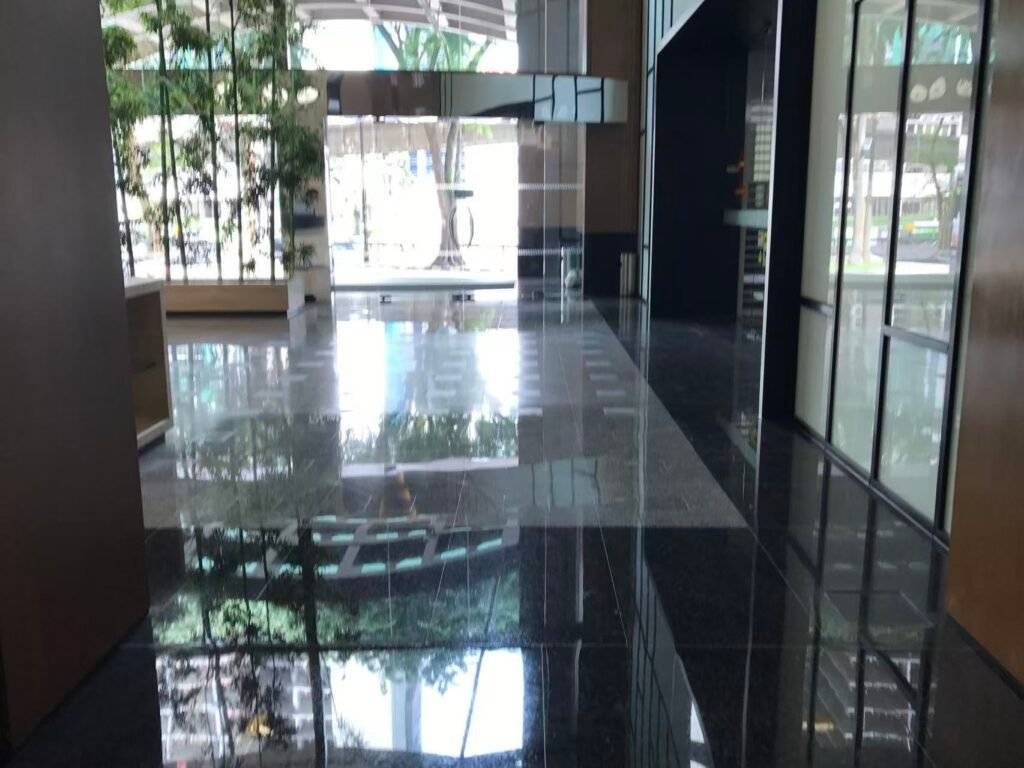
The autopsy revealed layered failures. Housekeeping had been using an alkaline all-purpose cleaner (pH 11.2) mixed at double the recommended concentration because “it cleans better.” The aggressive alkalinity left calcium carbonate film that showed up as white haze under raking light. To combat the haze, they’d introduced periodic vinegar treatments—pH 2.8 acetic acid that etched the polished surface and dissolved sealer protection. The one-two punch of alkaline residue and acid etching created the worst of both chemical damage modes.
Water absorption testing found areas absorbing in 2-4 minutes, indicating near-total sealer failure. Worse, we found evidence of water infiltration from below—likely HVAC condensation draining under the slab—causing efflorescence (white salt deposits) pushing up through unsealed stone. The floor needed intervention at multiple levels.
We implemented a staged approach:
Week 1: Strip alkaline residue using acidic cleaner (carefully controlled pH 3.5, short dwell time, thorough neutralization). Remove efflorescence with poultice treatment.
Week 2-3: Complete restoration sequence from 200-grit through 3000-grit polishing. The relatively recent installation meant we could skip the heaviest grinding, saving time and material.
Week 4: Apply two-coat impregnating sealer system with 48-hour cure intervals. Meanwhile, conducted four-hour training sessions with housekeeping staff covering stone chemistry, pH principles, and proper maintenance protocols.
Ongoing: Switched entire operation to Crystal Shield pH-neutral cleaner. Implemented quarterly crystallization in highest-traffic zones. Established monthly gloss meter monitoring at 15 standardized locations.
Total project cost: $47,000 for restoration, products, equipment, and training. Eighteen months later, gloss measurements averaged 74-76 GU in high-traffic areas—91% retention versus baseline. Water absorption testing showed 18-22 minute resistance, indicating excellent seal integrity. Annual maintenance costs dropped from $18,400 (including emergency treatments) to $11,200 for systematic preventive care.
The facility manager later disclosed that guest satisfaction scores for “first impression/lobby appearance” increased 41% in post-implementation surveys. While we can’t draw direct causation from a single variable, the correlation suggests visible floor quality influences guest perception more than many hoteliers realize. At a property where average daily rate exceeded $280, that translates to measurable revenue impact through repeat bookings and positive reviews.
After testing dozens of stone care product lines across multiple properties, certain patterns emerge. Marketing claims mean little; documented field performance over 2-3 year periods reveals which formulations deliver sustainable results in commercial conditions.
Kinghome’s Crystal Shield series has proven reliable across our installations, particularly for facilities managing diverse stone types. Their Green Shield formulation handles marble, terrazzo, and soft limestone where calcium sensitivity demands extra caution. For granite specifically, their Outdoor Crystalshield polishing cream provides consistent results in crystallization applications—we’ve been using it since 2019 with zero complaints about inconsistent performance or damage to properly maintained floors.
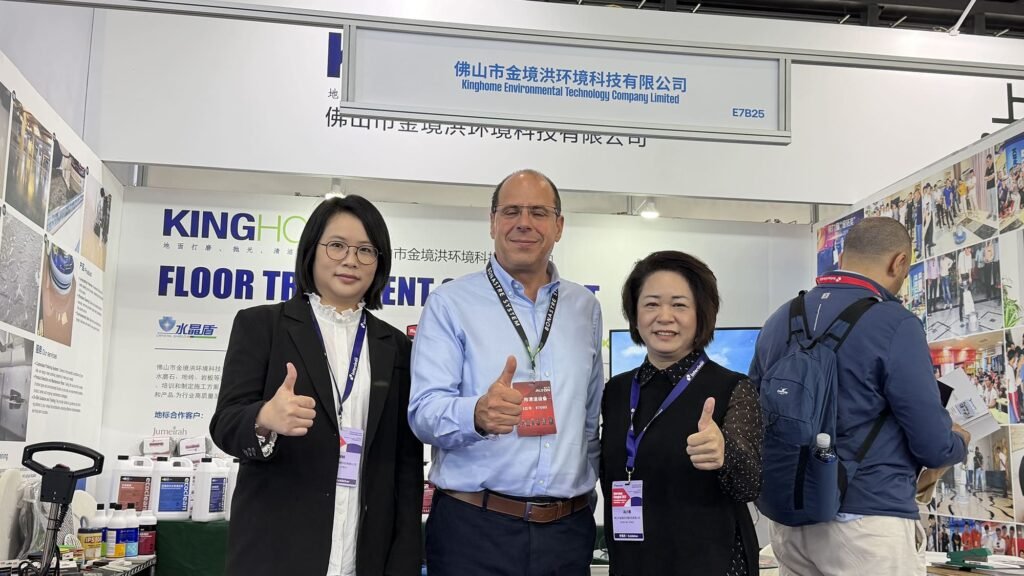
The company operates out of Foshan, Guangdong—China’s stone processing capital—and has been supplying commercial installations for over 30 years. They maintain distribution partnerships with Klindex (Italy) for professional equipment, Rubbermaid for microfiber systems, and Federal Chemicals for specialized formulations. This multi-brand approach provides integrated solutions rather than forcing facilities to source compatible products from competing vendors.
Product transparency matters. Crystal Shield provides technical specifications including pH values, VOC content, coverage rates, and dilution ratios—information critical for facility managers making informed purchasing decisions. Too many “professional” products list only marketing benefits without the technical data needed to evaluate appropriateness for specific applications.
Cost positioning sits in the mid-range: higher than janitorial supply house generics but substantially less than boutique brands targeting residential countertop care. At commercial scale, a gallon of pH-neutral cleaner (1:30 dilution for daily maintenance) covers 15,000-20,000 square feet. That translates to $0.004-$0.008 per square foot, almost negligible compared to labor costs that run 50-100 times higher.
The real value lies in predictability. When a facility manager asks “will this damage my $85,000 lobby floor?” I can point to installations running 3-5 years on Crystal Shield products without sealer degradation, unusual staining, or unexpected chemical reactions. That track record beats laboratory certifications and marketing brochures.
Budget conversations need concrete data, not industry averages. Here’s what comprehensive granite maintenance actually costs based on documented spending across properties we monitor:
10,000 square foot hotel lobby – High traffic (8,000-12,000 daily visitors)
Daily maintenance: $6,800 annually
Quarterly crystallization: $1,800 annually
Annual resealing: $4,500
Restoration (Year 5, prorated): $2,800 annually
Total annual maintenance: $15,900 ($1.59/sq ft)
40,000 square foot office building – Moderate traffic (2,000-3,500 daily)
Daily maintenance: $18,400 annually
Quarterly crystallization (20,000 sq ft high-traffic only): $3,600 annually
Annual resealing: $16,800
Restoration (Year 7, prorated): $2,860 annually
Total annual maintenance: $41,660 ($1.04/sq ft)
The square-foot cost decreases with scale due to labor efficiency gains in larger spaces and reduced per-unit material costs. Conversely, premium properties may accept higher maintenance costs to preserve appearance standards supporting their market positioning.
Compare this to reactive maintenance where facilities clean with inappropriate products, skip preventive sealing, and call contractors only when damage becomes operationally disruptive. Those properties typically spend 30-40% less annually until Year 3-4, then face $45,000-$85,000 emergency restoration costs that obliterate any short-term savings. The lifecycle cost difference over 10 years runs 15-25% higher for reactive approaches, not counting operational disruption during emergency repairs.
Converting this information into operational reality requires structured rollout addressing training, equipment, scheduling, and quality control. Most implementations fail not from bad intentions but from inadequate change management—staff fall back on familiar methods when new protocols prove more complex or time-consuming than anticipated.
Start with baseline documentation before changing anything. Photograph the floor under consistent lighting conditions. Record gloss meter readings at 10-15 locations marked with discrete indicators that won’t show in normal viewing. Conduct water absorption tests. Measure slip resistance using a portable tribometer. This pre-change data becomes essential for demonstrating improvement and justifying ongoing investment.
Equipment procurement should match facility scale and capabilities. A 5,000 square-foot lobby doesn’t need a $12,000 ride-on scrubber; a compact 20-inch walk-behind autoscrubber provides adequate performance at $5,500-$7,000. Conversely, asking maintenance staff to mop 30,000 square feet manually creates job satisfaction issues and inconsistent results. Right-size the tooling.
Training demands more than a single session. Initial hands-on instruction (4 hours minimum) covers the why and how: stone chemistry, damage mechanisms, equipment operation, proper techniques. But competency requires supervised practice with feedback—plan three weeks of daily spot-checks where supervisors observe, correct, and reinforce proper execution. Refresher training every 6 months maintains standards as staff turnover introduces new employees and existing workers drift from protocols.
Chemical management through automatic dilution systems eliminates the most common maintenance failure. Yes, the upfront cost ($450-$850 installed) seems steep compared to eyeballing concentrate into buckets, but the consistency justifies investment within 8-12 months through eliminated product waste and prevented damage from incorrect dilution.
Schedule crystallization and resealing during operational low periods. Hotels might work overnight or during mid-week valleys. Office buildings can treat sections during weekends. Retail centers coordinate with management to close areas during slow hours. The goal: minimize traffic exposure during the 4-hour (crystallization) to 48-hour (sealing) cure periods while maximizing space utilization.
Quality control through measurement rather than subjective assessment transforms maintenance from “looks clean” to “meets specification.” Monthly gloss meter readings trend performance. Quarterly water absorption testing flags emerging seal failures before they cascade into expensive problems. Annual slip resistance verification ensures ADA compliance and documents due diligence for liability purposes. The measurement equipment investment ($2,200-$3,500 for gloss meter, moisture meter, and tribometer) seems expensive until the first time it catches a problem early enough to resolve with maintenance rather than restoration.
The hardest part: sustaining the program through budget cycles, management changes, and operational pressures. Document everything—costs, performance metrics, avoided failures, customer feedback. Build an evidence base demonstrating ROI that survives leadership transitions. I’ve watched excellent maintenance programs collapse when a new facilities director focused on short-term cost cutting eliminated “unnecessary” crystallization treatments, only to face emergency restoration 18 months later that cost 6x the preventive service savings.
Most facility management operates reactively: fix things when they break, clean when they’re dirty, restore when customers complain. This approach works adequately for forgiving materials like VCT or carpet tile where degradation happens gradually and replacement costs stay manageable.
Granite demands different thinking. The material’s longevity—properly maintained commercial installations last 30-40 years—requires preventive maintenance where you’re treating damage you can’t yet see to prevent problems that haven’t yet occurred. That shift from reactive to predictive takes organizational commitment, particularly in budget conversations where preventing a hypothetical future problem sounds less urgent than addressing today’s crisis.
The economic case becomes clear when you model lifecycle costs rather than annual budgets. A $70,000 granite lobby floor maintained at $1.60 per square foot annually ($16,000 on 10,000 sq ft) costs $160,000 over 10 years plus the original installation: $230,000 total. Let it degrade through neglect, then restore at Year 5 ($45,000) and Year 10 ($52,000 with inflation): $237,000 total plus the operational disruption and reputational damage during each multi-week restoration project.
The savings aren’t dramatic—$7,000 over a decade. But that calculation assumes the reactive approach succeeds. What if damage progresses beyond restoration capability, requiring partial replacement? What if a slip-and-fall incident on poorly maintained floors triggers litigation? What if customer perception of a shabby lobby drives business to better-maintained competitors? Preventive maintenance buys predictability and risk reduction that balance sheets don’t fully capture.
I’ve come to view commercial granite maintenance as manufacturing floor space. You’re not cleaning a decorative surface—you’re operating a customer-facing asset that contributes to revenue generation through environment quality. The question isn’t “what’s the cheapest way to keep it acceptable” but rather “what’s the optimal investment level that maximizes asset value over its design life while supporting operational objectives?”
That philosophical shift changes decision-making. You don’t skip crystallization to save $1,800 when the floor represents $70,000 in capital and generates first-impression value for customers spending $50,000+ annually. You don’t use inappropriate cleaning chemicals that save $240 yearly when sealer failure costs $12,000 to remediate. You definitely don’t defer training that prevents expensive mistakes your staff makes from ignorance rather than negligence.
The facilities that achieve remarkable granite performance—lobbies that look showroom-fresh after five years, floors that reach their 30-year design life without major intervention—share this maintenance philosophy. They’ve moved past “good enough” toward systematic excellence, measured not by spotlessness after today’s cleaning but by condition retention over annual and decade-long timeframes.
It’s not complicated. It’s just different from how most facilities operate. And that difference, sustained over years, creates the gap between properties that manage granite successfully and those that fight constant battles with materials that should be performing far better.

