BIENVENIDO A KINGHOME
Obtenga un presupuesto gratuito
Le responderemos en un plazo de 8 horas

BIENVENIDO A KINGHOME
Le responderemos en un plazo de 8 horas
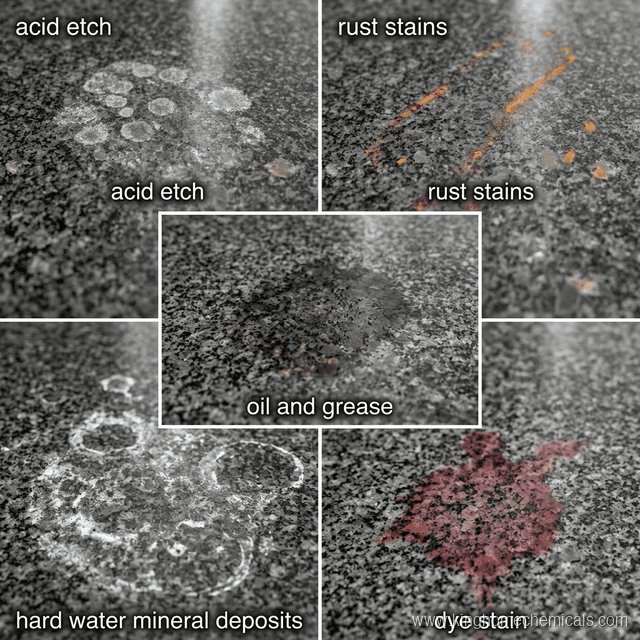
This guide identifies the five most common chemical stain types on granite and provides the exact removal method for each one — including when a professional poultice is required and when a surface treatment is enough.Why Granite Stains Differently Than Other Stone
Granite is one of the hardest natural stones (6–7 on the Mohs scale), but it is not impervious to staining. Its crystalline structure contains microscopic pores and natural fissures that can absorb liquids — especially in areas where the sealer has worn thin.
Key facts:
Polished granite has tighter pores and resists staining better than honed or flamed granite
Light-colored granites (white, beige, cream) show stains more visibly and absorb them faster than dark granites
Sealed granite resists penetration for 15–30 minutes (enough time to wipe up spills), but sealers do not make granite stain-proof
Chemical stains penetrate differently than organic stains — they often react with the minerals in the granite, making surface wiping ineffective
Understanding the stain type is essential because each type requires a different chemical approach for removal.
What it looks like: Dull, lighter-colored spots or rings where the polished surface has been chemically dissolved. Not a surface stain — it is actual surface damage.
Why it happens: Acids react with the feldspar and calcium-bearing minerals in granite, dissolving the polished surface layer. Even brief contact with citrus juice, vinegar, or acidic bathroom cleaners can etch polished granite.
Removal method:
Clean the area with a pH-neutral stone cleaner and water
If the etch mark is light, apply a granite polishing compound using a soft cloth in circular motions. Our with ultra-fine diamond abrasive is specifically formulated for this
For deeper etching, use progressively finer diamond polishing pads (400 → 800 → 1500 → 3000 grit) with a hand polisher
After restoring the polish, apply a penetrating sealer to the affected area
Prevention: Always use pH-neutral cleaners on granite. Never use vinegar, bleach, or ammonia-based products.
What it looks like: Orange, brown, or reddish-brown spots or streaks. Often appears near granite edges, around metal fixtures, or seemingly “from within” the stone.
Why it happens: Granite naturally contains iron-bearing minerals (pyrite, biotite). When exposed to moisture, these minerals oxidize and produce rust that migrates to the surface. External sources include metal furniture legs, iron brackets, and steel wool residue.
Removal method:
External rust (from metal objects on the stone): Remove the source of iron contact. Clean the area thoroughly. Apply a dedicated — these products are formulated with chelating agents that lift iron oxide without damaging the granite surface
Internal rust (from minerals within the stone): This is more challenging. Apply a poultice made from rust-removing compound and diatomaceous earth. Cover with plastic wrap, tape the edges, and allow 24–48 hours. Remove the poultice and evaluate. Multiple applications may be needed
After treatment, reseal the area with a penetrating sealer to slow future oxidation
Important: Never use generic rust removers (CLR, naval jelly) on granite — they contain hydrochloric acid that will etch and permanently damage the surface.
What it looks like: Dark, wet-looking patches that do not dry. The stain appears to be beneath the surface. Common in kitchen countertops near cooking areas.
Why it happens: Cooking oil, butter, grease, cosmetics, and petroleum products penetrate granite pores easily because oil has lower surface tension than water, allowing it to be absorbed faster and deeper.
Removal method:
Blot (never wipe) excess oil immediately — wiping spreads the stain
Apply a generous amount of an absorbent powder (baking soda, cornstarch, or diatomaceous earth) to the stain. Let it sit for 24 hours to draw out oil from the surface
For deeper stains, create a poultice: mix the absorbent powder with acetone (for light-colored granite) or mineral spirits (for dark granite) to the consistency of peanut butter
Apply the poultice 6mm thick over the stain, extending 15mm beyond the stain edges
Cover with plastic wrap and tape edges. Allow 24–48 hours for the poultice to dry completely
Remove the hardened poultice with a plastic scraper. Clean the area with pH-neutral cleaner
For persistent grease, a professional designed for stone surfaces provides stronger degreasing action without damaging the seal
What it looks like: White, chalky, or cloudy film or rings on the granite surface. Often appears around faucets, sinks, and shower areas.
Why it happens: Hard water contains dissolved calcium and magnesium. When water evaporates, these minerals are left behind as a solid deposit on the stone surface. Over time, deposits can bond chemically with the stone, making them extremely difficult to remove.
Removal method:
For light deposits, use a dedicated that uses targeted surfactants to penetrate and dissolve mineral buildup without acid
Apply the product directly to the deposit, allow 5–10 minutes of dwell time
Agitate gently with a nylon brush or non-scratch pad
Rinse thoroughly with clean water and dry immediately
For heavy buildup, repeat the application 2–3 times. Between applications, scrub with a fine (0000-grade) steel wool pad — this will not scratch polished granite but will help break up thick deposits
After removal, seal the area to resist future deposit formation
Never use vinegar or lemon juice to remove hard water spots from granite — the acid will create a bigger problem (etching) than the one you are solving.
What it looks like: Colored spots or patches — purple/red (wine), brown (coffee/tea), yellow (turmeric), blue/green (ink, dye). The stain may appear to be on the surface or absorbed into the stone.
Why it happens: Colored organic and synthetic compounds penetrate the pores of unsealed or poorly sealed granite, binding to the mineral structure.
Removal method:
For surface-level dye stains, apply a 12% hydrogen peroxide solution directly to the stain. Allow 10–15 minutes of dwell time, then blot and rinse. This works well on light-colored granite for organic dyes (wine, coffee, tea)
For deeper stains, create a hydrogen peroxide poultice: mix 12% hydrogen peroxide with flour or diatomaceous earth. Apply, cover with plastic, and allow 24–48 hours
For synthetic dyes (ink, fabric dye), use acetone or lacquer thinner applied via poultice
For stubborn multi-compound stains, a professional with stain-suspending technology can lift complex stains that simple poultices cannot
A poultice is the most effective deep-stain removal technique for granite. Here is the standard procedure:
Materials needed:
Absorbent powder (diatomaceous earth, kaolin clay, or flour)
Active chemical (acetone, hydrogen peroxide, mineral spirits, or product-specific cleaner — matched to stain type)
Plastic wrap and masking tape
Plastic scraper
pH-neutral stone cleaner
Pasos:
Clean the stained area with pH-neutral cleaner and dry completely
Mix the absorbent powder with the active chemical to a thick paste consistency (like peanut butter)
Apply 6mm thick over the entire stain, extending 15mm beyond the stain edges
Cover with plastic wrap and tape all edges to slow evaporation
Allow 24–48 hours for the poultice to draw out the stain. The paste will dry and pull the stain upward
Remove hardened poultice with a plastic scraper (never metal)
Clean the area with pH-neutral cleaner and water
Evaluate — deep stains may require 3–5 poultice applications
After successful stain removal, apply penetrating sealer to restore protection
Some granite stain situations require professional stone restoration rather than DIY treatment:
Deep acid etching that has removed the polished surface across a large area
Internal rust that keeps returning despite repeated treatment (indicates ongoing oxidation within the stone)
Stains that have been set by heat, incorrect cleaning products, or long exposure (months or years)
Multiple stain types on the same area requiring different chemical approaches
Countertop edges and seams where stains have penetrated behind the stone
Professional restorers use industrial diamond polishing equipment, commercial-grade poultice systems, and application techniques that deliver results home methods cannot match. For more on professional stone care, see our

