BIENVENIDO A KINGHOME
Obtenga un presupuesto gratuito
Le responderemos en un plazo de 8 horas

BIENVENIDO A KINGHOME
Le responderemos en un plazo de 8 horas

Dry grinding needs effective dust extraction at the grinding head; wet grinding needs continuous water delivery and controlled slurry recovery. Choose between them according to the floor material, diamond tooling, surrounding areas, and the condition required for the next treatment or reopening—not simply which method appears faster.
Wet grinding reduces airborne dust but does not eliminate exposure risks. Dry grinding avoids slurry, but a vacuum connected to the machine is not, by itself, evidence of adequate dust control. Both methods require equipment matched to the task, maintained controls, and a cleanup plan.
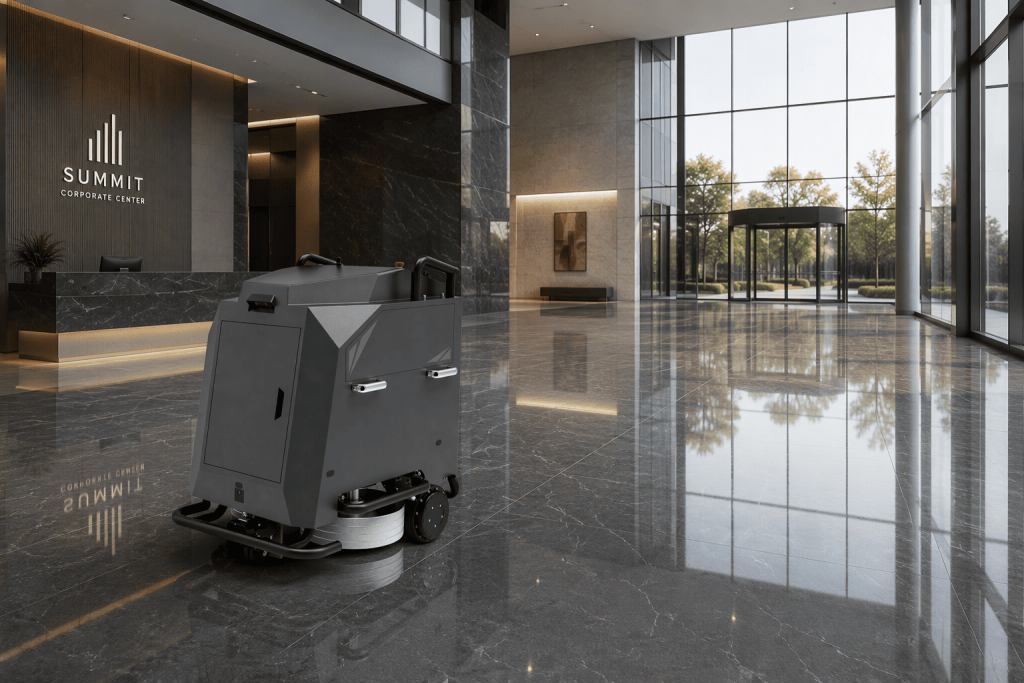
Dust and slurry management also affect working visibility, abrasive performance, cleanup time, and the cleanliness of the surface handed over for coating, sealing, or polishing.
| Decision factor | Dry grinding with dust extraction | Wet grinding with slurry recovery |
|---|---|---|
| Airborne dust | Captures dust through a compatible shroud and extractor; performance depends on airflow, filtration, seals, and maintenance. | Suppresses dust at the grinding surface; water delivery must remain effective throughout the pass. |
| Waste stream | Produces collected dust requiring controlled bagging and disposal. | Produces slurry requiring containment, pickup, storage, and appropriate disposal. |
| Tool cooling | Requires tooling approved for dry operation and attention to heat buildup. | Water helps cool the contact area, provided the machine and tooling are approved for wet use. |
| Surface inspection | Vacuuming exposes the scratch pattern without a slurry layer. | Slurry must be removed before checking scratches; inspect a dry test area when assessing final appearance. |
| Equipment requirements | Grinder, compatible shroud, appropriately sized extractor, hoses, and suitable dust collection containers. | Wet-capable grinder, controlled water supply, wet pickup equipment, and slurry containers. |
| Adjacent-area protection | Controls must prevent dust migration into occupied spaces and ventilation systems. | Protection must prevent splash, leakage, and slurry tracking onto adjacent finishes. |
| Next treatment | Avoids adding process water, but does not prove that concrete meets a coating’s moisture requirements. | May introduce a drying step before products that require a dry substrate. |
| Overall productivity | Includes filter maintenance, bag changes, edge work, and final vacuuming. | Includes water handling, slurry pickup, cleaning, and any required drying time. |
Neither method is universally faster or produces a better finish. Compare the complete workflow on a representative test area, including waste handling and preparation for the next stage.
For the broader process comparison, see dry versus wet stone grinding.
Material identification determines both the abrasive sequence and the exposure-control plan.
En Natural Stone Institute’s care guidance distinguishes calcareous stone from siliceous stone and explains their different chemical sensitivities. Stone appearance or a commercial name alone is insufficient for selecting cleanup chemistry.
For engineered stone, ordinary wet-versus-dry convenience is not the only consideration. Great Britain’s HSE guidance on working engineered stone addresses water suppression, contaminated mist, respiratory protection, and other exposure controls for powered handheld processing. These requirements should not be generalized to every material or jurisdiction.
Before removing unidentified coatings or adhesives, resolve whether hazardous-material assessment is needed. Grinding should not begin simply because the underlying slab is known to be concrete.
Effective capture depends on the complete airflow path, not just the filter label.
Confirm the following before starting:
For U.S. construction work covered by OSHA 29 CFR 1926.1153, Table 1’s walk-behind floor-grinder entry specifies manufacturer-recommended extraction airflow or greater, a filter with at least 99% efficiency, and a filter-cleaning mechanism. When using that extraction method indoors or in enclosed areas, it also requires HEPA-filtered vacuuming of loose dust between passes. These are task-specific U.S. requirements, not a global equipment specification.
A HEPA filter alone does not establish compliance. Handheld edge grinders have a separate Table 1 entry, with different airflow and respiratory-protection provisions; do not apply the walk-behind requirements to every tool on the project.
Confirm that the grinder, tooling, and electrical arrangement are suitable for wet work. Provide:
Water must reach the working surface continuously and sufficiently to control dust. Occasional spraying or dampening the floor before grinding is not equivalent to an effective water-fed system. OSHA’s walk-behind guidance describes continuous delivery at the cutting surface and prompt slurry cleanup.
Do not collect slurry through a dry-only dust extractor. Confirm the pickup equipment’s liquid-handling capability and required configuration before use.
For machine-selection considerations beyond dust control, see the floor grinder buying guide.
| Site condition | Selection approach | Critical check |
|---|---|---|
| Indoor premises remaining in operation | Schedule isolated work zones; select wet recovery or dry extraction according to material and site restrictions. | Neither method justifies exposing occupants to the work zone. Confirm separation, access, and ventilation arrangements. |
| Vacant industrial concrete floor | Test both feasible methods against removal rate and the next treatment. | Include waste handling and coating-readiness checks, not just grinding speed. |
| Hotel night work | Plan backwards from the required handover condition. | Allow time for edges, cleanup, inspection, drying, and any treatment-specific curing. |
| Outdoor concrete | Choose according to tooling, water availability, runoff containment, and local exposure rules. | Wind is not a substitute for dust control; wet work must not create uncontrolled runoff. |
| Moisture-sensitive stone or assembly | Confirm stone, backing, repairs, adhesive, and installation compatibility before wet work. | Do not select dry grinding unless the tooling and exposure controls are also suitable. |
| Narrow edges, corners, and columns | Specify a dedicated edge-tool workflow and recovery arrangement. | Check tool-specific controls and match the field’s scratch pattern and finish. |
Occupied-site work may need physical enclosure and filtered negative-pressure containment designed for the location. Room air filtration is supplementary: it does not replace capture at the grinding head.
Choose the starting abrasive from the defect to be removed, not from a fixed universal grit sequence. Excessively coarse tooling creates additional scratches and extra refinement work.
A controlled sequence is:
Switching from wet to dry is not tied to a universal grit number. Make the change only where the machine, tooling, material, and finishing system permit it. Likewise, a dry-rated pad should not automatically be treated as wet-compatible.
Grinding removes material; honing and polishing progressively refine the surface. Crystallization, densification, and sealing are separate treatments with material-specific purposes. They do not substitute for removing deep grinding scratches.
Use the diamond grinding disc selection guide when assessing tooling, and compare the workflow in floor grinder versus concrete polisher. Many machines can perform both removal and refinement when configured appropriately.
| Symptom | Possible causes to investigate | Corrective approach |
|---|---|---|
| Glazed tooling with little cutting | Bond unsuitable for the substrate, insufficient bond wear, or inappropriate operating conditions. | Check the tooling supplier’s guidance. Use an approved dressing method or change the bond rather than continually increasing load. |
| Cutting becomes progressively slower | Loaded segments, worn diamonds, coating buildup, unsuitable tooling, or poor debris recovery. | Inspect tools and extraction or water delivery; reassess removal tooling and repeat the test area. |
| Excessive heat, odor, or resin smearing | Wrong wet/dry rating, excessive pressure, unsuitable speed, inadequate cooling, or incompatible residue. | Stop and inspect. Correct the setup and replace damaged tooling before continuing. |
| Uneven or isolated deep scratches | Trapped coarse particles, damaged tools, uneven wear, incomplete previous-stage removal, or mismatched edge work. | Clean and inspect the system; correct the affected area before moving finer. |
| Dust escapes around the head | Damaged shroud, leaking hose, clogged filter, full collection container, or inadequate airflow. | Stop grinding and restore capture before restarting. |
| Slurry escapes or dries behind the machine | Insufficient pickup, failed containment, or an oversized working section. | Reduce the working area and recover slurry continuously. |
For concrete grinding, bond selection generally follows substrate behavior: harder concrete often needs a softer bond to expose fresh diamonds, while softer, abrasive concrete generally needs a harder bond to control wear. Confirm the actual response through test cutting rather than transferring this rule indiscriminately to every stone or resin pad.
Replace tooling when it reaches the manufacturer’s wear limit, becomes damaged, or no longer matches the task. Additional pressure cannot correct a failed segment, unsuitable bond, or inadequate dust extraction.
Separate pedestrian routes from grinding, hose runs, and slurry pickup. Protect adjacent finishes and coordinate ventilation changes with facilities personnel. Keep dust-bag changes and slurry transfers inside the controlled workflow.
For silica-containing waste, prevent slurry from drying into deposits that can become airborne. The British Occupational Hygiene Society’s stone-processing guidance recommends capturing process water, preventing pooling and drying, and placing slurry in covered containers for disposal. Confirm local waste and wastewater requirements rather than assuming a floor drain is an approved disposal route.
Recover slurry promptly and remove residual contamination using a material-compatible method. For dry dust, use suitable vacuum equipment rather than redistributing it with sweeping or compressed air.
The U.S. OSHA construction silica standard restricts dry sweeping and compressed-air cleaning where they could contribute to silica exposure, subject to the specific exceptions in the regulation.
Do not promise a universal reopening time for either method. Confirm that:
For coating work, separately verify cleanliness, required surface profile, and the product’s moisture acceptance criteria. Dry grinding does not prove that a slab is dry enough, and a wet-ground surface that looks dry is not sufficient evidence either. Follow the selected product’s TDS and specified test method.
Quote the complete working system—not the grinder alone.
| Information to collect | Why it affects selection and cost |
|---|---|
| Material type, installation details, and photos | Determines compatibility, exposure controls, and restoration options. |
| Area, layout, access, and edge proportion | Separates open-floor production from slower detail work and transport constraints. |
| Concrete hardness or stone condition | Helps select tooling and estimate consumption through a test area. |
| Coating or adhesive type, thickness, and condition | Determines removal tooling, potential assessment needs, and waste handling. |
| Required finish or coating specification | Defines the endpoint and the number of processing stages. |
| Power supply and circuit availability | Confirms whether the grinder and recovery equipment can operate together. |
| Water access and slurry restrictions | Establishes whether wet work is practical. |
| Dust restrictions, occupancy, and ventilation | Determines containment and scheduling requirements. |
| Reopening deadline | Identifies cleanup, drying, curing, and inspection constraints. |
| Representative test-area results | Provides a defensible basis for productivity and tooling estimates. |
Total cost of ownership includes equipment purchase or rental, diamond consumption, filters and bags, hoses, maintenance, labor, containment, water handling, waste disposal, transport, and downtime. A higher grinding rate does not necessarily mean a lower completed-project cost.
KingHome’s official range includes stone-care machines, grinding discs, and related floor-treatment tools. For a relevant equipment and tooling enquiry, provide the floor material, area, existing coating or damage, dust and water restrictions, available power, target finish, and required reopening time.
 Spanish
  English