BIENVENIDO A KINGHOME
Obtenga un presupuesto gratuito
Le responderemos en un plazo de 8 horas

BIENVENIDO A KINGHOME
Le responderemos en un plazo de 8 horas
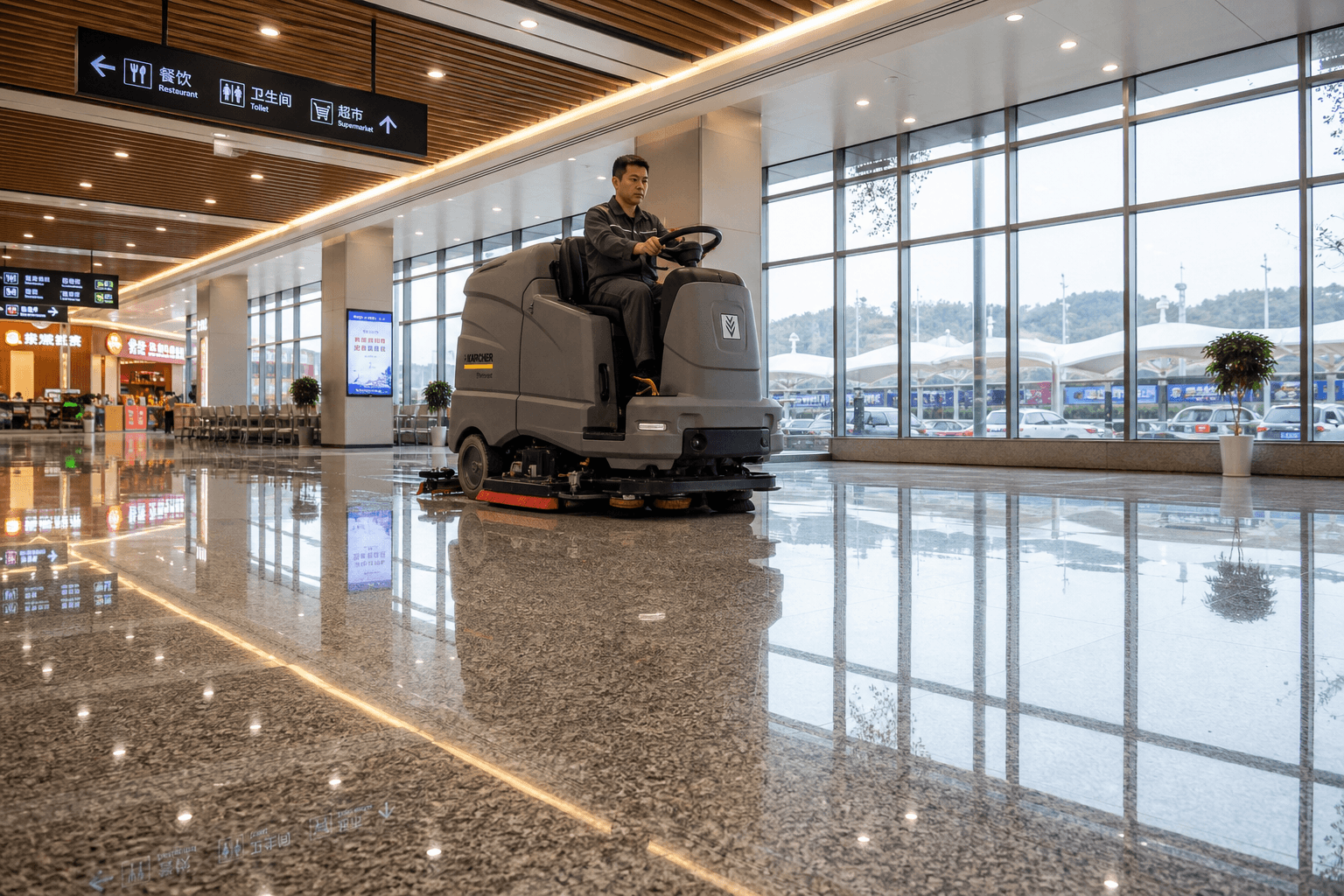
Running a BD 75/120R across 40,000 m² of commercial floor daily puts real numbers on every chemical decision. At 120 litres per tank fill and 4,500 m²/h coverage, a single wrong product choice doesn’t just affect one zone — it gets applied across an entire terminal, service area, or mall floor before the operator gets back to base. This guide cuts straight to the right products for each deployment scenario, with actual dilution ratios and consumption figures you can take to procurement.
The BD 75/120R isn’t just a bigger version of a walk-behind scrubber. Three things change at ride-on scale:
Foam tolerance drops. At 120L solution volume and the BD 75/120R’s flow rate, even a marginally high-foam product overwhelms the recovery tank within 20–30 minutes of operation. A walk-behind operator notices foam building in a small tank and stops — a ride-on operator may complete an entire floor section before the problem surfaces. Always use industrial-grade, low-foam concentrate.
Residue coverage is total. If you’re using a formula that leaves a polymer film on the floor, that film gets laid uniformly across every square metre the machine covers. On polished stone, this creates a progressive surface contamination problem that eventually requires a full strip-and-recrystallize restoration job.
Chemical cost becomes a real budget line. At 80–100L working solution per shift, a property running five BD 75/120R units spends serious money on cleaning chemical annually. The gap between OEM chemical pricing and professional-grade concentrate from a specialist supplier — at equivalent cleaning performance — is typically 60–65% per litre of working solution.
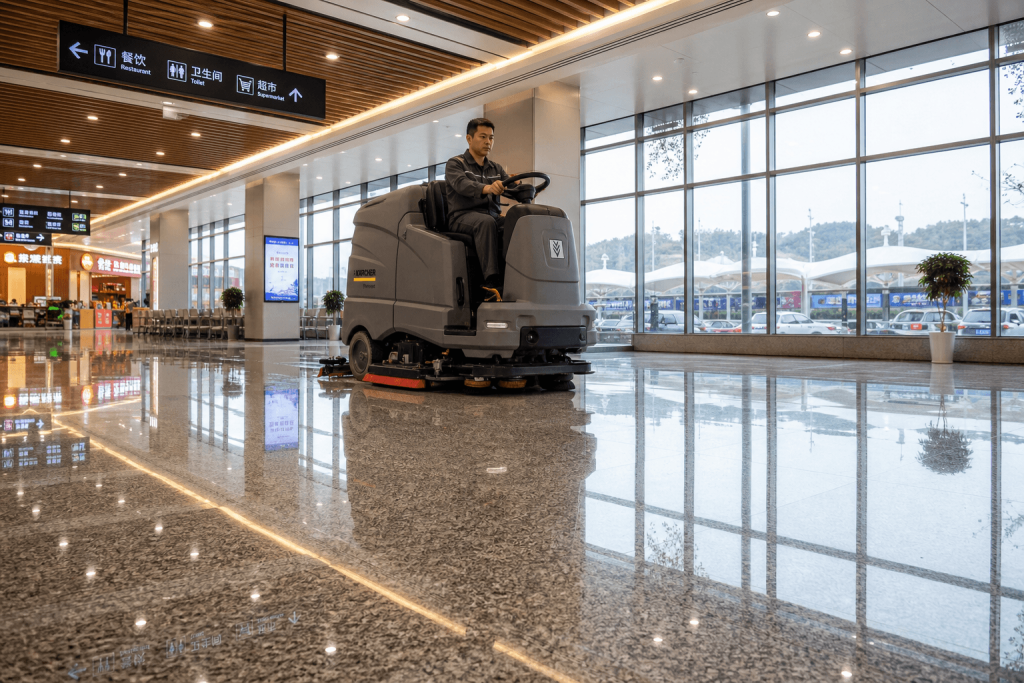
Major service area interiors are almost always large-format polished granite or quartzite — chosen for durability and the ability to be maintained and recrystallized in-place. The BD 75/120R is the standard equipment for these environments because manual or walk-behind coverage simply isn’t viable at 40,000+ m² per station.
EcoClean Neutral Cleaner — pH 6.5–7.5, low-foam, zero-residue formula designed for daily machine application on polished stone.
Dilution for daily maintenance: 1:150 in the solution tank
At this dilution, one 20L drum covers 3,000L of working solution — enough for roughly 25 full tank fills on the BD 75/120R, or approximately 112,000 m² of cleaned floor area per drum.
What makes this the correct product here isn’t just the pH — it’s the interaction with the floor’s protective layer. Service area stone floors in a well-managed programme are protected with a crystallization treatment using products like Crystal Shield Blue Shield or Green Shield. Using a neutral, residue-free daily cleaner preserves that crystallization layer. An alkaline cleaner — even a mild one at pH 9 — strips the crystallized layer over repeated passes, meaning the floor needs expensive restoration every few months instead of annually.
Not every zone in a service area needs the same chemical approach:
| Zone | Suelo | Producto | Dilution |
|---|---|---|---|
| Main concourse | Polished granite | EcoClean Neutral Cleaner | 1:150 |
| Entry / drop-off threshold | Anti-slip ceramic | EcoClean Floor Deep Cleaner | 1:80 |
| Dining zone approach | Ceramic tile | EcoClean Floor Deep Cleaner | 1:50 |
| Restroom corridor | Ceramic tile | EcoClean Floor Deep Cleaner | 1:80 |
The BD 75/120R operator changes solution at each zone boundary. A quick tank drain and refill with the zone-appropriate mix takes under 3 minutes — less time than a foam-related machine stoppage.
Underground car parks are a different cleaning challenge entirely. The floor is bare or epoxy-coated concrete — pH-tolerant, durable, and covered in tyre rubber, oil drips, and road grit that neutral chemistry won’t touch.
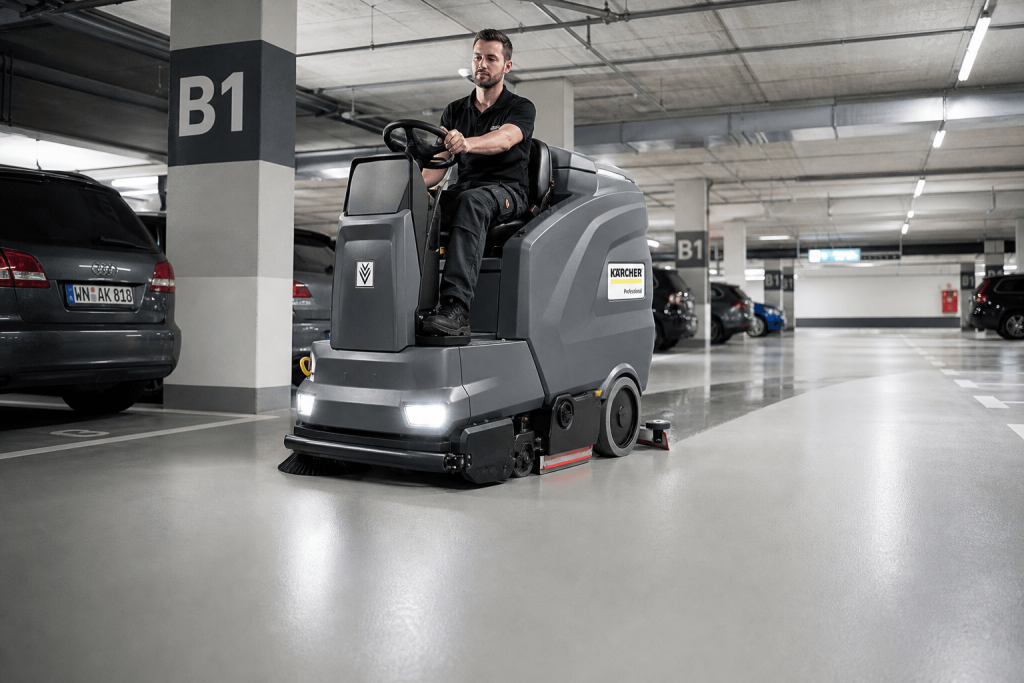
EcoClean Floor Deep Cleaner at 1:40 dilution handles standard car park maintenance on epoxy concrete floors.
For the heavy-soiling zones — entry corners, the first two parking bays on either side of the ramp where vehicles sit and drip — increase to 1:20 as a targeted pre-treatment application. Apply with a hand sprayer, allow 3 minutes dwell, then run the BD 75/120R pass over it.
One thing to manage at higher concentrations in a 120L tank: foam build-up. At 1:20 in a full tank, run a clean water flush pass after every 3,000 m² of cleaning to prevent foam from accumulating in the recovery system.
Car park floors almost never need the polish-preservation approach required for stone. The EcoClean Floor Deep Cleaner’s mildly alkaline surfactant load is the correct tool here — no need to pay for neutral-pH formulation chemistry when the substrate doesn’t require it.
Post-SOP-optimisation residential property projects — managing 60,000–700,000 m² across multiple phases — increasingly deploy the BD 75/120R for basement garage cleaning and, in some configurations, covered walkway and lobby areas. The floor types are mixed: polished stone in lobby entrances (treat as Scenario 1), epoxy basement floors (treat as Scenario 2), and sometimes terrazzo in older residential blocks.
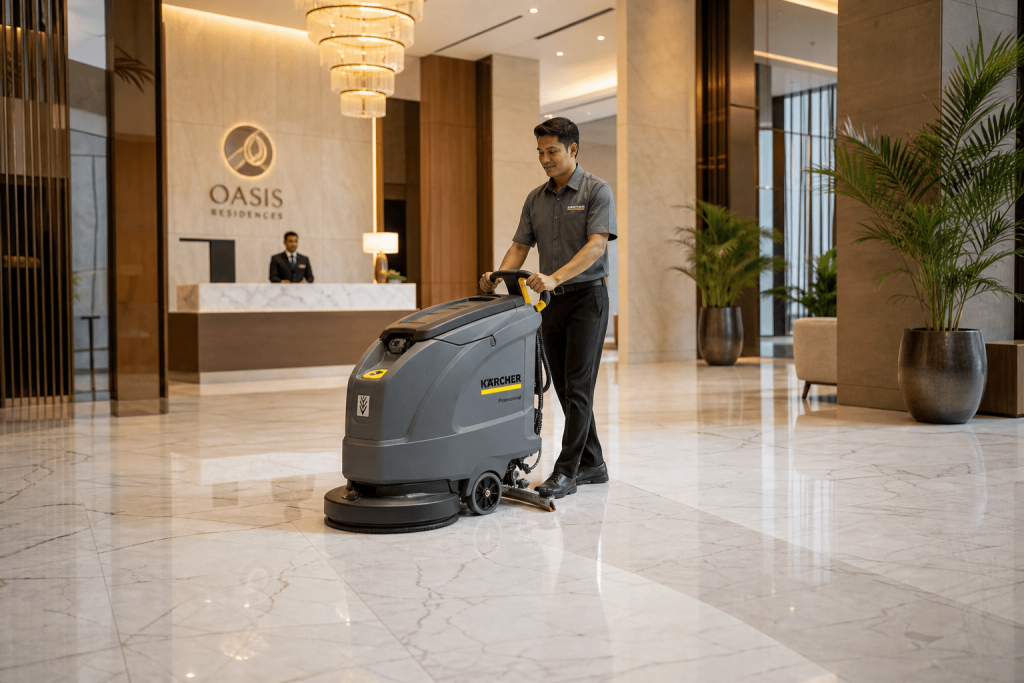
For terrazzo floors: EcoClean Neutral Cleaner at 1:100. Terrazzo is a cement-aggregate composite — it tolerates alkalinity better than marble but can still be etched by sustained exposure to pH above 10. Neutral cleaner is the safe daily choice.
For coverage efficiency planning: A residential complex BD 75/120R operator covering 30,000 m² of basement floor per day consumes approximately:
This is the most common complaint from facilities that have switched to a ride-on machine. Nine times out of ten, the cause is one of:
The fix is EcoClean Neutral Cleaner at correct dilution (1:150) with demineralised or softened water if local tap hardness exceeds 300 ppm. If streaking has already built up on the floor surface, a deep cleaning pass with EcoClean Floor Deep Cleaner at 1:50 strips the accumulated residue — then resume with Neutral Cleaner for daily maintenance.
If the stone has lost its gloss from accumulated residue or chemical damage, cleaning chemistry won’t restore it. That requires a crystallization treatment: Crystal Shield Golden Shield for premium stone protection and gloss restoration, or Revontulet KR Marble Kristallux for instant hard-coat luminance on marble. Run the restoration process first, then resume BD 75/120R daily maintenance with Neutral Cleaner.
For a facility operating one BD 75/120R at 40,000 m²/day, 250 working days/year:
| Producto | Annual Volume | Pack Format | Est. Annual Cost |
|---|---|---|---|
| EcoClean Neutral Cleaner (stone zones) | 50L concentrate | 20L drums × 3 | Contact KingHome for pricing |
| EcoClean Floor Deep Cleaner (tile/concrete zones) | 30L concentrate | 20L drums × 2 | Contact KingHome for pricing |
Volume pricing for drum quantities is available directly from KingHome Chemicals. For operations running multiple BD 75/120R units across a property portfolio, consolidated procurement across sites typically unlocks a further 15–20% reduction against single-site pricing.
Can we use the same EcoClean Neutral Cleaner in our Tennant scrubbers?
Yes. EcoClean products are formulated for machine application across all major commercial scrubber-dryer brands including Tennant — KingHome is also an authorised Tennant equipment supplier. The dilution ratios remain the same regardless of machine brand.
The BD 75/120R’s brush pressure is set to maximum for our car park floors. Does this change which chemical to use?
No — brush pressure affects mechanical soil removal, not the chemical selection logic. Higher brush pressure on epoxy concrete is appropriate for heavy soiling, but the chemical (Floor Deep Cleaner at 1:40) stays the same. What changes with higher brush pressure is the squeegee recovery load — run slower to give the squeegee time to fully recover the agitated cleaning solution.
Our building manager wants to see a safety data sheet for everything going in the scrubber tank.
EcoClean products come with full SDS documentation. Contact KingHome Chemicals directly to request SDS files for the specific products in your programme — they supply SDS in both English and Chinese.
How do we handle a floor that has both stone and tile sections in the same open-plan area?
If the zones are clearly delineated (e.g., stone lobby transitioning to ceramic tile food court), change solution at the zone boundary. If stone and tile are interspersed across the same floor area, default to EcoClean Neutral Cleaner at 1:100 — it’s safe for both surface types and effective enough for daily maintenance cleaning on tile. Save the stronger Floor Deep Cleaner application for the tile-only sections during the nightly deep clean when you can zone the machine properly.
 Spanish
  English