WELCOME TO KINGHOME
Get A Free Quote
We will get back to you within 8 hours

WELCOME TO KINGHOME
We will get back to you within 8 hours

Hard-surface floors are selected based on laying materials and mainly fall into two categories: natural rocks and artificial plates. The granite, sandstone, and marble we commonly encounter belong to igneous rocks, sedimentary rocks, and metamorphic rocks (types of natural rocks) respectively; while ceramic tiles, polished tiles, microcrystalline stones, artificial stones, and concrete are modern products that artificially simulate the rock formation process. Due to the different core structural substances of various types, daily cleaning and maintenance should also be treated differently by category.
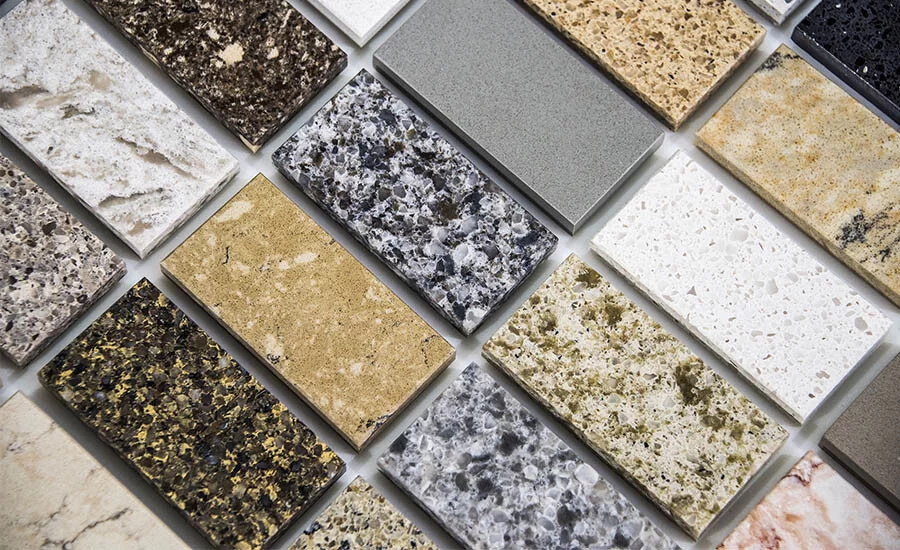
Even for the same series of the same brand of artificial stone, the ratio of resin to filler is not uniform. Each style should have an independent formula, which is derived from precise calculations and repeated tests. The manufacturing process involves a series of complex procedures. To produce high-quality artificial stone, strict control is needed in terms of equipment, materials, and processes, which requires manufacturers to have certain capabilities. For consumers, the choice of artificial stone mainly depends on appearance and price. As for its quality, their judgment can only rely on the manufacturer’s reputation and the certification of quality supervision departments. In fact, a mature market should be like this.
Depending on the product type, use, and nature, fillers account for 55% – 80% of the total formula. They are usually inorganic substances and do not undergo chemical reactions in artificial stone, but they are indispensable for increasing product strength and adjusting the texture of artificial stone. Meanwhile, reducing costs is also one of their important roles. The most suitable substance for artificial stone filler is aluminum hydroxide. Aluminum hydroxide is a non-toxic, tasteless, and odorless white powder with crystal water in its molecules. It serves as both a filler and a flame retardant in artificial stone. Due to its high refractive index, the artificial stone produced has a translucent texture similar to jade. Another major type of filler is calcium carbonate ore powder. Calcium carbonate is a white crystal or powder, and the artificial stone made with it has a solid texture like natural stone. Although its toughness is not as good as that of artificial stone with aluminum hydroxide as filler, calcium carbonate ore is cheaper than aluminum hydroxide, so it is still used by many manufacturers at present. In addition, some non-standard manufacturers use cheaper materials such as talcum powder and gypsum powder as fillers, but these materials are not suitable for artificial stone. Products made with them have problems such as easy breakage and dull surfaces, and their quality cannot be guaranteed.
Artificial stone maintenance should start with the binder, filler, finish, and exposure risk. Resin-rich artificial stone, engineered stone, microcrystalline stone, and cement-based materials may respond differently to abrasion, strong alkalinity, solvents, heat, and coating products.
| Artificial stone condition | Maintenance direction | Risk to check | Evidence to collect |
|---|---|---|---|
| Resin-rich artificial stone | Use mild cleaning first and avoid untested strong solvents or aggressive pads. | Whitening, resin aging, surface roughness, or color change. | Material type, cleaner history, stain source, and test-area photos. |
| High-filler engineered stone | Match cleaning and protection to porosity, finish level, and manufacturer guidance. | Over-polishing, residue buildup, or coating incompatibility. | Finish type, traffic pattern, and previous coating or sealer use. |
| Food, oil, or dye exposure | Remove contamination early and test any poultice or specialty cleaner before broad use. | Deep absorption, spreading stain edges, or cleaner marks. | Stain age, source, moisture condition, and before/after photos. |
| Commercial floor traffic | Control grit with daily soil removal before relying on polishing or coating. | Fine scratches from sand and hard-wheel traffic. | Entrance matting, cleaning frequency, wheel type, and gloss observations. |
For a maintenance recommendation, provide the artificial stone type, finish, traffic level, cleaner used, stain or scratch history, coating history, and photos under side lighting. Keep any product recommendation tied to a small test area and the material’s actual response.
Artificial stone has good flexural strength, but its hardness is relatively lower than that of most natural marbles. Therefore, contact with sharp objects or hard wheels should be avoided in daily use. Moreover, the acid and alkali resistance of artificial stone surfaces is poor, so strong acid or alkali cleaning is not suitable. If strong acid-based crystallization products are used, the surface of artificial stone will often be burned by acid. Using strong acid-based crystallization powder or strong acid-based crystallizer for daily maintenance will also cause the original thickness of artificial stone to be thinned (due to the coarse and hard powder), the flatness to decrease, and particles to fall off. The most common surface symptom is that the stone becomes rough and dusty after maintenance, and the acid gas expanding inside the stone forces the artificial stone to burst.
The best maintenance solution for artificial stone is to use Green Shield of Crystal Shield, which is a water-based nano-resin coating formula product and does not belong to friction-polishing maintenance products.
In daily life, the greatest damage to floors comes from sand particles (with a Mohs hardness of 6 – 7), while the Mohs hardness of artificial stone is only 3 – 5. The crystallized layer contains not only high-polymer resin similar to silicon particles, and its highest hardness does not exceed 5. Therefore, it cannot resist damage from sand particles. Some hotels, shopping malls, and office buildings can only maintain the cleanliness of lobbies through frequent polishing and grinding. Crystal Shield contains nano-crystal molecules with a Mohs hardness of 7, so it is more than 3 times more wear-resistant than commonly used crystallizers, greatly saving the manpower and materials needed for repeated polishing and truly reducing high maintenance costs for user units.
The nano-crystal molecules of Crystal Shield are fully absorbed by artificial stone, emitting the charming luster of crystal. In addition, Crystal Shield also has anti-slip and high stain-resistant properties. The protective film layer it forms is hydrophobic, resisting pollution from ink, juice, sewage, etc., and preventing oxidation and decomposition of the shield layer by common cleaning agents. Moreover, it can form a physical suction cup effect when in contact with water or feet, and the effective anti-slip function can prevent safety accidents.
Author : Chen Weihui, Director of South China Region, Hong Kong Jinjinghong (International) Chemical Trade Co., Ltd. Written in 2007.
 English
  Spanish