WELCOME TO KINGHOME
Get A Free Quote
We will get back to you within 8 hours

WELCOME TO KINGHOME
We will get back to you within 8 hours
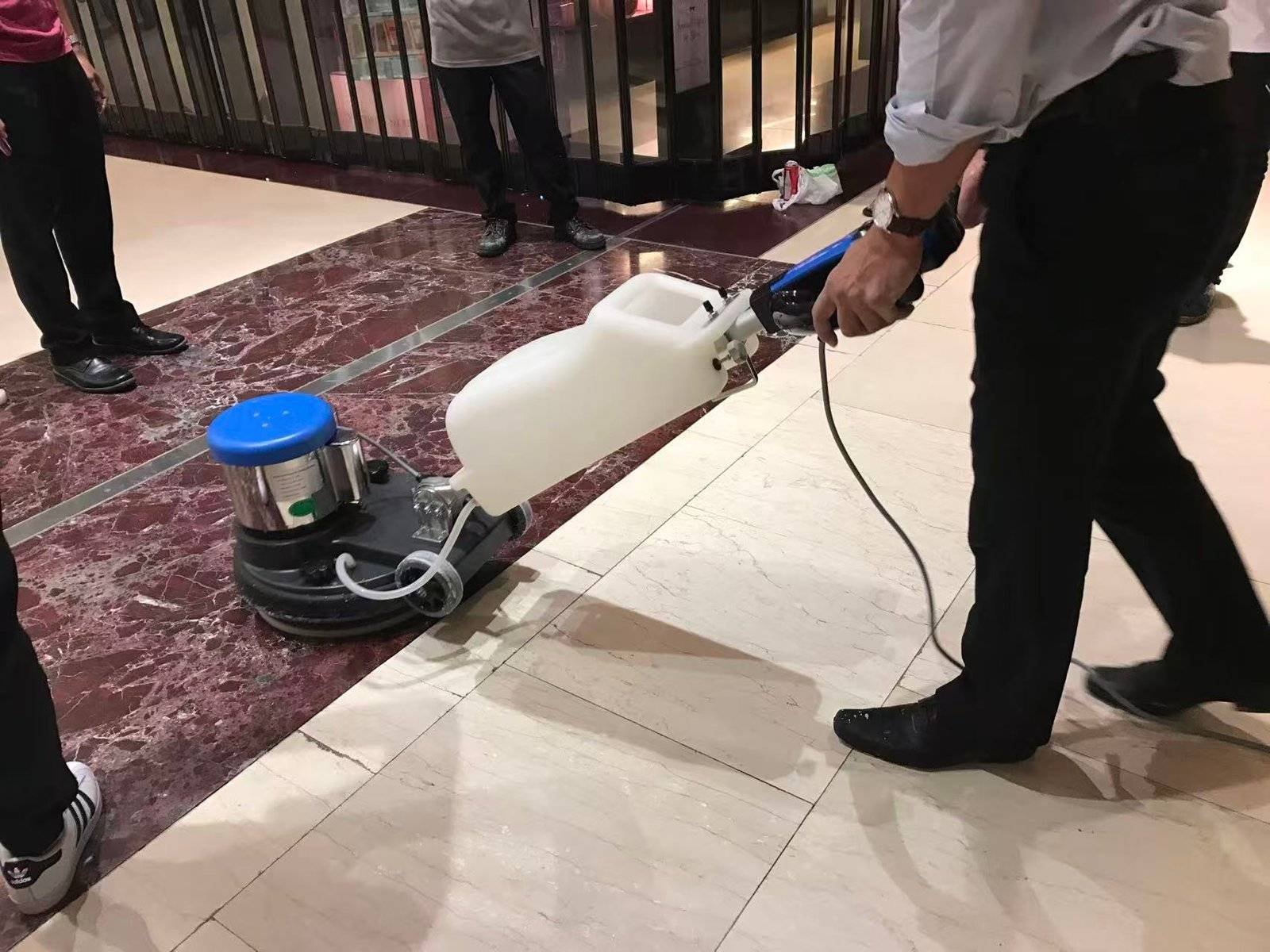
The best industrial floor polisher supplier depends on the floor material, required gloss level, service coverage, pad and chemical compatibility, training support and total maintenance cost. For marble, granite and terrazzo, a supplier that understands polishing chemistry and machine setup can reduce rework more than a lower equipment price.
| Supplier type | Strength | Risk to check |
| Large equipment manufacturer | Machine range, parts and service network | May not specialize in stone gloss recovery |
| Stone-care solution supplier | Machine, pad, chemical and process knowledge | Confirm local support and training options |
| Distributor or reseller | Fast sourcing and multiple brands | May compare price better than process fit |
Useful follow-up pages include industrial floor polishing machines, high-speed buffer vs low-speed scrubber, and professional marble floor maintenance.
When a facility director at a 350,000-square-foot medical center in Houston contacted our technical team last year, his marble floors had deteriorated to the point where quarterly refinishing was costing $127,000 annually. After switching from a commodity floor scrubber to an integrated stone care program, his maintenance costs dropped 61% within eighteen months—not through aggressive price negotiation, but by selecting the right supplier category for his specific flooring substrate.
This outcome illustrates why supplier selection in the industrial floor polishing sector demands more than equipment price comparisons. The United States market segments into three distinct supplier tiers, each serving fundamentally different operational requirements: integrated equipment manufacturers optimized for coverage efficiency, specialized stone care solution providers focused on surface chemistry and longevity, and regional distributors offering localized support networks.
Industrial floor polisher suppliers should be evaluated by the complete floor-care package, not only the machine list. A supplier for industrial floor polishing machines should be able to explain which stone floor polisher, pads and chemicals, training plan, and service proof fit the facility. This is especially important when marble, terrazzo, granite, concrete, or coated floors require different polishing pressure, crystallization products, dust or slurry control, and operator workflow.
| GSC search intent | Supplier check | Why it matters |
|---|---|---|
| Industrial floor polishing machines | Compare machine range, motor power, RPM control, pad diameter, and coverage per hour | A broad catalog only helps if the supplier can match the machine to floor material, route size, and gloss target. |
| Stone floor polisher | Confirm stone-care expertise, crystallization support, diamond pad knowledge, and chemical compatibility | Stone polishing failures often come from the wrong process, not a weak machine. |
| Professional floor polishers | Ask for training, maintenance parts, consumables, warranty terms, and local service proof | Supplier support protects uptime after the first purchase and reduces costly operator mistakes. |
| Industrial floor polisher suppliers | Review pads and chemicals, test-area results, ROI assumptions, and repeat supply capability | The right supplier can support the full workflow from cleaning and polishing to protection and long-term maintenance. |
For procurement, request a sample workflow instead of a simple quotation. A supplier should specify the machine, pad sequence, chemical or polish, expected coverage, training time, and service response for the actual floor. That service proof helps separate equipment resellers from suppliers who can support a stone-care system across daily maintenance, gloss recovery, and periodic restoration.
Related planning paths: compare industrial floor polishing machines, review industrial floor polisher choices, and use professional marble floor maintenance guidance when supplier selection depends on pads, chemicals, and stone-care expertise.
Industrial floor polisher supplier comparisons should be based on service proof, machine fit, consumables, training, and the floor system being maintained. A supplier that looks strong for general scrubbers may not be the right support path for marble crystallization, terrazzo restoration, or mixed stone maintenance.
| Supplier check | What to request | Why it matters | Evidence to keep |
|---|---|---|---|
| Floor-system fit | Ask the supplier to match machine, pad, brush, and chemical path to the actual stone or floor finish. | Supplier lists are only useful when they connect equipment to the surface risk. | Floor type, finish condition, photos, and written method recommendation. |
| Training and start-up support | Confirm who trains operators, what the training covers, and how problems are escalated. | Operator technique affects gloss, residue, water recovery, and rework. | Training outline, startup checklist, and support contact route. |
| Parts and consumables | Check local supply for pads, brushes, squeegees, batteries, chargers, and service parts. | A low machine price can become expensive when routine parts are slow or unclear. | Lead times, part numbers, and consumable cost assumptions. |
| Reference fit | Request references or examples that match the facility type and floor material. | A warehouse concrete example does not prove a marble lobby workflow. | Comparable site type, floor material, machine model, and maintenance result. |
Before shortlisting suppliers, document the floor material, target finish, area size, work window, operator skill level, maintenance history, and service location. Adjacent planning resources include industrial floor polishing machines, buffer vs scrubber selection, and professional marble maintenance.
Operating since 1870 with 4,000 employees globally, Tennant dominates the mechanized cleaning segment with comprehensive scrubber, sweeper, and burnisher lines. Their T17 rider scrubber delivers 75,000 square feet per hour coverage with a 26-inch dual-disk cleaning path, 6-hour lithium-ion runtime, and 25-gallon solution capacity—specifications engineered for maximum productivity across vinyl composite tile, sealed concrete, and ceramic installations.
The company’s ec-H2O NanoClean® technology electrolyzes ordinary tap water into electrically charged cleaning solution, reducing chemical consumption by 70% while maintaining soil-removal efficacy comparable to traditional detergents. This innovation particularly benefits facilities pursuing LEED certification or managing sensitive environments like food processing plants where chemical residue presents contamination risks.
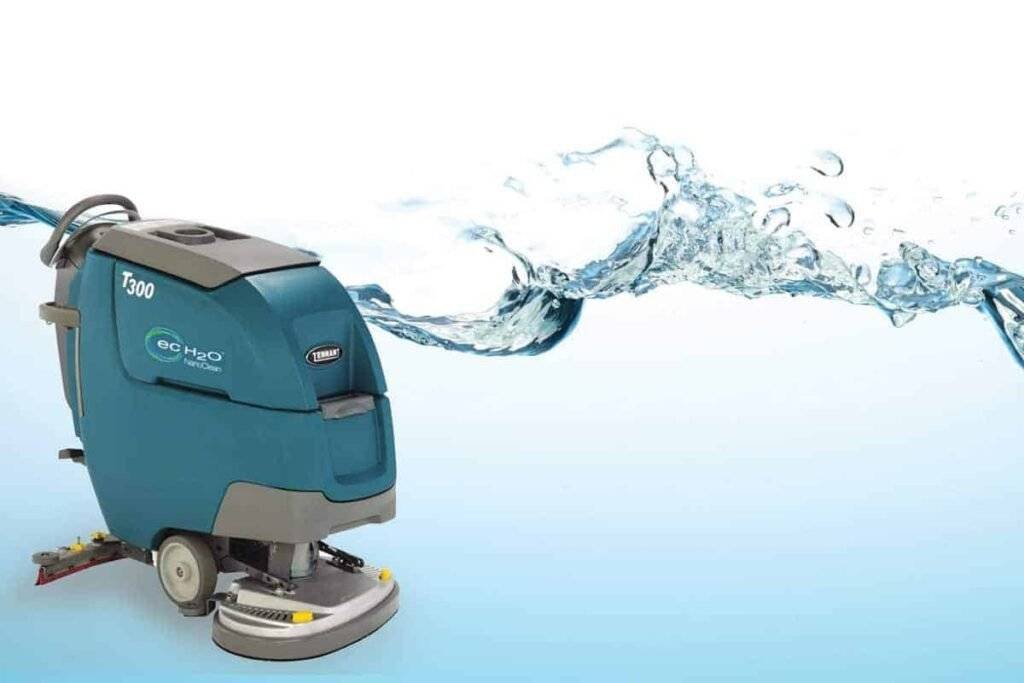
Real-World Performance: A 1.2-million-square-foot distribution center in Pennsylvania replaced manual mopping crews with Tennant T7AMR autonomous scrubbers, reducing labor hours from 240 hours per week to 65 hours per week while improving floor cleanliness scores from 72% to 94% based on ATP bioluminescence testing.
Application Limitations: Tennant equipment excels at surface cleaning but lacks stone-specific crystallization capability. The standard 500 RPM brush speed and pH-neutral ec-H2O chemistry cannot perform the chemical hardening reactions required for marble or travertine maintenance, which demand acidic crystallizers (pH 2.0-2.5) applied at lower speeds (175-300 RPM) with steel wool or specialized synthetic pads.
This Danish multinational maintains US manufacturing and distribution through its Advance and Viper brand portfolios. The Nilfisk Liberty SC50 autonomous scrubber represents the market’s most advanced autonomous cleaning technology, earning CSA/ANSI C22.2 No. 336-17 certification (the only robotic floor machine with this North American safety approval) through integration of Hokuyo UAM-05LP safety scanners that detect obstacles in real-time and adjust cleaning paths accordingly.
The SC50 cleans continuously for six hours without human intervention, automatically maps optimal cleaning routes, and replicates these patterns with millimeter precision across shifts—delivering consistency impossible with manual operators whose fatigue and technique variations create uneven results.
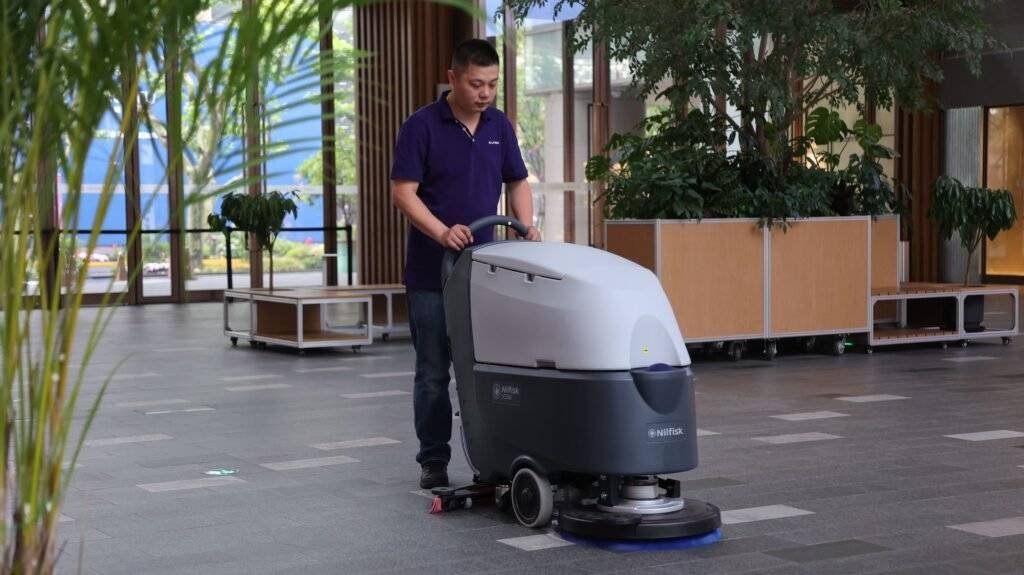
Typical Applications: Healthcare facilities (EMC-certified for sensitive electronic environments), airports, universities, retail malls, office buildings.
Investment Context: While autonomous scrubbers command $40,000-$65,000 price points versus $8,000-$15,000 for manual walk-behind units, facilities with 200,000+ square feet achieve 14-18 month payback through labor displacement. A regional hospital system operating twelve campuses consolidated nightshift custodial staff from 84 personnel to 31 personnel after deploying eighteen SC50 units, generating $1.7 million in annual labor savings against $780,000 in equipment amortization.
Founded in Italy as a floor grinding and polishing machine specialist, Klindex manufactures variable-speed single-disc machines (175-3,000 RPM), planetary grinders, and edge polishers specifically engineered for natural stone applications. Unlike general-purpose scrubbers with fixed brush speeds, Klindex machines provide the multi-speed functionality essential for different stone treatment phases:
Klindex also manufactures the diamond tooling used with their machines—a vertical integration ensuring compatibility between abrasive specifications and motor torque curves that third-party accessories cannot guarantee.
US Distribution Network: Klindex operates through authorized dealers across North America rather than direct sales, requiring facility managers to identify regional partners for equipment acquisition, warranty service, and technical training. This distribution model provides localized support but lacks the nationwide service infrastructure of Tennant or Nilfisk.
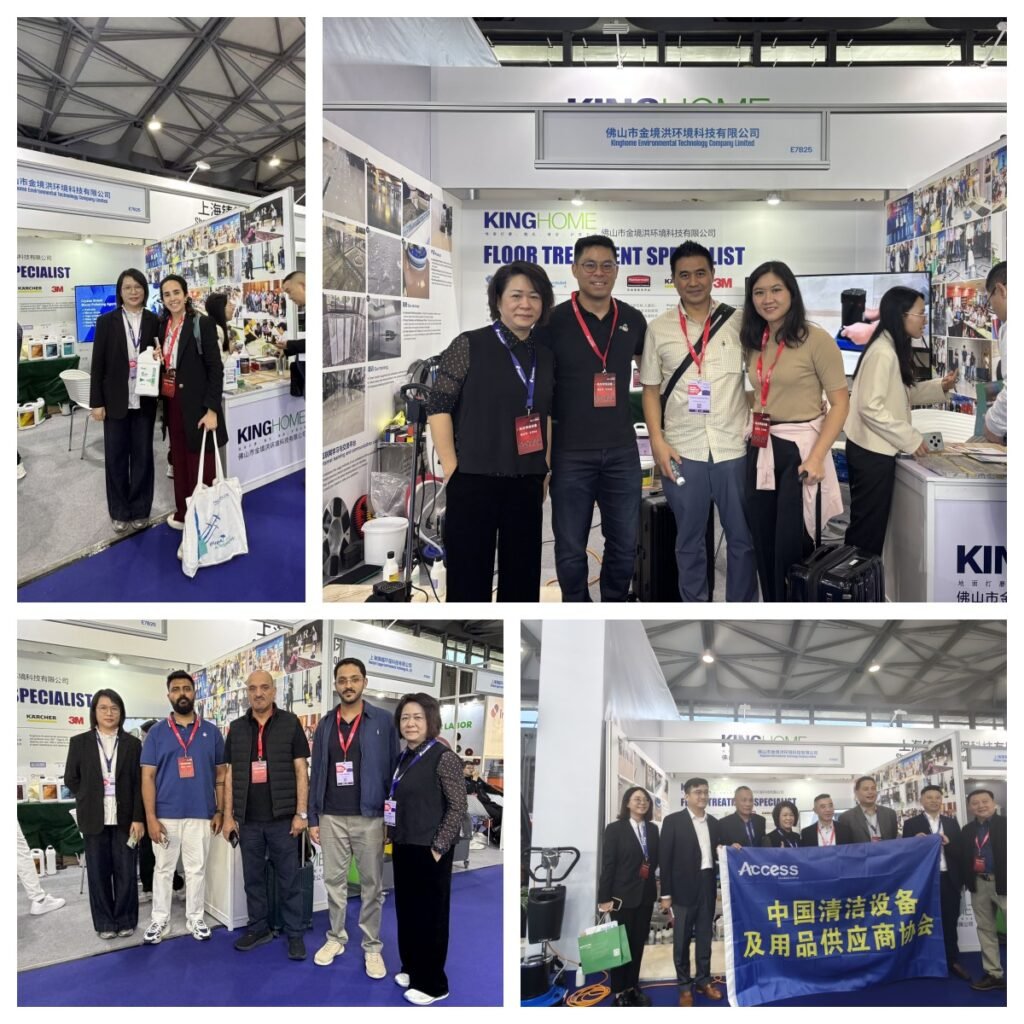
Established in 1994, Kinghome specializes in stone care chemical formulations and distributes Klindex equipment as part of integrated chemistry-machine solutions. The company’s product portfolio includes:
Kinghome’s technical approach centers on matching chemistry pH profiles and active compound concentrations to specific Klindex machine parameters—rotational speed, pad-contact pressure, and thermal generation characteristics. For example, their Crystal Shield marble crystallizer operates at pH 2.0-2.5 and works optimally at Klindex’s 250 RPM setting, where frictional heat reaches 150-165°F—the temperature range maximizing magnesium hexafluorosilicate reaction kinetics without causing premature water evaporation.
Technical Note on Data Availability: While Kinghome maintains presence at international trade shows and provides product information through stoneshine.cn, detailed technical data sheets with specific pH values, VOC content, solid percentages, and third-party test reports were not accessible through their primary web channels during this research. Facility managers should request TDS (Technical Data Sheets) and SDS (Safety Data Sheets) directly from authorized distributors to verify formulation specifications before procurement decisions.
A division of R.P.S. Corporation, Tomcat manufactures rugged walk-behind and rider scrubbers targeting industrial environments—manufacturing plants, warehouses, transportation facilities—where equipment durability under harsh conditions outweighs sophisticated features. Their Edge 20 mini scrubber (20-inch cleaning path, 1.0 HP motor) serves tight spaces like restroom corridors and kitchen prep areas where larger machines cannot maneuver.
Market Position: Tomcat competes on price accessibility rather than technology innovation, typically pricing 20-30% below Tennant or Nilfisk equivalents while offering shorter warranty terms (1-2 years versus 3-5 years for premium brands).
The medical center case introduced earlier illustrates a common procurement error: selecting equipment based on coverage rate metrics (square feet per hour) without assessing flooring substrate compatibility. His facility’s marble lobbies and travertine corridors required surface hardening through crystallization—a chemical process that generic floor scrubbers cannot perform regardless of their efficiency in other applications.
Choose Tennant, Nilfisk, or equivalent suppliers when:
Flooring Profile: Vinyl composite tile (VCT), sealed concrete, ceramic tile, or rubber compose >75% of total square footage.
Maintenance Objective: Soil removal, disinfection, and appearance maintenance rather than surface modification or hardness enhancement.
Labor Optimization Priority: Facilities managing large contiguous areas (>50,000 sq ft) where coverage rate directly impacts staffing requirements.
Automation Interest: Organizations willing to invest $40,000-$65,000 per unit for autonomous scrubbers that eliminate supervision requirements and deliver consistent results across shifts.
Example Application: A 2.8-million-square-foot airport terminal with 95% sealed concrete flooring deployed sixteen Tennant T20 rider scrubbers, achieving complete terminal cleaning in 4.5 hours versus 11 hours with previous manual methods—enabling twice-daily cleaning cycles that improved passenger satisfaction scores 23%.
Choose Klindex, Kinghome, or equivalent suppliers when:
Flooring Profile: Natural stone (marble, granite, travertine, terrazzo, limestone) exceeds 20% of total square footage or comprises high-visibility areas like lobbies, elevator banks, or executive suites where appearance directly impacts brand perception.
Maintenance Objective: Surface hardening, crystallization, scratch repair, stain removal, or color enhancement—interventions requiring chemistry knowledge beyond commodity cleaning.
Finish Requirements: Specifications demanding high-gloss finishes >70 gloss units (GU) at 60° geometry, achievable only through proper crystallization rather than mechanical buffing alone.
Lifecycle Cost Focus: Long-term asset preservation strategies where extending refinishing intervals from 18-24 months to 36-48 months generates greater ROI than short-term labor-hour reduction.
In-House Expertise Level: Facilities willing to invest in operator training covering stone identification, pH testing, hardness measurement, and troubleshooting—technical skills that general custodial training does not address.
Example Application: A 540,000-square-foot mixed-use development (luxury retail, class-A offices, residential condominiums) with 180,000 square feet of Calacatta marble flooring implemented quarterly crystallization using Klindex single-disc machines with specialized chemistry. Over a five-year period, they avoided three full refinishing cycles at $0.95 per square foot, saving $513,000 while maintaining 75+ GU gloss readings that contributed to 15% rental premium over competing properties with dull stone floors.
Understanding why stone care specialists occupy a distinct market category requires examining crystallization chemistry—the surface hardening technique that separates natural stone maintenance from general floor cleaning.
Marble, travertine, and limestone consist primarily of calcium carbonate (CaCO₃), a relatively soft mineral registering 3-4 on the Mohs hardness scale. This softness makes calcitic stone vulnerable to micro-scratching from foot traffic, dulling that no amount of mechanical buffing can permanently reverse.
Crystallization applies acidic chemistry (typically pH 2.0-2.5) containing magnesium hexafluorosilicate (MgSiF₆) or similar fluorosilicate compounds. When combined with mechanical friction heat (140-180°F generated by single-disc machines operating at 175-300 RPM with steel wool or synthetic pads), these chemicals react with surface calcium carbonate to form calcium/magnesium silicate crystals—harder compounds registering 5-6 on the Mohs scale.
This 40-50% hardness increase translates into:
Three factors prevent general equipment from replicating crystallization:
Facilities pursuing crystallization must budget for:
Operator Training (8-16 hours initial, 4 hours annual refresher):
Safety Protocols (OSHA HazCom 29 CFR 1910.1200):
Quality Verification Testing:
Equipment: Three Tennant T7 walk-behind scrubbers
Capital Cost: $44,400 ($14,800 × 3 units)
Annual Chemistry: $8,200 (ec-H2O + neutral cleaners for VCT; generic marble cleaner)
Annual Labor: VCT cleaning 28 hrs/week at $28/hr = $40,768; marble cleaning 12 hrs/week = $17,472 (subtotal: $58,240)
Marble Refinishing: Professional diamond grinding every 18 months at $0.85/sq ft = $28,333 annually amortized
Equipment Replacement: Year 6 at $44,400 (7% annual inflation)
7-Year Total Cost: $44,400 + ($8,200 × 7) + ($58,240 × 7) + ($28,333 × 7) + $44,400 = $747,811
Equipment: Two Tennant T7 scrubbers for VCT ($29,600); one Klindex single-disc machine for marble ($6,800)
Capital Cost: $36,400
Annual Chemistry: $7,100 (ec-H2O for VCT; specialized crystallizers and pH-neutral marble cleaner)
Annual Labor: VCT cleaning 28 hrs/week at $28/hr = $40,768; marble crystallization quarterly (32 hrs/year) + daily maintenance (6 hrs/week) = $17,888 (subtotal: $58,656)
Marble Refinishing: Extended to 42-month intervals at $0.85/sq ft = $12,143 annually amortized (crystallization defers refinishing)
Equipment Replacement: Year 6 scrubbers ($29,600), year 11 Klindex machine (outside analysis window)
7-Year Total Cost: $36,400 + ($7,100 × 7) + ($58,656 × 7) + ($12,143 × 7) + $29,600 = $611,593
Savings: $136,218 (18% reduction)
ROI: Dual-supplier strategy pays back investment differential ($8,000 higher training and initial chemistry costs) within 16 months through deferred marble refinishing costs.
Approach A Risks:
Approach B Risks:
Based on analysis of service records from commercial installations, these issues represent 78% of crystallization quality complaints:
Symptom: Cloudy white streaks appearing hours after crystallization, particularly visible in angled sunlight
Root Cause: Over-application of crystallizer (exceeding manufacturer dilution ratios by >25%) or insufficient buffing time allowing chemical residue to dry on surface
Corrective Action:
Prevention: Reduce crystallizer concentration by 20-25% from maximum recommended dilution; increase buffing pass count from two to three passes per 4×4-ft section; verify operators are not “pushing” chemistry across floors (which creates uneven concentration)
Cost Impact: Rework labor averages $0.08-$0.12 per square foot—eliminating this defect on a 50,000-sq-ft installation saves $4,000-$6,000 per crystallization cycle
Symptom: Ivory or yellow discoloration on white Carrara, Thassos, or Calacatta marble, typically appearing 2-4 weeks post-crystallization
Root Cause: Iron oxidation from steel wool particles embedding in porous stone (porosity >3% measured via ASTM C97 water absorption testing)
Corrective Action:
Prevention: Transition to synthetic white pads (3M 4100 White Super Polish Pad or equivalent) for all white marble applications; test porosity before selecting pad type—stone with >3% absorption should never contact steel wool
Cost Impact: Iron stain removal requires $0.25-$0.40 per square foot in specialized chemistry and labor; prevention through proper pad selection costs $0.02 per square foot difference in consumable pricing
Symptom: Crystallized marble losing gloss from 75+ GU to <55 GU within three months despite moderate traffic
Root Cause: Alkaline detergent residue from improper daily maintenance chemistry degrading fluorosilicate crystal matrix
Mechanism: Many facility teams use general-purpose floor cleaners with pH 9-11 on crystallized marble. These alkaline solutions slowly dissolve the magnesium/calcium silicate crystals formed during crystallization, reversing the hardness gains and requiring premature re-crystallization
Corrective Action:
Prevention: Implement weekly pH testing of maintenance solution using digital pH meters or litmus paper; train all custodial staff on neutral cleaner dilution ratios (typically 1:128 for daily applications); audit chemical storage areas quarterly to remove alkaline products incompatible with crystallized marble
Cost Impact: Premature re-crystallization every 3-4 months versus proper 9-12 month intervals increases annual costs by $12,000-$18,000 on a 50,000-sq-ft installation; pH monitoring ($40 for digital meter, $12 for 100-strip litmus paper) provides 150:1 ROI
IMPORTANT: ASTM C1028 (Static Coefficient of Friction) was withdrawn in 2014 because it provided misleadingly high slip resistance ratings for polished surfaces that were actually hazardous when wet. Facilities still specifying C1028 in flooring contracts or maintenance protocols are using an obsolete standard that creates liability exposure.
Current Applicable Standards:
Target Performance: 2012 International Building Code (IBC) Section 2103.6 requires wet DCOF ≥0.42 for level walking surfaces and ≥0.60 for ramps—requirements adopted by most US state building codes
Crystallization Impact: Properly formulated crystallizers increase marble hardness without sacrificing surface friction; target post-crystallization wet DCOF of 0.44-0.48 (measured via ASTM F2508) provides safety margin above code minimums while achieving desired gloss levels
The Natural Stone Institute references these ASTM standards for floor applications:
Procurement Specification: Require suppliers to provide ASTM C1353 abrasion resistance data for any crystallization chemistry or polishing system. Products should demonstrate <20 mm³ volume loss per ASTM C241 testing to qualify for moderate-traffic commercial applications
VOC Regulations: California Air Resources Board (CARB) establishes VOC limits for floor care products at 400 g/L maximum; low-VOC formulations targeting <50 g/L enable LEED v4.1 EQ Credit 1 (Enhanced Indoor Air Quality) worth 1-2 points
Green Seal GS-40: Third-party certification for floor care products evaluating both performance and environmental criteria including biodegradability (OECD 301B testing: >90% degradation within 28 days), aquatic toxicity, and packaging recyclability
EPA Safer Choice: Voluntary program identifying products with safer chemical ingredients; particularly relevant for healthcare and educational facilities where chemical sensitivity concerns drive procurement decisions
For facility managers evaluating industrial floor polisher suppliers:
For facility-specific guidance on supplier selection, chemistry compatibility assessments, or equipment specification development, consult with stone care technical specialists or independent facility management consultants with crystallization expertise. While this analysis provides framework for decision-making, individual facility variables—stone porosity, traffic patterns, water hardness, existing maintenance protocols—require customized evaluation before procurement commitments.
 English
  Spanish