WELCOME TO KINGHOME
Get A Free Quote
We will get back to you within 8 hours

WELCOME TO KINGHOME
We will get back to you within 8 hours
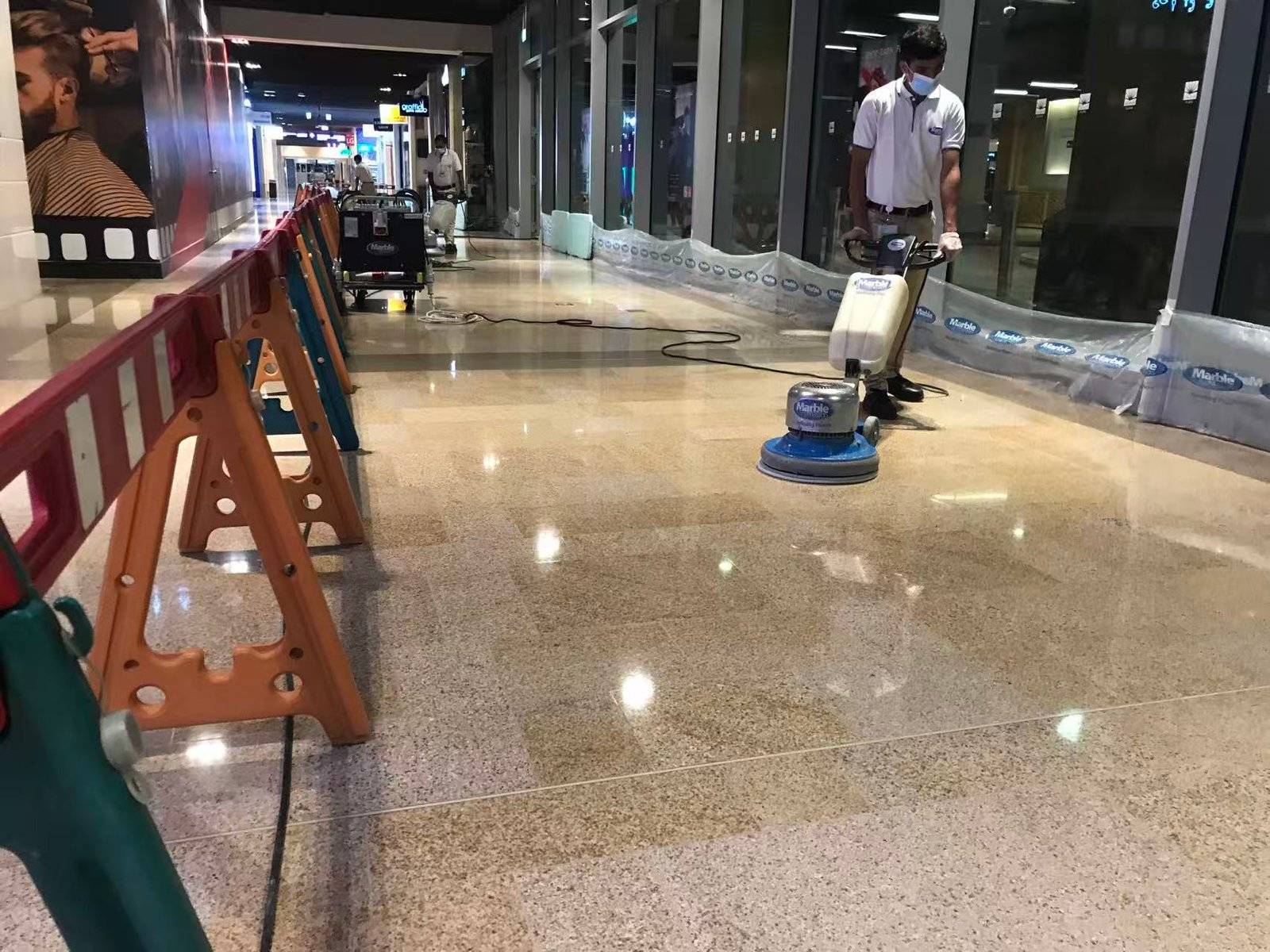
The Kärcher BD 50/50C is a workhorse in commercial floor cleaning — but the machine only performs as well as the chemical you put in the tank. Use the wrong product and you’ll deal with foam overflow, streaky residue, or surface damage that no amount of extra passes will fix.
This guide covers exactly which cleaning chemicals pair with the BD 50/50C across the floor types it’s most commonly deployed on: polished marble and granite, ceramic tile, epoxy-coated concrete, and anti-slip rubber. All product recommendations link to what’s actually stocked at KingHome Chemicals.
The BD 50/50C holds 50 litres of solution and covers around 2,000 m²/h. At that rate, a wrong dilution or incompatible formula gets applied across an entire building floor before anyone notices the problem. Stone surfaces etched by alkaline overspray, foam-locked recovery tanks, and filmy residue that attracts fresh dirt faster than a clean floor — these are all chemical problems, not machine problems.
The three failure modes to avoid:
Chemical requirement: pH-neutral, residue-free, low-foam concentrate
Polished stone is the most unforgiving surface the BD 50/50C will encounter. The surface has been ground, honed, and crystallized to achieve a mirror finish — one alkaline cleaning pass can etch micro-pores into that surface and scatter the light reflection permanently.

Recommended product: EcoClean Neutral Cleaner
EcoClean’s Neutral Cleaner is formulated at pH 6.5–7.5, making it safe for daily machine use on marble, granite, and terrazzo without risk of surface degradation. It’s low-foam by design — built for scrubber-dryer application, not bucket mopping — and leaves zero residue film after drying.
If the stone floor has lost its gloss due to foot traffic abrasion or prior chemical damage, daily BD 50/50C cleaning with Neutral Cleaner maintains condition but won’t restore shine. That requires a crystallization treatment — see the Crystal Shield Golden Shield or Revontulet KR Marble Kristallux restoration process before resuming daily machine cleaning.
Chemical requirement: Neutral-to-mildly alkaline, disinfecting capability, low-foam
Large-format ceramic tile in high-traffic commercial spaces accumulates a different soil profile than stone: food debris near dining zones, tracked-in outdoor grime at entry points, and general bacterial load from foot traffic. A pure neutral cleaner handles this adequately for daily maintenance, but restroom approach corridors and food court floors benefit from a cleaner with disinfecting action.
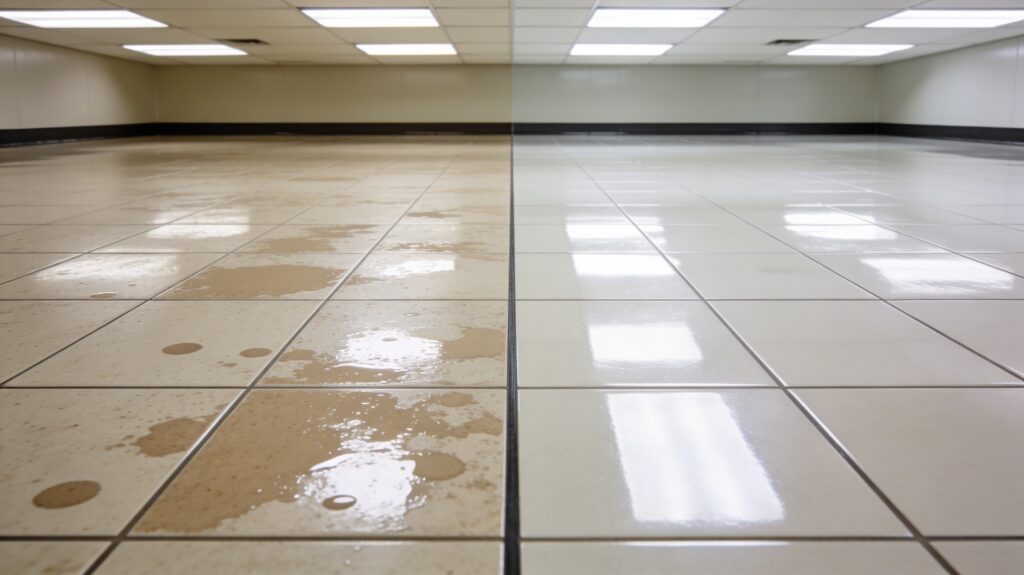
Recommended product: EcoClean Floor Deep Cleaner
The Floor Deep Cleaner from EcoClean handles the heavier soil load on tile without the pH risk of an industrial degreaser. It’s designed specifically for machine application — the foam-control formula is tested for scrubber-dryer use at the recommended dilution range.
For restroom tile floors specifically, this product pairs with the manual enzyme treatment described in the restroom chemical guide for the BR 30/4 C — the BD 50/50C handles the main floor area while the handheld machine handles cubicle interiors.
Chemical requirement: Alkaline degreaser, pH 9–11, oil-emulsifying surfactant
Epoxy-coated concrete is the one surface type where you want alkalinity working for you. Tyre rubber transfer, motor oil drips, and compacted road grit don’t respond to neutral chemistry — you need the emulsification power of an alkaline formula to lift and suspend them for the squeegee to recover.
Recommended product: EcoClean Floor Deep Cleaner at elevated dilution
At a 1:30 dilution, the Floor Deep Cleaner’s alkaline surfactant load is sufficient for standard car park maintenance on epoxy floors. For heavy oil-contaminated zones — typically the entry/exit lane corners and parking bays frequented by older vehicles — apply at 1:15 as a pre-treatment, allow 3 minutes dwell, then run the BD 50/50C pass.
Epoxy floors tolerate up to pH 11 without damage. The concern here is not surface chemistry but foam management: at 1:15 concentration, some formulas generate foam that overloads the recovery tank after 500–800 m². Run a clean water flush pass halfway through the shift to clear any foam accumulation from the recovery system.
Chemical requirement: Low-foam, neutral pH, no optical brighteners
Anti-slip rubber and textured vinyl have micro-grooved surfaces that trap soil — the BD 50/50C’s rotating brush is one of the only effective tools for getting into those grooves. But the chemical must be chosen carefully:
Recommended product: EcoClean Neutral Cleaner at 1:80, same product as the stone floor application but at a slightly stronger dilution to address the higher soil retention in textured surfaces.
| Floor Type | Product | Dilution | Coverage per 5L concentrate |
|---|---|---|---|
| Polished marble / granite | EcoClean Neutral Cleaner | 1:150 | 750L working solution |
| Ceramic tile (daily) | EcoClean Floor Deep Cleaner | 1:80 | 400L working solution |
| Ceramic tile (food zone) | EcoClean Floor Deep Cleaner | 1:40 | 200L working solution |
| Epoxy concrete (standard) | EcoClean Floor Deep Cleaner | 1:30 | 150L working solution |
| Anti-slip rubber / vinyl | EcoClean Neutral Cleaner | 1:80 | 400L working solution |
At a BD 50/50C tank size of 50L and an effective coverage rate of ~1,500 m²/tank, a 5L bottle of Neutral Cleaner at 1:150 dilution covers roughly 22,500 m² of polished stone before reorder.
The BD 50/50C is leaving white streaks on our granite floor after drying. Chemical issue or machine issue?
Usually chemical. White streaks on polished granite after scrubbing are caused by one of three things: over-concentrated cleaner leaving surfactant residue, hard water mineral deposits bonding to the stone surface as the cleaning water dries, or a cleaner containing wax or polymer additives. Switch to EcoClean Neutral Cleaner at 1:150 and use demineralised water if your local supply is above 300 ppm hardness. If streaks persist, the floor may need a deep clean with EcoClean Floor Deep Cleaner at 1:50 to strip accumulated residue before resuming daily maintenance dilution.
Can I use the same chemical in the BD 50/50C and in a mop bucket for manual touch-up?
Yes — EcoClean Neutral Cleaner and Floor Deep Cleaner both work in conventional mop application. The dilution ratios are the same. The only difference is that manual mopping doesn’t apply the mechanical scrubbing pressure of the rotating brush, so grout lines and textured surfaces won’t get the same depth of clean from a mop pass alone.
We run the BD 50/50C twice daily. Are we using double the chemical?
Yes, in terms of total volume — but your per-m² chemical cost stays constant. The more relevant question is whether two daily passes at maintenance dilution (1:150) is better than one pass at a stronger dilution (1:80). For polished stone, two light passes at 1:150 is preferable — you’re protecting the crystallized surface while removing daily soil load. For tile floors in food zones, one stronger pass (1:40) plus one maintenance pass (1:80) is more effective than two passes at the same dilution.
Where do I buy EcoClean products in China?
Direct from KingHome Chemicals. They supply property management contractors, facility management companies, and cleaning service providers directly — not through retail channels. Contact them for volume pricing on 20L drum formats.
 English
  Spanish