WELCOME TO KINGHOME
Get A Free Quote
We will get back to you within 8 hours

WELCOME TO KINGHOME
We will get back to you within 8 hours
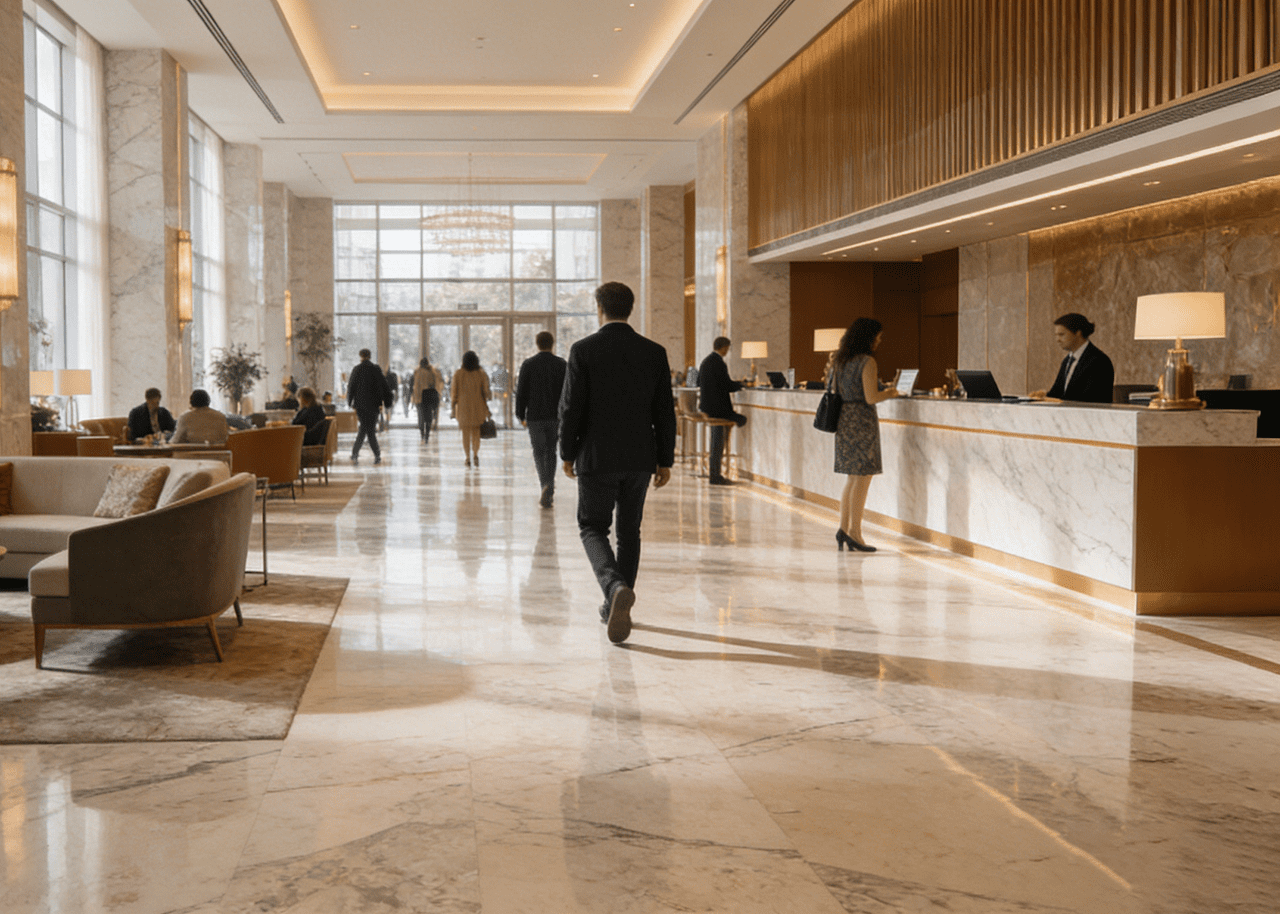
Selecting the right granite cleaning machine or terrazzo floor cleaning machine represents a critical investment decision for facility managers, stone contractors, and cleaning professionals. Unlike generic floor care equipment, natural stone surfaces demand specialized machinery engineered to preserve surface integrity while delivering commercial-grade cleaning performance. Granite’s dense crystalline structure requires different mechanical approaches than terrazzo’s composite matrix, yet many operations need equipment versatile enough to handle both materials efficiently.
Professional stone floor maintenance has evolved significantly beyond traditional mop-and-bucket methods. Modern granite cleaner machines incorporate precision-engineered components—variable speed motors, specialized pad systems, and integrated chemical delivery—that enable facility teams to maintain the aesthetic appeal of high-traffic natural stone installations in hospitality, commercial real estate, and institutional environments. This comprehensive guide examines the technical specifications, machine types, and operational considerations that distinguish professional-grade equipment from consumer alternatives, helping you select solutions that optimize cleaning efficiency while protecting your natural stone investment.
The fundamental distinction between granite and terrazzo cleaning requirements stems from their compositional differences. Granite, an igneous rock formed from cooled magma, presents an extremely hard, dense surface with Mohs hardness ratings typically between 6-7. Terrazzo, a composite material combining marble chips, glass, or other aggregates within a cement or epoxy matrix, offers varied hardness depending on its binder system. These differences mandate specific equipment capabilities: granite responds well to high-pressure crystallization and aggressive polishing, while terrazzo—particularly cement-based varieties—requires gentler oscillating or cylindrical brush systems to avoid damaging the binder material.

Standard cleaning equipment designed for resilient flooring or vinyl tiles operates at speeds and pressures that can irreversibly damage natural stone. Conventional floor scrubbers typically run at 300-450 RPM with aggressive nylon or polypropylene brushes optimized for breaking down organic soils on synthetic surfaces. When applied to polished granite, these specifications create micro-scratches that dull the surface finish. For terrazzo, excessive mechanical pressure can erode the softer cement matrix faster than the harder aggregate chips, creating an uneven surface profile over time.
Professional-grade machines distinguish themselves through stone-specific engineering: variable speed control allowing 150-350 RPM ranges, compatibility with specialized diamond and crystallization pad systems, and weighted construction that provides consistent contact pressure without operator force. Commercial operations serving hotels, office buildings, and public spaces require equipment with higher duty cycles, larger solution and recovery tanks, and serviceability features that consumer-grade machines lack. Learn more about choosing between different machine types in our Floor Scrubber vs Buffer guide.
Single-disc rotary machines represent the most versatile category of granite cleaning machines for restoration and maintenance applications. These units feature a circular pad driver ranging from 13 to 20 inches in diameter, mounted beneath a motor housing with an adjustable handle extending to operator chest height. The critical specification for granite work is rotational speed: machines offering 150-175 RPM settings enable gentle buffing and maintenance polishing with soft pads, while 300-350 RPM capabilities allow for more aggressive restoration work using diamond-embedded pads. Professional models incorporate planetary gear systems that distribute weight evenly across the pad surface, ensuring consistent contact even when operators adjust handle angles during use.
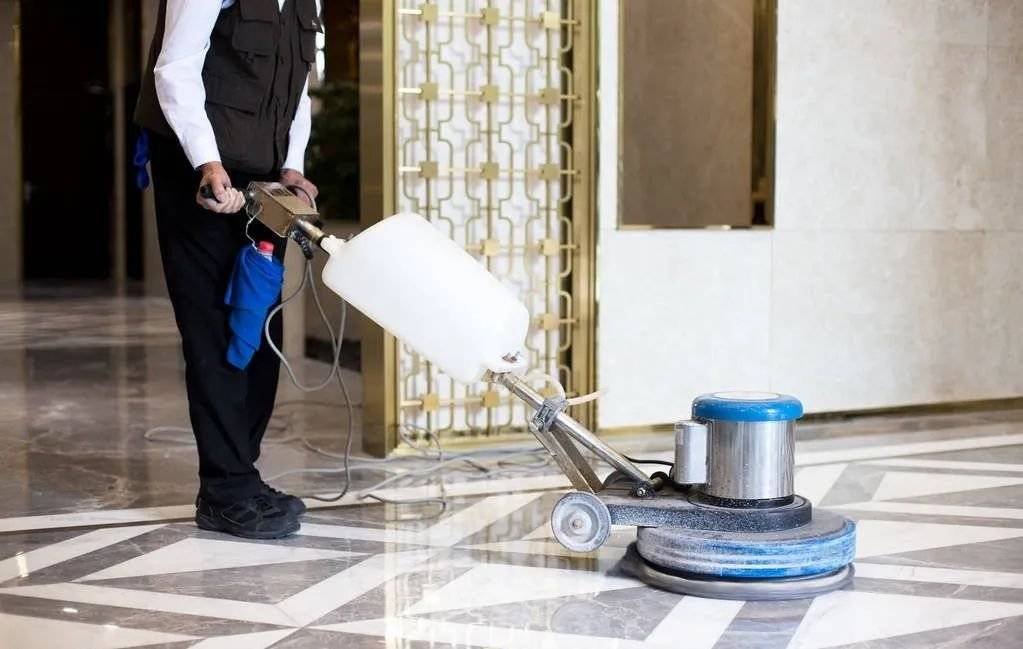
Heavy-duty floor polishers designed specifically for stone applications integrate variable speed controls that allow technicians to match RPM to the specific task and granite finish. A machine equipped with electronic speed adjustment enables seamless transitions between crystallization procedures (requiring 150-175 RPM with specialized chemical compounds), daily maintenance buffing (200-250 RPM with microfiber pads), and restoration grinding (300-350 RPM with diamond abrasive systems). Motor power ranging from 1100W to 1500W provides sufficient torque to maintain consistent pad rotation even under the increased friction generated by granite’s hard surface, preventing motor burnout during extended commercial operations.
Planetary grinding systems represent the premium tier of granite cleaner machine technology for deep restoration and surface preparation. Unlike single-disc machines where one large pad rotates in a single direction, planetary grinders employ three or four smaller satellite heads that rotate individually while also orbiting around a central axis. This dual-rotation mechanism generates superior flatness and eliminates the “swirl marks” that single-disc machines can create during aggressive grinding. For granite restoration projects requiring lippage removal, deep scratch elimination, or preparation for sealing treatments, planetary systems equipped with progressive diamond grit sequences (from 30-grit metal bonds through 3000-grit resin bonds) deliver results previously achievable only through time-intensive hand grinding.
Weight specifications directly impact granite cleaning effectiveness. Professional rotary machines typically weigh between 90-150 pounds, with this mass generating the downward pressure necessary for effective pad contact without requiring operators to manually force the equipment. Some advanced models incorporate modular weight systems allowing technicians to add or remove ballast plates based on the specific application: lighter configurations (90-110 lbs) for daily maintenance on polished surfaces, heavier setups (130-150 lbs) for crystallization procedures where increased pressure enhances chemical reaction with the stone surface.
Cylindrical brush scrubbers excel at cleaning textured and honed terrazzo surfaces where dirt accumulates within the material’s natural porosity and surface undulations. Unlike disc-style pads that glide across surface peaks, cylindrical brushes feature bristles arranged around a horizontal roller that rotates forward into the cleaning path. This configuration enables bristles to penetrate into surface valleys and grout lines, extracting embedded particulates that disc systems leave behind. For cement-based terrazzo installations common in schools, hospitals, and government buildings, cylindrical scrubbers equipped with medium-stiffness nylon bristles (0.5mm diameter) provide thorough soil removal without abrading the cementitious binder material.
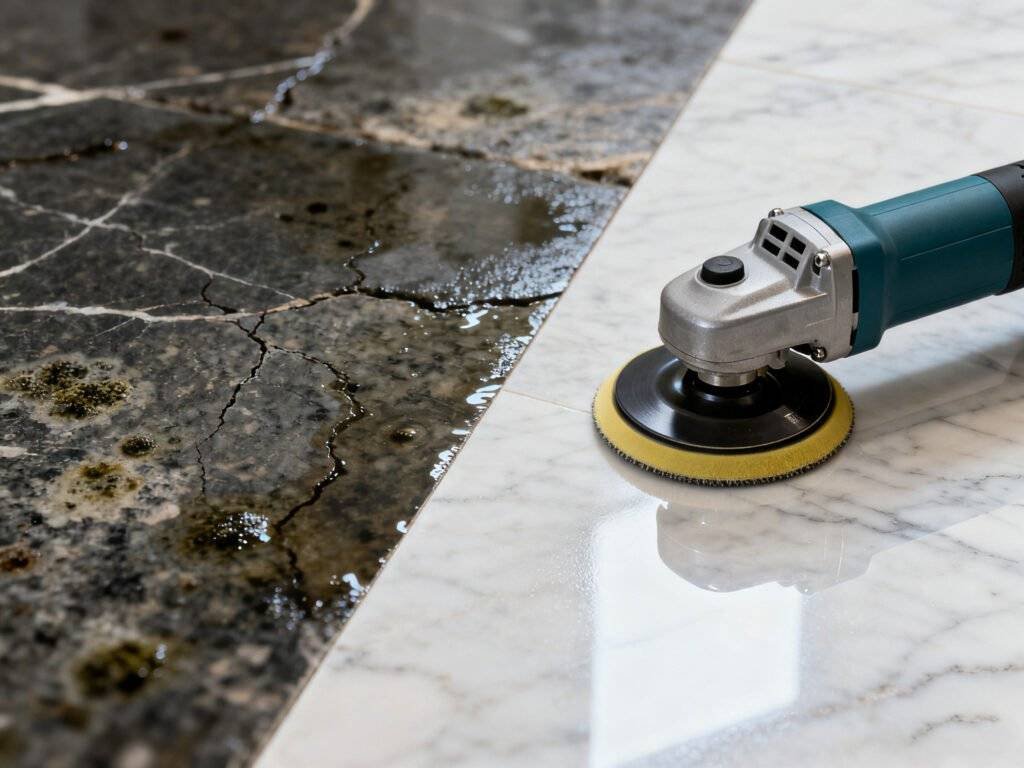
Auto scrubber specifications for terrazzo floor cleaning machines require careful matching of three motor systems to the application scale. The brush motor (typically 500W for walk-behind units) drives the cleaning head rotation—optimal terrazzo maintenance occurs at 180-220 RPM to balance cleaning effectiveness with material preservation. The suction motor (550W standard) powers the vacuum system that recovers dirty solution, preventing water from pooling in terrazzo’s porous surface where it can cause long-term discoloration or efflorescence issues. The traction motor (500W for motorized models) propels the machine forward, reducing operator fatigue during large-area cleaning in commercial environments. Battery-powered models typically employ dual 12V 120Ah batteries providing 2-3 hours of continuous operation—sufficient for facilities up to 15,000 square feet per charge cycle.
Oscillating floor machines offer superior results for delicate cement-based terrazzo that requires gentle mechanical action. Rather than rotating in circles, oscillating machines move cleaning pads in rapid back-and-forth or orbital patterns at frequencies of 1,500-3,000 oscillations per minute. This motion distributes cleaning force across a broader surface area, reducing point pressure that can damage softer terrazzo matrices. The oscillating mechanism proves particularly valuable when working with terrazzo incorporating decorative glass chips or mother-of-pearl inlays, where traditional rotary equipment risks dislodging or scratching these delicate elements. Professional facilities maintaining historic terrazzo installations—common in Art Deco-era hotels and municipal buildings—often specify oscillating equipment to preserve irreplaceable surfaces.
Coverage efficiency metrics guide equipment selection based on facility size and cleaning frequency requirements. Walk-behind terrazzo floor cleaning machines with 17-20 inch cleaning paths typically achieve 100-200 square meters per hour in routine maintenance scenarios, while larger 26-32 inch models reach 250-350 m²/h. Ride-on scrubbers equipped with dual brush systems and 32+ inch cleaning widths can process up to 2,000 m²/h, making them cost-effective for airport terminals, convention centers, and casino floors featuring extensive terrazzo installations. However, intensive restoration procedures like diamond polishing or crystallization require slower speeds of 10-15 m²/h regardless of machine size, as these processes depend on dwell time and chemical reaction rates rather than mechanical coverage speed.
Brush and pad compatibility represents perhaps the most critical specification when evaluating stone cleaning equipment. Diamond finishing pads, available in grit progressions from 50 through 3000, enable complete granite restoration sequences from initial grinding through final polishing. Metal-bond diamonds (50-400 grit) remove significant material during lippage correction and deep scratch elimination, transitioning to resin-bond diamonds (400-3000 grit) for honing and polishing operations. Crystallization pads, typically constructed from natural wool fibers or steel wool embedded in nylon carriers, work in conjunction with acidic powder compounds to chemically transform the outermost granite layer into a glossy crystalline structure. Polishing discs made from microfiber or melamine foam provide maintenance buffing capabilities for daily or weekly touch-ups between intensive restoration procedures.
Motor specifications must align with stone density and intended cleaning intensity. Entry-level machines equipped with 500-750W motors handle routine maintenance adequately for facilities with bi-weekly deep cleaning schedules and daily dust mopping between machine applications. Commercial operations demanding daily machine cleaning—common in hotel lobbies, high-end retail spaces, and corporate headquarters—require 1000-1100W motors that sustain performance through extended duty cycles without overheating. Heavy-duty restoration contractors and stone fabrication shops benefit from 1500W+ machines capable of running aggressive diamond tooling for 4-6 hour periods during complete floor refinishing projects. Motor specifications should include thermal overload protection that prevents burnout when operators inadvertently apply excessive downward pressure or attempt to run inappropriate tooling.
Water recovery systems in scrubber-style machines directly impact cleaning effectiveness and facility safety on natural stone. Solution tank capacities ranging from 15-25 gallons allow 60-90 minutes of continuous operation before requiring refills, while recovery tanks sized 20-30 gallons accommodate the solution plus extracted soil. The vacuum system’s water lift capability (typically 60-90 inches on professional equipment) determines how effectively the machine removes dirty solution from textured or porous stone surfaces. Terrazzo and honed granite surfaces require higher water lift specifications than polished granite due to their greater solution absorption. Squeegee blade condition and adjustment prove equally critical—worn or improperly angled squeegees leave water films that can cause slip hazards and deposit mineral residues as they evaporate.
Battery versus corded power configurations each offer distinct operational advantages. Battery-powered models employing 24V systems with dual 12V deep-cycle batteries provide 2-4 hours runtime depending on brush motor load and operator speed. This cordless operation eliminates trip hazards and enables efficient cleaning of complex floor plans without repeatedly relocating power cords. However, facilities operating continuous cleaning shifts require either multiple battery sets for hot-swapping or access to fast-charging systems (50-80% charge in 60-90 minutes). Corded machines offer unlimited runtime and consistent power delivery throughout cleaning sessions, making them preferred for large open areas in warehouses, manufacturing facilities, and parking structures. The trade-off involves managing 50-75 foot power cords and ensuring access to appropriate electrical outlets (most professional equipment requires 110V 15A circuits).
Walk-behind scrubber-dryers dominate facilities ranging from 5,000 to 50,000 square feet where operator maneuverability and equipment versatility outweigh pure coverage speed. These machines, with cleaning path widths of 17-32 inches, navigate doorways, work around furniture, and access tight spaces that larger equipment cannot reach. For commercial properties with mixed flooring—granite in lobbies, terrazzo in corridors, vinyl in back-of-house areas—a single walk-behind unit equipped with appropriate pad systems handles all surfaces efficiently. Professional models incorporate intuitive controls allowing quick transitions between scrubbing pressure settings, solution flow rates, and brush/pad down-pressure, enabling operators to adjust parameters when moving between granite and terrazzo zones without stopping the machine. Explore our complete range of commercial cleaning machines.
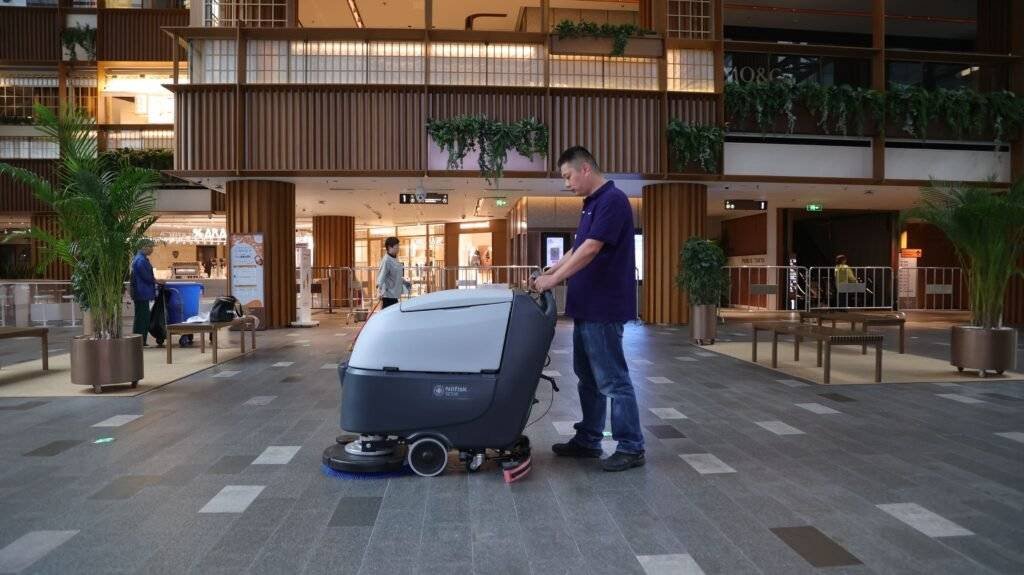
Ride-on machines transform cleaning economics for airports, hotels, and large commercial properties exceeding 50,000 square feet. These units, featuring cleaning widths from 28 to 45 inches and forward speeds of 3-5 mph, enable single operators to clean 2,000-4,000 m²/h compared to 150-350 m²/h with walk-behind equipment. The productivity advantage proves particularly significant in 24/7 hospitality and transportation facilities where cleaning must occur during narrow overnight windows. Ride-on machines equipped with cylindrical brush systems and stone-compatible pad drivers maintain the surface specificity required for granite and terrazzo while delivering scrubber-dryer efficiency. Many facilities serving 100,000+ square feet deploy hybrid fleets: ride-on equipment for main circulation areas and lobbies, walk-behind units for restaurants, meeting rooms, and other compartmentalized spaces.
Compact models designed for restaurant and retail granite installations prioritize tight-space maneuverability over maximum coverage speed. Units with 13-17 inch cleaning paths, foldable handles, and weights under 100 pounds navigate between dining tables, display fixtures, and merchandise aisles without requiring furniture relocation. Battery-powered compact scrubbers prove especially valuable in occupied retail environments where power cord management creates trip hazards and limits operational flexibility. The smaller solution tanks (3-5 gallons) that make these machines portable require more frequent refilling, but this trade-off proves acceptable when cleaning areas under 5,000 square feet. Restaurant operations benefit from compact machines’ ability to perform quick spot-cleaning during service hours, addressing spills and traffic patterns before soiling becomes embedded in granite or terrazzo surfaces.
Operator comfort and productivity factors extend beyond basic machine operation to encompass the entire cleaning workflow. Ergonomic handle designs incorporating vibration dampening reduce operator fatigue during extended shifts—particularly important when maintaining larger facilities requiring 4-6 hours of continuous machine operation. Intuitive control placement allows operators to adjust water flow, brush pressure, and travel speed without releasing the handle or interrupting cleaning patterns. Solution fill and recovery tank access design impacts turnaround time between cleaning cycles: top-loading tanks with large openings enable quick refilling from standard mop sinks, while front-access recovery tanks simplify dumping and rinsing procedures. These seemingly minor design elements compound into significant productivity differences across 20-40 hour weekly cleaning schedules.
Polished granite installations demand equipment and consumables calibrated to maintain mirror-like finishes without introducing swirl marks or hazing. High-hardness green roller pads constructed from melamine foam or specialized microfiber operate at 150-175 RPM to gently buff surfaces while removing light soil accumulation. For restoration of traffic-worn areas, crystallization procedures employ acidic powder compounds (typically oxalic or fluosilicic acid-based formulations) applied to damp granite surfaces, then worked with natural wool or steel wool pads at 150-180 RPM until a creamy consistency develops. The chemical reaction converts a microscopic surface layer of granite into a harder, glossier crystalline structure that enhances both appearance and stain resistance. This process achieves optimal results when machines provide consistent 90-120 pounds of downward pressure across the pad surface—excessive pressure creates heat that prematurely evaporates the working solution, while insufficient pressure prevents adequate chemical contact with the stone.
Honed granite surfaces, featuring matte or satin finishes rather than mirror polish, require different mechanical approaches than their polished counterparts. Medium roughening techniques using 200-400 grit diamond pads at 200-250 RPM restore uniform texture to honed finishes that have become uneven from differential wear patterns. The restoration protocol typically involves initial cleaning with neutral pH detergents delivered through machine solution systems, followed by diamond pad sequences progressing from 200 to 400 grit to re-establish consistent surface texture. Unlike polished granite where higher grit numbers (800-3000) create increasing gloss, honed granite restoration stops at 400-800 grit to preserve the intended matte appearance. Operators must carefully control pad pressure and solution flow—excessive pressure or dry operation causes rapid pad loading with granite particles, reducing cutting efficiency and potentially creating scratch patterns.
Resin-based terrazzo, increasingly common in modern commercial construction, demands gentle cleaning protocols that preserve sealant integrity and prevent delamination of the epoxy binder. Oscillating machines or low-speed (150-200 RPM) rotary equipment with soft nylon brushes (0.3-0.4mm diameter bristles) provide effective cleaning without generating the heat and friction that can soften epoxy matrices. When machine cleaning resin terrazzo, solution temperature must remain below 110°F as elevated temperatures may compromise epoxy properties over repeated exposures. Chemical compatibility becomes critical: avoid alkaline cleaners above pH 10 and acidic formulations below pH 5, as these chemistries can degrade epoxy bonds over time. Discover our stone-safe cleaning chemicals formulated for terrazzo maintenance.
Cement terrazzo installations benefit from deep-penetrating oscillating brushes that access the material’s inherent porosity without causing erosion damage. Cylindrical brush scrubbers equipped with crimped nylon bristles arranged in tufted patterns excel at dislodging embedded particulates from textured cement surfaces. The brush configuration proves critical: too-soft bristles (0.3mm) bend rather than scrub, failing to remove compacted soil, while overly-aggressive bristles (0.8mm+) can abrade the cement matrix faster than the harder aggregate chips, creating an uneven surface over time. Optimal cement terrazzo maintenance employs 0.5mm bristles rotating at 180-220 RPM with neutral pH cleaning solutions (pH 7-9) delivered at 0.5-1.0 ounces per minute through the machine’s solution system. After mechanical cleaning, thorough solution recovery prevents water infiltration into cement’s porous structure where it can transport dissolved minerals back to the surface as unsightly efflorescence deposits during drying.
Hospitality sector operations require quiet operation models that enable cleaning during occupied hours without disrupting guest experiences. Machines certified under 70dB operate quietly enough for use in hotel corridors, restaurant dining rooms, and casino gaming floors while guests remain present. Battery-powered equipment eliminates the loud motor whine characteristic of corded models, with brushless motor technology further reducing operational noise. Facilities maintaining granite and terrazzo in luxury hotel environments often specify premium machines incorporating sound-dampening motor housings, vibration-isolated brush decks, and soft rubber wheels that minimize rolling noise across hard surfaces. The acoustic investment pays dividends in operational flexibility—housekeeping teams can perform maintenance cleaning during profitable business hours rather than being restricted to narrow overnight windows when noise proves acceptable but labor costs increase due to shift differentials.
Commercial real estate properties managing high-capacity office buildings prioritize equipment capable of handling lobby and common areas ranging from 10,000 to 100,000+ square feet. These facilities benefit from larger walk-behind or compact ride-on machines featuring 26-32 inch cleaning paths, 20-30 gallon solution capacities, and productivity ratings of 300-500 m²/h. During tenant improvement projects or periodic deep cleaning, commercial property teams often employ specialized restoration equipment including planetary grinders and high-speed burnishers that restore granite and terrazzo to like-new condition before property showings or lease renewals. The ability to demonstrate well-maintained stone flooring directly impacts property values and tenant retention—Class A office buildings with pristine lobby granite command premium rental rates justified partly by visible commitment to facility quality.
Stone fabrication shops require wet/dry capabilities that enable safe operation in workshop environments where water containment proves challenging. Portable single-disc machines with integrated dust shrouds and vacuum ports connect to industrial dust collection systems, enabling dry grinding and polishing operations that contain silica dust at the source. For wet processing, shops employ machines with sealed electrical components (IPX4 or higher ratings) capable of operating in constant water spray conditions during diamond grinding and polishing sequences. The workshop environment demands exceptionally robust construction—impact-resistant motor housings, corrosion-resistant fasteners, and easily serviceable components that shop technicians can maintain without relying on external service providers. Many fabrication shops maintain dedicated machine fleets: lighter 13-17 inch rotary units for countertop and vanity work, heavier 20+ inch machines for large-format floor slab processing.
Contract cleaning services managing diverse client portfolios need lightweight portable units under 50 pounds that crew members can load and unload from service vehicles multiple times daily. Compact battery-powered machines with folding handles fit standard cargo vans alongside other cleaning equipment, chemical supplies, and consumables. The portability requirement often conflicts with cleaning performance capabilities—lighter machines necessarily sacrifice motor power, solution capacity, and structural durability compared to facility-dedicated equipment. Professional contractors balance these trade-offs by deploying equipment tiers: compact portable units for routine maintenance contracts at smaller restaurants and retail spaces, mid-sized walk-behind equipment for regular commercial office clients, and heavy-duty machinery reserved for restoration projects and large-venue contracts where productivity justifies transportation logistics.
Neutral cleaner delivery through machine solution tanks enables consistent chemical application while reducing labor compared to manual spray-and-mop methods. Professional granite cleaning machines equipped with solution flow control systems dispense diluted cleaning concentrates at 0.5-1.5 ounces per minute, automatically adjusting delivery rates based on machine travel speed and brush down-pressure. This automated dosing ensures optimal chemical contact with the stone surface while preventing waste from over-application. Granite responds well to pH-neutral formulations (pH 7-8.5) that emulsify oils and suspend particulate soils without interacting chemically with the stone’s mineral structure. Terrazzo similarly benefits from neutral cleaners, though cement-based varieties tolerate mildly alkaline solutions (pH 9-10) that enhance grease-cutting performance in commercial kitchen environments.
Crystallization compound application using single-disc equipment represents one of the most effective methods for restoring luster to dull or traffic-worn granite. The procedure involves spraying acidic powder compounds—typically containing oxalic acid, fluosilicic acid, or phosphoric acid formulations—onto damp granite surfaces at coverage rates of 50-100 grams per square meter. Operators then work the compound using natural wool crystallization pads mounted to 175 RPM rotary machines, maintaining consistent circular overlapping patterns until the material develops a creamy consistency. The mechanical action combined with acidic chemistry converts a microscopic layer of granite’s calcium-containing minerals into harder calcium fluoride or calcium oxalate crystals that exhibit enhanced gloss and density. Proper technique requires 3-5 minutes per square meter of intensive pad work, generating characteristic squeaking sounds as friction increases during the crystallization reaction. After treatment, thorough water rinsing removes residual compounds and reaction byproducts, revealing a noticeably enhanced surface finish.
Water-based sealer compatibility with scrubber-dryer systems enables efficient application across large terrazzo installations in single coordinated procedures. After initial cleaning and complete drying (typically 12-24 hours), facilities can deploy scrubber-dryers with solution tanks filled with diluted penetrating sealers rather than cleaning chemicals. The machine’s controlled solution delivery system applies sealer uniformly at manufacturer-specified coverage rates (typically 150-300 square feet per gallon), while the pad or brush system works the product into terrazzo’s porous structure. This mechanized application proves particularly valuable for large commercial installations where manual spray-and-wipe methods would require multiple technicians and extended facility closures. However, machines used for sealer application require thorough flushing with clean water immediately after completion—dried sealer residues in pumps, hoses, and solution tanks can clog delivery systems and necessitate expensive component replacement.
Chemical resistance requirements for alkali-resistant machines prove essential when maintaining terrazzo in environments exposed to harsh cleaning agents or industrial chemicals. View our alkali-resistant cleaning equipment specifications. Food processing facilities, commercial kitchens, and manufacturing operations often employ strong alkaline degreasers (pH 11-13) to remove stubborn grease and protein soils. Standard machine components including solution pumps, gaskets, hoses, and brush blocks can deteriorate rapidly when exposed to these aggressive chemistries. Alkali-resistant machines incorporate specialized materials: Viton or EPDM gaskets rather than standard rubber, stainless steel or chemical-resistant plastic solution systems instead of mild steel, and reinforced brush blocks that resist chemical swelling. These upgrades add 15-30% to equipment costs but prove economical in operations requiring frequent aggressive cleaning, where standard machines might require component replacement every 6-12 months versus multi-year service life for chemical-resistant alternatives.
Daily maintenance protocols significantly impact machine longevity and cleaning performance reliability. Pad inspection should occur at the start of each shift, checking for loading with soil or stone particles that reduces cleaning effectiveness. Saturated or heavily soiled pads require replacement—continuing to operate with degraded pads not only compromises cleaning quality but also increases motor strain as the equipment works harder to achieve results. Brush cleaning involves removing the brush cartridge and rinsing under running water to dislodge accumulated debris, then inspecting bristle wear patterns. Uneven wear indicates improper machine operation (excessive downward pressure or worn suspension components), while bristles worn shorter than 50% of original length should trigger replacement to maintain effective cleaning action. Solution and recovery tanks require daily emptying and rinsing even when cleaning appears finished—residual dirty water becomes a bacterial growth medium that can produce objectionable odors and potentially contaminate subsequent cleaning operations.
Squeegee adjustment for optimal water recovery on stone surfaces represents one of the most critical yet frequently neglected maintenance tasks. The squeegee assembly, consisting of front and rear rubber or polyurethane blades mounted in an adjustable frame, must maintain consistent contact pressure across its entire width to effectively remove dirty solution. On textured terrazzo or honed granite, slightly increased squeegee pressure (achieved by tightening the angle adjustment) improves water pickup from surface valleys and pores. Conversely, polished granite’s smooth surface requires minimal squeegee pressure to avoid chattering that leaves water streaks. Blade edges wear through use, developing rounded profiles rather than sharp edges—this wear compromises water recovery performance and necessitates blade rotation (most squeegees feature four usable edges through 180° rotations) or replacement. Professional operations serving 50,000+ square feet should budget for monthly squeegee blade rotation and quarterly complete blade replacement to maintain consistent drying performance. Source replacement brushes and squeegees for your equipment.
Battery care extends equipment lifespan in facilities operating 24/7 cleaning schedules across hospitality and healthcare environments. Deep-cycle batteries powering commercial scrubbers require different charging protocols than automotive batteries: complete discharge followed by full recharge cycles actually improve deep-cycle battery longevity, unlike automotive batteries where partial cycling proves less stressful. However, facilities should avoid complete voltage depletion—most professional machines incorporate low-voltage cutoffs that stop operations when batteries reach 20-30% capacity, preventing the harmful deep discharge that permanently reduces capacity. Battery maintenance includes monthly water level checks for flooded lead-acid types (adding distilled water to maintain proper electrolyte levels), quarterly terminal cleaning to remove corrosion that increases electrical resistance, and annual load testing to identify cells developing capacity loss before they fail completely during critical cleaning operations. Facilities can expect 3-5 year battery service life under proper maintenance protocols, compared to 18-24 months when neglecting routine care.
Replacement brush selection between rotary and disc configurations impacts both cleaning effectiveness and consumable costs. Rotary brushes, featuring bristles arranged radially around a central hub, excel at aggressive scrubbing applications on textured surfaces where bristle penetration into surface irregularities proves critical. These brushes typically cost $40-80 each and last 20,000-40,000 square meters of cleaning depending on bristle stiffness and surface abrasiveness. Disc pads, ranging from soft microfiber through aggressive diamond-embedded varieties, mount to hook-and-loop (Velcro) pad drivers and provide versatility across multiple stone types and cleaning intensities. Pad costs vary dramatically—basic scrubbing pads cost $5-15 each with service life around 5,000 square meters, while specialized diamond pads range $30-100 with similar or longer service expectations. Professional operations benefit from maintaining organized pad inventory systems with color-coded pads designated for specific applications: white/red for light cleaning, green/blue for scrubbing, black for stripping or aggressive work, and specialty pads (crystallization, diamond) stored separately to prevent accidental misuse that could damage stone surfaces or waste expensive consumables.
Labor efficiency comparisons between automated cleaning and manual mop-and-bucket methods reveal compelling economics favoring mechanical equipment in commercial operations. A skilled technician employing traditional mopping techniques typically cleans 500-800 square feet per hour on hard surfaces, including time for solution preparation, mopping, and bucket changes. In contrast, a walk-behind scrubber enables that same technician to clean 1,500-3,500 square feet per hour (depending on machine size and facility layout) while simultaneously drying the floor—eliminating the safety hazard period when mopped floors remain wet and reducing slip-and-fall liability exposure. For a 20,000 square foot commercial facility, the labor time difference translates to approximately 25-40 hours monthly when cleaning occurs twice weekly. At typical commercial cleaning labor rates of $18-25 per hour including benefits, the monthly labor savings of $450-1,000 justify equipment lease payments or depreciation costs for machines priced $3,000-8,000.
Area performance metrics provide concrete productivity baselines for equipment ROI analysis. Crystallization restoration procedures, while labor-intensive at 10-15 m²/h (approximately 100-160 sq ft/h), create dramatic visual improvements that enable facilities to extend time between complete floor refinishing. A 5,000 square foot granite lobby requiring crystallization twice annually consumes approximately 60-80 labor hours plus $200-300 in consumables (pads and compounds), compared to complete refinishing requiring 120-150 hours and $2,000-3,000 in diamond tooling, sealing, and materials. Routine maintenance scrubbing at 100-350 m²/h productivity rates maintains appearance between crystallization intervals, establishing a tiered maintenance program: daily or bi-weekly scrubbing (low cost per cycle), quarterly crystallization (moderate cost), and 3-5 year complete restoration (high cost but infrequent). This strategic approach optimizes total maintenance expenditure while preserving stone appearance.
Equipment ROI for stone installation contractors and facility managers involves calculating total cleaning cost per square foot annually, then comparing scenarios with and without mechanical equipment. Consider a hotel with 50,000 square feet of combined granite and terrazzo requiring daily maintenance: manual cleaning consumes approximately 80-125 labor hours weekly at prevailing rates totaling $75,000-160,000 annually in labor alone. Implementing a mechanical cleaning program using walk-behind and compact scrubbers reduces labor to 35-50 hours weekly (annual savings $40,000-100,000), while equipment costs including purchase/lease, consumables, and maintenance total $15,000-25,000 annually. The net annual savings of $25,000-75,000 provides 6-18 month ROI on equipment investment, with continuing annual savings throughout the machinery’s 5-7 year service life. Contractors serving multiple clients benefit from even faster ROI as equipment investment amortizes across broader billable hours.
Total cost of ownership analysis must account for machine purchase price, consumable expenses, routine maintenance, and eventual replacement costs over expected equipment lifespan. A quality commercial granite cleaning machine priced $5,000-7,000 requires annual consumables (pads, brushes, chemicals) costing $800-1,500 depending on usage intensity. Routine maintenance including annual service, battery replacement (years 3-4), and component repairs typically adds $300-600 annually. Over a 6-year service life, total ownership cost reaches $11,000-16,000, equating to $1,800-2,700 per year or $150-225 monthly—modest compared to the productivity gains and labor savings the equipment enables. Facilities managing 100,000+ square feet often find that equipment purchases pay for themselves within 12-18 months through labor reduction alone, with all subsequent savings flowing directly to operational efficiency improvements or margin enhancement.
Selecting appropriate granite cleaning machines and terrazzo floor cleaning equipment requires careful evaluation of surface types, facility scale, operational constraints, and long-term maintenance objectives. Professional-grade equipment distinguishes itself through stone-specific engineering: variable speed controls spanning 150-350 RPM ranges, compatibility with specialized pad and brush systems, robust construction supporting extended commercial duty cycles, and integration capabilities with chemical treatment programs. The investment in proper machinery pays dividends through enhanced labor productivity (3-5x improvements compared to manual methods), superior cleaning outcomes that preserve stone aesthetics and extend surface lifespan, and reduced liability exposure from faster drying times.
Facility managers overseeing hospitality properties, commercial real estate portfolios, and institutional environments should approach equipment selection as a strategic facilities investment rather than a commodity procurement decision. The differentiation between adequate and optimal equipment selection manifests over months and years—properly specified machines maintain stone appearance through routine maintenance while avoiding the accelerated wear and premature restoration requirements that result from inappropriate equipment use. Whether deploying compact portable units for small-scale applications or ride-on systems for extensive commercial installations, aligning machine specifications with operational requirements delivers measurable returns through reduced labor costs, extended surface service life, and maintained property values.
For professional guidance on equipment selection and access to stone-safe chemical systems engineered to work synergistically with mechanical cleaning programs, contact King Home Chemicals’ technical team. Request a consultation on optimizing your stone maintenance program. Our global expertise serving hospitality, commercial real estate, and stone installation industries enables us to recommend complete solutions—equipment, chemicals, and protocols—tailored to your specific facility requirements and operational objectives.
Single-disc rotary machines operating at 150-175 RPM provide optimal maintenance for polished granite installations. Look for equipment featuring 1100W minimum motor power, compatibility with green high-hardness polishing pads and natural wool crystallization pads, and weight specifications of 90-120 pounds to ensure adequate contact pressure. For commercial applications in hotels, office buildings, and retail spaces, select machines with variable speed controls allowing transitions between daily buffing operations and periodic crystallization procedures without requiring separate equipment purchases.
Yes, professional-grade equipment can effectively maintain both granite and terrazzo surfaces when operators employ appropriate pad and brush systems for each material. For granite maintenance, use high-hardness polishing pads, diamond finishing systems, and crystallization consumables operating at 150-300 RPM depending on the specific procedure. When transitioning to terrazzo, switch to soft nylon cylindrical brushes or oscillating pad systems operating at the lower end of the speed range (150-200 RPM), particularly for delicate cement-based terrazzo. Ensure the machine offers alkali-resistant construction if terrazzo cleaning involves pH 10+ solutions common in commercial kitchens and food service environments. Compare equipment options suitable for multi-surface applications.
Standard floor scrubbers designed for resilient flooring typically operate at 300-450 RPM with aggressive brush systems optimized for synthetic surfaces—specifications that can damage natural stone through micro-scratching and accelerated wear. Granite cleaning machines feature stone-specific engineering including variable speed controls down to 150 RPM, compatibility with specialized diamond and crystallization pad systems, and weighted construction providing consistent contact pressure without excessive mechanical force. While both equipment types perform cleaning functions, granite cleaner machines preserve stone integrity through gentler mechanical action combined with chemical enhancement procedures like crystallization. Learn detailed differences in our scrubber vs buffer comparison guide.
Coverage efficiency varies significantly based on machine type and cleaning intensity. Walk-behind scrubber-dryers with 17-20 inch cleaning paths achieve 100-200 m²/h (approximately 1,000-2,000 sq ft/h) during routine maintenance, while larger 26-32 inch models reach 250-350 m²/h. Ride-on scrubbers equipped with dual brush systems process up to 2,000 m²/h, making them economical for airports, convention centers, and large hospitality installations. However, intensive restoration procedures including diamond polishing or crystallization treatments require substantially slower speeds of 10-15 m²/h regardless of machine size, as these processes depend on chemical dwell time and mechanical working action rather than coverage speed.
Motor power requirements scale with cleaning intensity and operational demands. Minimum 500W brush motors handle light maintenance in facilities with bi-weekly machine cleaning supplemented by daily dust mopping. Commercial operations demanding daily cleaning—typical in hotel lobbies, office building entrances, and high-end retail spaces—require 1000-1100W motors providing sustained performance through extended duty cycles without thermal overload. Heavy-duty restoration contractors and stone fabrication shops benefit from 1500W+ machines capable of running aggressive diamond grinding tooling for 4-6 hour sessions during complete floor refinishing projects. For scrubber-dryer configurations, also verify adequate suction motor power (550W minimum) and traction motor specifications (500W for motorized walk-behind models) to ensure balanced system performance.

