BIENVENIDO A KINGHOME
Obtenga un presupuesto gratuito
Le responderemos en un plazo de 8 horas

BIENVENIDO A KINGHOME
Le responderemos en un plazo de 8 horas
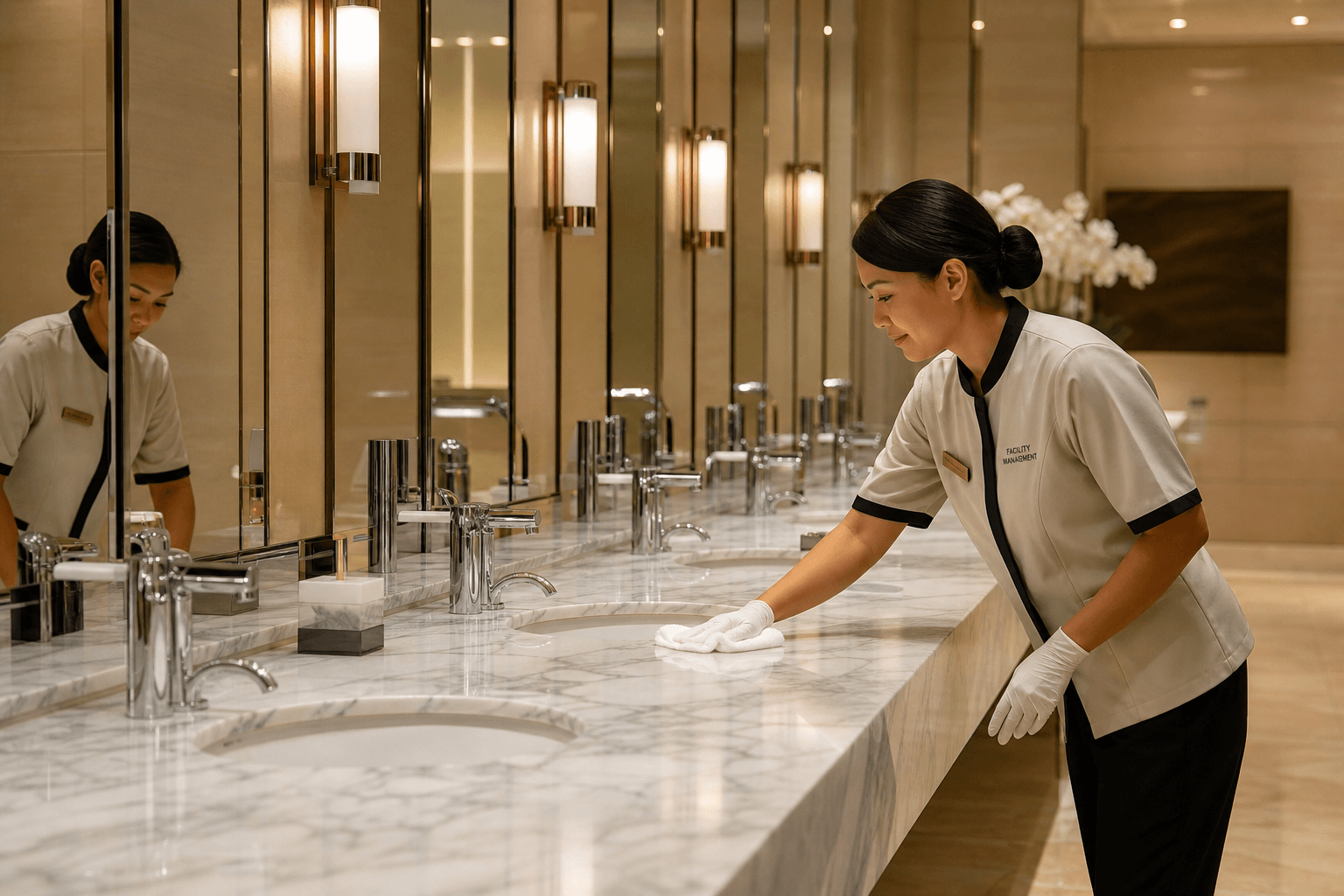
Highway service area restrooms are not difficult to clean. They’re difficult to keep clean — and those are entirely different problems.
A premium mall restroom has 5,000 visitors on a busy day. A major expressway service area processes that in a morning rush window. Staff fatigue, back-to-back coach arrivals, 24-hour operation, and a visitor demographic that includes heavy vehicle drivers and families with young children all at once — this is the operating environment. The cleaning programme has to be built for it specifically, not adapted from a standard commercial building SOP.
This article documents a complete, deployable SOP for highway service area restroom cleaning: the equipment deployment sequence, chemical selection for each zone and time window, and the daily schedule that actually maintains hygiene quality across 16–24 operating hours.
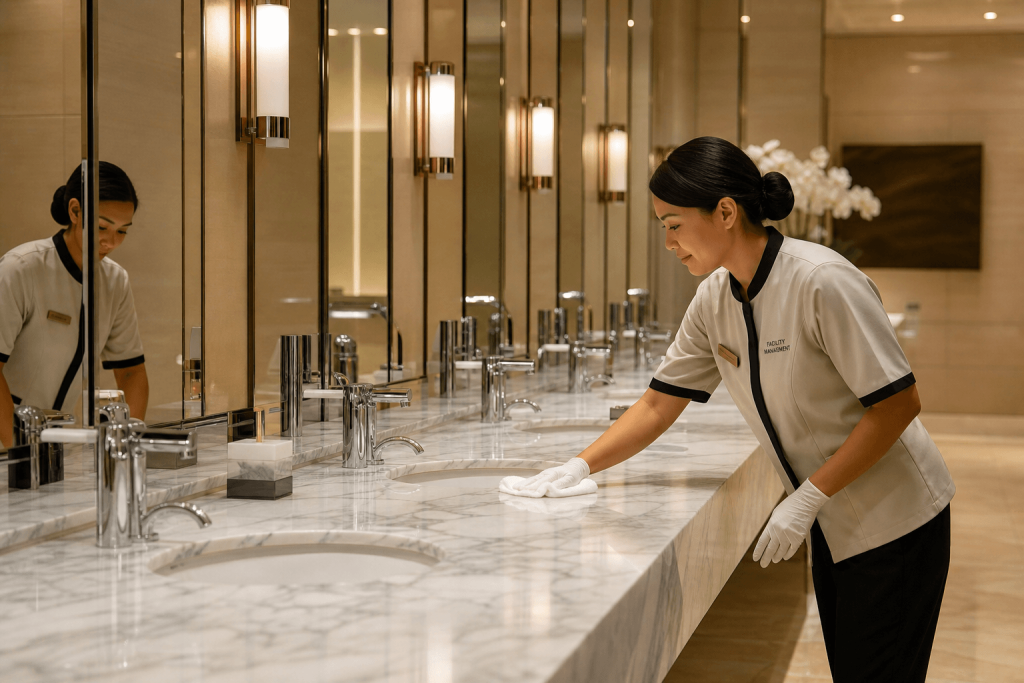
Three structural differences between service area restrooms and standard commercial restrooms break conventional SOPs:
No closure window. A mall restroom can be closed for 15 minutes for a deep-clean pass. A service area restroom cannot — coaches stop for 20 minutes and 40 passengers need access during that window. Cleaning has to happen around continuous occupancy.
Uric acid accumulates faster than any cleaning frequency can eliminate it at the surface level. At 10,000+ daily restroom users, grout lines in the urinal zone and male cubicles are under sustained uric acid loading. Without enzymatic chemistry addressing the embedded contamination — not just disinfectant on the surface — odour returns within minutes of cleaning regardless of how often you clean.
The floor must be dry before the next visitor group arrives, every time. A wet floor warning cone is not a solution in a restroom used by elderly passengers and parents with toddlers at 2:00 AM. The Kärcher AB 28 floor dryer is a functional safety requirement here, not an optional efficiency tool.
Before writing the schedule, map the facility:
| Zone | Area | Primary Contamination | Risk Level |
|---|---|---|---|
| Entry / exit threshold | 15–25 m² | Tracked grime, water | Slip hazard |
| Wash basin row | 20–40 m² | Soap, water, cosmetics | Apariencia |
| Female cubicles | 30–60 m² | Urine, biological | Hygiene |
| Male cubicles | 20–40 m² | Urine, biological | Hygiene + Odour |
| Urinal zone | 15–30 m² | Urine (concentrated), biofilm | Odour critical |
| Exit / hand-dry area | 10–20 m² | Water, soap overflow | Slip hazard |
Two stations (north and south), male and female per station: four restroom units operating simultaneously. Cleaning resource allocation must cover all four.
All floor surface cleaning in a service area restroom runs on two products from the EcoClean range:
EcoClean Neutral Cleaner — daily maintenance on stone-finish tile floors, entry threshold, wash basin area
EcoClean Floor Deep Cleaner — disinfection passes on cubicle and urinal zone floors
Plus three supporting products that address specific contamination types no general cleaner handles:
Enzyme odour eliminator — pre-treatment on all cubicle and urinal zone floors; the only chemistry that breaks down uric acid crystals in grout
Limpiador de eflorescencias e incrustaciones — weekly treatment on urinal bowl interiors, drain surrounds, and tap bases for mineral scale removal
Enzyme odour gel blocks — passive continuous treatment in urinal trap housings; replace monthly
If the restroom has stone-finish or polished tile floors and those floors have been crystallized with Escudo de cristal, the daily cleaning chemical must be pH-neutral. Crystal Shield’s protective layer — which is what gives the floor its gloss and stain resistance — is stripped by alkaline cleaners above pH 8.5 on repeated contact. EcoClean Neutral Cleaner is the correct daily maintenance companion for a Crystal Shield-protected floor.
This sets the baseline for the entire day. It must be thorough.
07:00–07:10 — Enzyme pre-treatment
Spray enzyme odour eliminator at 1:10 concentration onto all cubicle floors and urinal zone floors. Leave to dwell while completing mirror and fixture tasks. The 10-minute dwell time is non-negotiable — anything shorter doesn’t give the enzyme sufficient contact time with the uric acid substrate.
07:05–07:15 — Mirrors and vanity
Kärcher WV 5 + streak-free glass cleaner on all mirrors. Wipe vanity counter with EcoClean Neutral Cleaner at 1:50 on microfibre cloth.
07:10–07:20 — Fixture pre-treatment
Limpiador de eflorescencias e incrustaciones applied inside urinal bowls. 5-minute dwell. (Runs concurrently with enzyme floor dwell.)
07:20–07:35 — Full floor scrub
07:35–07:45 — Dry and reset
AB 28 floor dryer over all wet zones, starting at entry. Restock toilet paper, soap, paper towels. Restroom open by 07:45.
At 09:00, 11:00, 13:00, 15:00, 17:00. Each cycle runs 15–20 minutes.
During peak windows (08:30–10:00, 11:30–13:30, 15:30–17:30 at most major service areas), compress to 60-minute cycles. Priority order when time is constrained: AB 28 dry pass first (slip prevention), enzyme spray second (odour control), mirror wipe third (appearance).
The night shift deep clean resets the facility properly. Two hours, two staff, full equipment deployment.
21:00–21:15 — Pre-treatment
21:15–21:45 — Fixture and partition deep clean
21:45–22:15 — Full floor scrub
22:15–22:45 — Rinse, dry, restock
| Producto | Daily Consumption | Pack Format | Approx. Reorder Cycle |
|---|---|---|---|
| EcoClean Neutral Cleaner | ~50mL concentrate | 5L or 20L | Every 12–15 weeks (5L) |
| EcoClean Floor Deep Cleaner | ~100mL concentrate | 5L or 20L | Every 6–8 weeks (5L) |
| Enzyme odour eliminator | ~80mL concentrate | 5L | Every 8–10 weeks |
| Limpiador de eflorescencias e incrustaciones | ~20mL | 1L or 5L | Monthly (1L) |
| Enzyme gel blocks | - | Monthly pack | Mensualmente |
Four restroom units per service area (north + south, male + female): multiply all figures by 4. Annual chemical spend across the four-unit complex: contact KingHome Chemicals for volume pricing on drum formats — 20L drums for EcoClean products substantially reduce per-litre cost versus 5L bottles at this consumption volume.
Three measurable indicators that tell you whether the programme is actually working:
Odour threshold check: Facility manager walks to the entry threshold of each restroom 3× daily (mid-morning, post-lunch peak, early evening). Standard: no detectable odour at threshold. Any positive hit triggers an immediate unscheduled maintenance pass.
Floor dry time: Post-cleaning floor should be guest-ready within 5 minutes of the AB 28 pass. If it’s taking longer, the squeegee recovery performance on the BD 50/50C or BR 30/4 C needs checking — worn squeegee blade leaves residual water that the AB 28 can’t fully compensate for.
Guest complaints: Zero hygiene-related complaints per month is the target. Track through the facility management system or feedback QR code at restroom exit. Any complaint triggers a protocol audit within 24 hours — not a reminder to clean more often, but an examination of which step in the protocol is failing.
The restroom passes inspection every 2 hours but guests complain of smell 45 minutes after cleaning. What’s failing?
Almost certainly the enzyme step is being skipped or the dwell time is being cut short. Ask your supervisor to observe one full cleaning cycle and verify: (1) enzyme solution is actually being applied to cubicle and urinal zone floors, not just sprayed briefly and wiped off, (2) 5-minute minimum dwell is being observed before the BR 30/4 C pass, (3) concentration is 1:10 for daytime passes and 1:5 for the night deep clean. If any of these are being skipped, the uric acid load in the grout is not being addressed — surface cleaning on top of it is masking the symptom, not treating the cause.
We can’t do a 45-minute opening protocol with current staffing. What’s the minimum viable version?
Compress to 30 minutes by running pre-treatments concurrently (enzyme on floors and scale cleaner on fixtures applied at the same time, both dwelling while mirrors and vanity are cleaned), and prioritise the BD 50/50C + AB 28 pass on the entry zone first so the restroom can open while the cubicle and urinal deep clean continues. The 5-minute enzyme dwell cannot be cut — everything else in the sequence can be compressed or parallelised.
The floor looks clean after the BD 50/50C pass but feels slightly sticky. What causes this?
Over-concentration of the cleaning chemical, or using a product with polymer or wax additives at scrubber-dryer concentration. Check your dilution: if you’re adding concentrate to the solution tank by eye rather than measuring, you’re likely using 2–3× the correct amount. EcoClean products are formulated residue-free at correct dilution — at 2–3× overdose, any formula will leave a surface film. Use a measuring cup and log dilution ratios on the equipment control sheet.
 Spanish
  English