WELCOME TO KINGHOME
Get A Free Quote
We will get back to you within 8 hours

WELCOME TO KINGHOME
We will get back to you within 8 hours
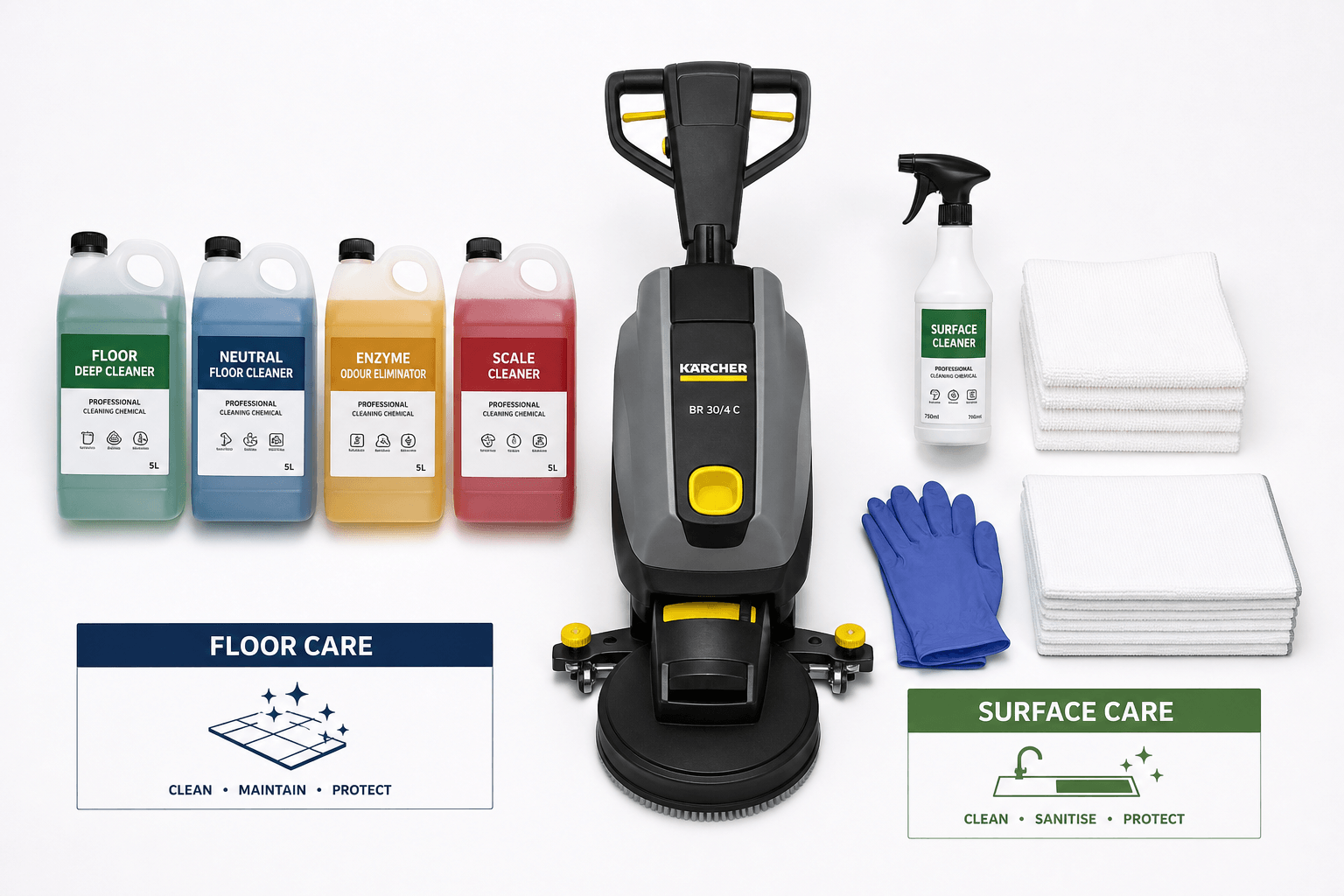
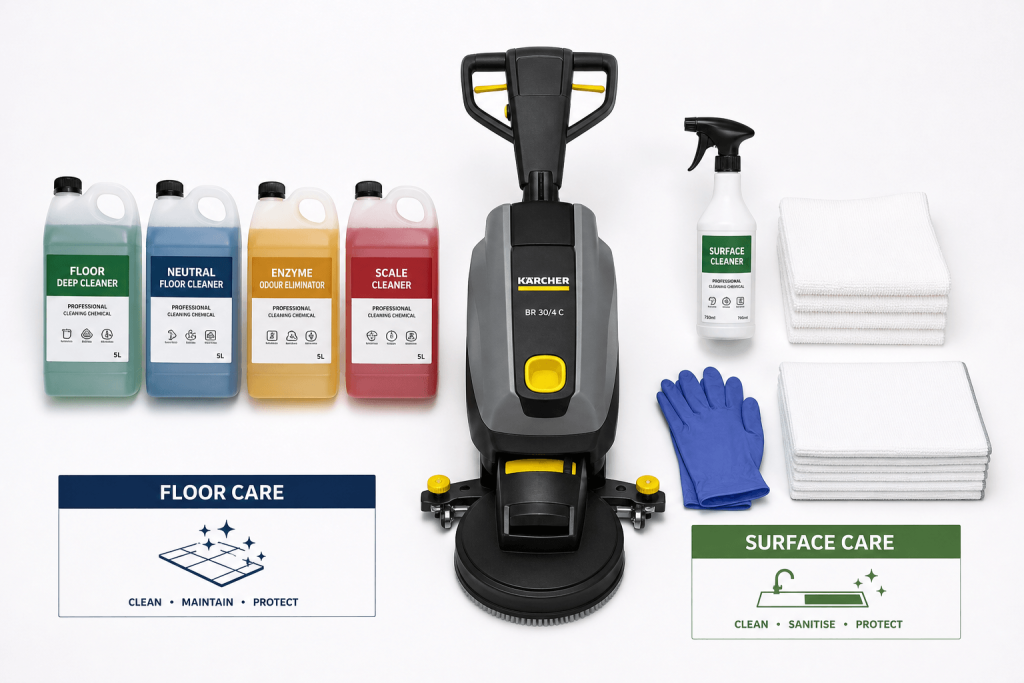
The Kärcher BR 30/4 C is a compact battery-powered scrubber designed for exactly the zones that large floor machines can’t get into: restroom cubicles, urinal surrounds, vanity counter bases, and narrow corridor sections. It’s the machine that does the detail work — but it only works properly when paired with the right chemistry for each surface it touches.
Restrooms concentrate more surface types, more soil types, and more conflicting chemical requirements into a small space than almost anywhere else in a commercial building. This guide breaks it down by zone.
Most restroom cleaning programmes fail not because of inadequate effort but because of chemical incompatibility. Three specific problems show up repeatedly:
Wrong pH on the wrong surface. Marble vanity counters and polished tile need neutral pH (6–8). Acid bowl cleaner needs to stay inside the fixture, not spread to the floor. Alkaline degreasers appropriate for concrete have no business near a crystallized stone floor. In a small restroom, these zones are centimetres apart.
Odour that survives disinfection. Quaternary ammonium disinfectants kill surface bacteria effectively. They do not break down uric acid crystals embedded in grout lines — the actual source of the ammonia smell in male restrooms that returns within hours of cleaning. Only enzymatic chemistry addresses this at the root.
Acid-disinfectant sequencing mistakes. Applying acid bowl cleaner and then immediately following with a QAC disinfectant on the same surface neutralises the disinfectant and can generate chloramine compounds if the bowl cleaner contains chlorine. Sequence matters and staff need to understand why.
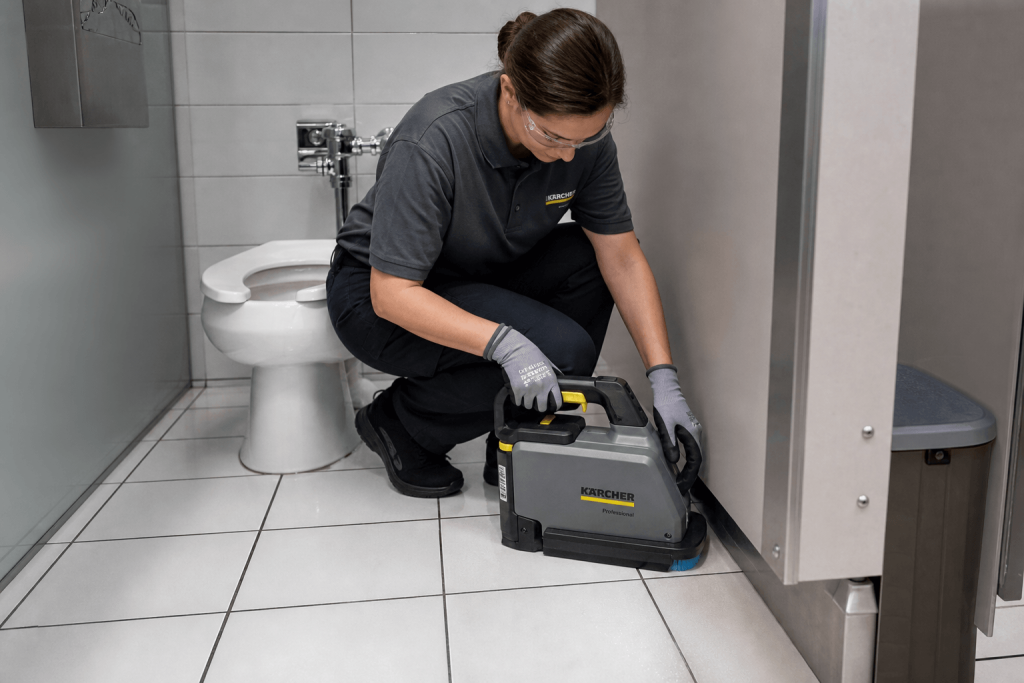
Surface type: Ceramic or vitrified tile, 300×600 mm or larger format
Soil load: Urine splash, foot traffic grime, water from sinks, soap overflow
For daily maintenance passes:
EcoClean Neutral Cleaner at 1:80 in the BR 30/4 C tank handles routine floor tile cleaning without pH risk to any surface type in the restroom. It’s the safe default for any pass where you’re not targeting specific contamination.
For disinfection passes (every 2–4 hours in high-traffic facilities):
EcoClean Floor Deep Cleaner at 1:60. This is where the cleaning programme moves beyond removing visible dirt into actually reducing microbial load on the floor surface. Allow 2 minutes contact time before the BR 30/4 C recovery pass — the machine’s rotating brush drives the solution into grout lines and the floor-wall junction where contamination concentrates.
For persistent urine odour on grout (the problem no standard cleaner solves):
Pre-treat the floor with an enzyme-based odour eliminator before running the BR 30/4 C. Apply the enzyme solution at 1:10 concentration directly onto the floor, allow 5 minutes dwell, then run the scrub pass. The enzymatic action breaks down uric acid crystals in grout pores — the substrate that feeds the ammonia odour cycle. Without this step, disinfection kills the bacteria on the surface but leaves the food source intact for the next colony to establish.
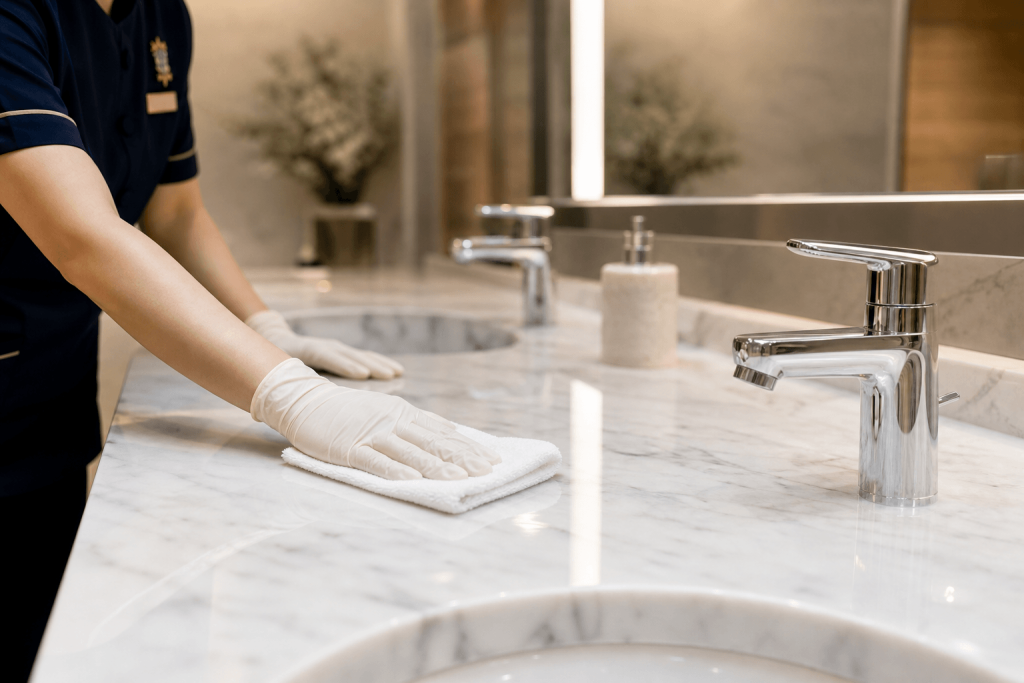
Surface type: Polished marble, engineered stone, or granite composite
Soil load: Soap scum, cosmetics, water hardness scale, hand cream residue
This is the zone that gets damaged most often by restroom cleaning staff using the wrong product. A stone vanity counter in a premium mall or hotel restroom is either crystallized with a product like Crystal Shield Blue Shield or polished with KR Marble Kristallux — in either case, alkaline cleaners and acids will degrade that surface layer on contact.
Correct product: EcoClean Neutral Cleaner at 1:50, applied with a microfibre cloth — not through the BR 30/4 C machine.
The BR 30/4 C is not the right tool for vanity counters. Its rotating brush applies too much mechanical pressure for polished stone at close range. Use it for the floor pass, switch to manual cloth application for the counter surface.
For limescale around taps and drains:
Hard water scale on chrome fittings and around drain surrounds requires acid chemistry — but targeted, manual application only. KingHome’s Efflorescence and Scale Cleaner handles mineral scale deposits effectively. Apply with a cloth directly to the scale deposit, allow 3–5 minutes, wipe and rinse. Keep it off the marble counter surface. Never add this product to the BR 30/4 C tank.
If the stone vanity surface has become dull or hazy from prior cleaning damage — common in facilities that have been using alkaline products — cleaning chemistry alone won’t restore it. The surface needs re-polishing with MR Marble Gloss Restorer before the correct daily maintenance routine is resumed.
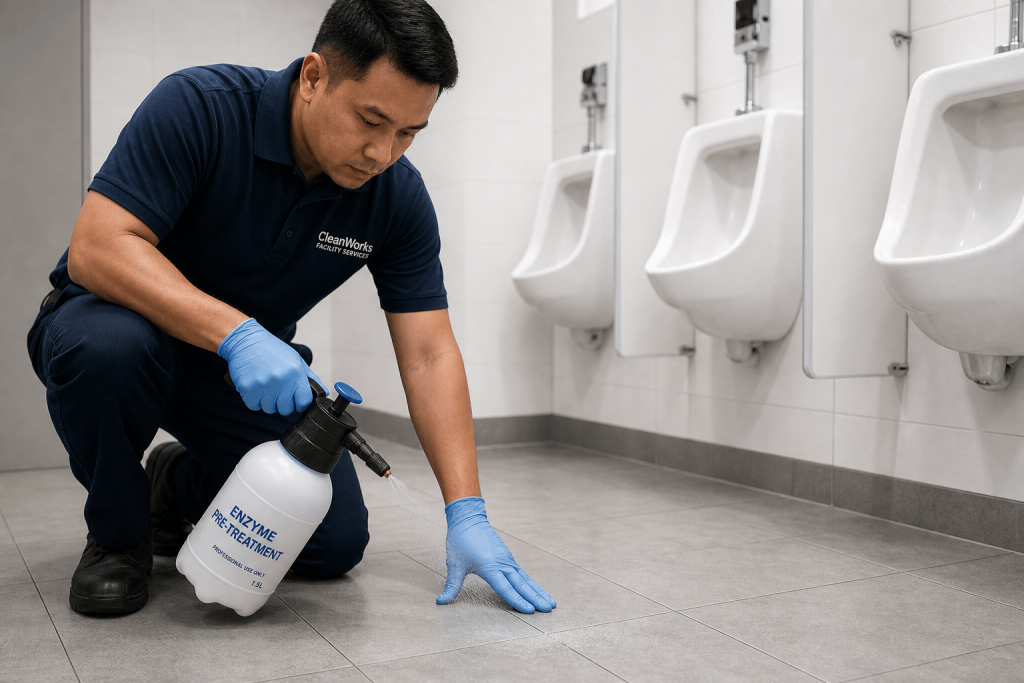
Surface type: Vitrified floor tile, wall tile to 300 mm height
Soil load: Urine (floor) and biological contamination at the base of toilet and wall-floor junction
This is the highest-contamination zone in the restroom and the one where the BR 30/4 C adds the most value over manual mopping. The machine’s rotating brush drives cleaning solution into grout lines that a mop head physically cannot enter.
Protocol — two stages:
Stage 1 (enzyme pre-treatment):
Spray enzyme odour eliminator at 1:10 concentration over the cubicle floor and grout lines. Leave 5 minutes minimum. This is the step most operators skip because the result isn’t immediately visible — but it’s the only step that addresses the embedded biological contamination in grout, not just the surface.
Stage 2 (BR 30/4 C disinfecting scrub):
EcoClean Floor Deep Cleaner at 1:60. Run the BR 30/4 C pass after the enzyme dwell. The combined action — enzyme having broken down uric acid, machine brush driving disinfectant into the grout — achieves what neither step does independently.
For toilet bowl fixtures themselves: manual application of an acid bowl cleaner (HCl-free formula — phosphoric or citric acid base) directly inside the bowl, 5-minute dwell, brush, flush. The BR 30/4 C does not go inside the bowl.
Surface type: Floor tile, ceramic partition bases
Soil load: Concentrated urine splash, biofilm on partition bases, limescale in floor drain surrounds
The urinal zone is where odour control requires the most disciplined chemical protocol. The same two-stage approach as cubicle floors applies, with one addition: targeted descaling treatment for drain surrounds and urinal bases where mineral-organic deposits accumulate.
Complete urinal zone protocol:
Between cleaning cycles: odour gel blocks placed inside urinal trap housings provide continuous enzymatic breakdown of uric compounds — the passive layer of odour control that keeps the zone acceptable between active cleaning passes.
Surface type: Anti-slip tile or textured rubber transition strip
Soil load: Tracked water, outdoor grime, soap overflow from sinks
The lightest-contamination zone in the restroom. EcoClean Neutral Cleaner at 1:100 with the BR 30/4 C handles routine maintenance. Focus brush pressure on the grout lines in the textured tile — these accumulate dark grime that is invisible on textured surfaces until it’s been building for weeks.
| Zone | Product | Format | Notes |
|---|---|---|---|
| All tile floors (daily) | EcoClean Neutral Cleaner | 5L or 20L | Primary maintenance cleaner |
| All tile floors (disinfection) | EcoClean Floor Deep Cleaner | 5L or 20L | 2-min contact time required |
| Stone vanity counter | EcoClean Neutral Cleaner | Same bottle | Cloth application only, not machine |
| Scale deposits | Efflorescence and Scale Cleaner | 1L | Manual targeted application |
| Grout / odour control | Enzyme odour eliminator | 5L | Pre-treatment before machine pass |
| Urinal traps / drains | Enzyme odour gel blocks | Monthly pack | Passive between-cycle treatment |
| Glass / mirrors | Glass cleaner (streak-free) | 500mL RTU | For WV 5 application |
All products available at KingHome Chemicals.
The BR 30/4 C brush is leaving marks on our floor tile after using a new cleaning product. What happened?
Most likely the product contains an abrasive compound or undissolved particles — some cheaper “deep cleaner” formulas do. Switch to EcoClean products, which are purpose-formulated for machine application without abrasive components. Also check whether the brush pad type is appropriate for the tile — a stiff nylon brush on soft polished tile will cause micro-scratching regardless of the chemical.
We clean the restrooms every 2 hours but the odour is back within 30 minutes of finishing. Why?
The cleaning frequency isn’t the problem — the protocol is. If you’re cleaning with disinfectant but skipping the enzyme pre-treatment step, you’re killing surface bacteria but leaving uric acid crystals in the grout intact. Those crystals off-gas ammonia continuously. No amount of cleaning frequency fixes this without enzyme chemistry addressing the root contamination. Implement the 5-minute enzyme pre-treatment on every deep clean pass and the problem resolves within 3–5 days as accumulated crystals are broken down.
Can we use the BR 30/4 C on the marble vanity counter top?
No. The counter surface requires hand application with a microfibre cloth — the machine’s brush pressure is too high for polished stone at close quarters. Use the BR 30/4 C for floors only in the restroom context.
Where do we buy these products?
KingHome Chemicals supplies EcoClean, Crystal Shield, and Revontulet products directly to commercial facility operators and property management contractors. Minimum orders start at carton quantities. Contact them for SDS documentation and volume pricing.
 English
  Spanish