WELCOME TO KINGHOME
Get A Free Quote
We will get back to you within 8 hours

WELCOME TO KINGHOME
We will get back to you within 8 hours
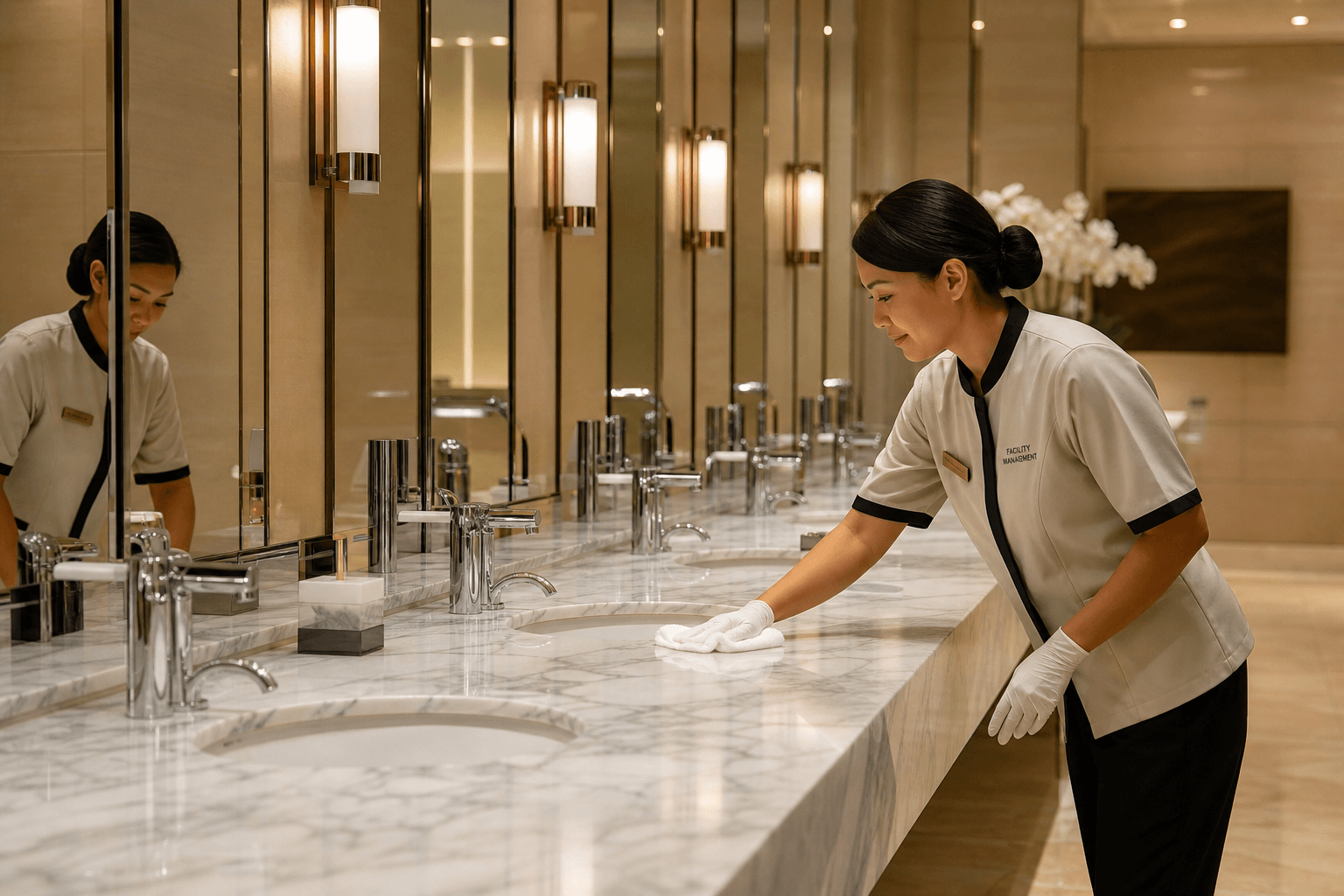
Walk into the restroom of a top-tier shopping mall and you notice — or don’t notice — it immediately. When it works, the space smells fresh, the floor is dry, the mirrors are clear, and the stone counter looks like it was just polished. When it doesn’t work, you smell the disinfectant before you see anything else, and no amount of equipment will fix that.
The difference between a technically clean restroom and one that reads as clean to guests comes down to three things working together: the right Kärcher equipment for each zone, the correct chemistry for each surface type, and a maintenance schedule tight enough to keep pace with foot traffic. This article documents the full programme — zone by zone — built around the specific surface types and contamination challenges of a premium Chinese commercial mall restroom.
Premium mall restrooms use materials that look luxurious but punish cleaning mistakes. Polished marble vanity counters. Large-format stone tile floors, often crystallized. Chrome fixtures on engineered stone bases. Frameless glass partitions.
Every one of these surfaces has a narrow pH window. Use the wrong cleaner once and the damage is done: an etched marble counter, a dulled crystallized floor, a haze on the glass that won’t wipe off. The cleaning programme has to be built around surface protection first, cleaning efficacy second.
This is why the chemical backbone of a premium restroom programme at KingHome runs through two product families: EcoClean for daily machine cleaning, and Crystal Shield for the stone protection layer that the daily cleaning maintains.
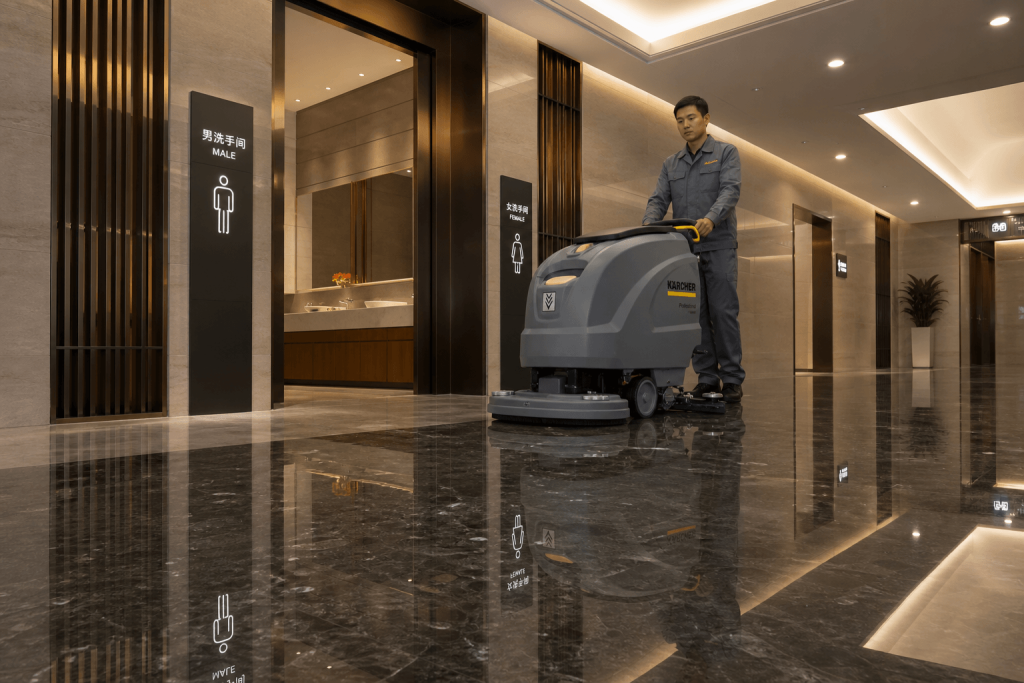
Equipment: Kärcher BD 50/50C + AB 28
Floor: Large-format polished porcelain matching the mall concourse
The entry zone is the first sensory impression. It also carries the heaviest foot traffic of any restroom zone and, because it transitions from the dry mall floor to the potentially wet restroom interior, it is the highest slip-risk surface in the space.
Chemical: EcoClean Neutral Cleaner at 1:100
Polished porcelain at mall concourse standard is typically protected with a sealer or crystallization treatment — the same logic applies here as for marble. An alkaline cleaner strips that protective layer on repeated passes. EcoClean Neutral Cleaner at 1:100 removes daily soil without touching the surface chemistry.
Schedule:
If this floor has lost its gloss from prior cleaning damage, restore it with Crystal Shield Blue Shield before resuming daily maintenance. Running Neutral Cleaner on a degraded surface maintains the degraded state — it doesn’t fix it.
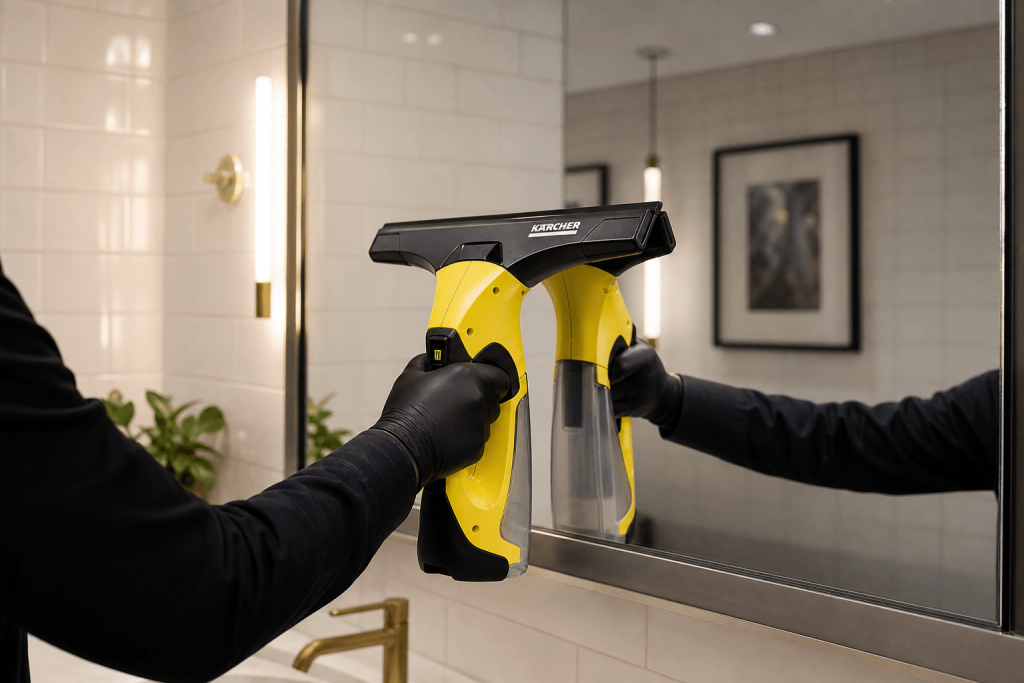
Equipment: Kärcher WV 5 (mirrors), BR 30/4 C (counter and basin surrounds)
Surfaces: Polished marble counter, chrome/stainless fixtures, large mirror panels
The vanity is the highest-scrutiny surface in the restroom. Guests stand here for 30–60 seconds at close range. A smear on the mirror or soap residue on the stone counter registers immediately.
Mirrors — WV 5 + streak-free glass cleaner
Apply glass cleaner by spray bottle, recover with the WV 5 squeegee vacuum. The WV 5 eliminates the smearing that cloth wiping causes on large mirror panels. Every 4 hours during trading, plus on-demand after peak rushes.
Do not use ammonia-based glass cleaners on premium mirror glass — ammonia causes progressive cloudiness on the anti-reflective or privacy coatings common in premium retail installations.
Marble counter — EcoClean Neutral Cleaner at 1:50, microfibre cloth only
The BR 30/4 C does not go on the marble counter. Its rotary brush pressure is too aggressive for polished stone surfaces at close range. Microfibre cloth with Neutral Cleaner: soap scum, cosmetics, water film — all removed without pH risk.
If the marble counter is protected with Crystal Shield Golden Shield — the correct specification for a premium installation — daily Neutral Cleaner maintenance preserves that protective layer. Any cleaner above pH 8 strips it.
Limescale on tap bases and drain surrounds:
Hard water scale around chrome fittings is a weekly task in most Chinese cities. Manual application of Efflorescence and Scale Cleaner to the specific deposit, 3–5 minute dwell, wipe and rinse. Never apply to the marble counter surface. Complete this step and rinse fully before any disinfectant is applied to the same area — acid and disinfectant do not go on the same surface in the same pass.
If the marble has become dull or hazy from prior alkaline cleaning damage — which is the case in most legacy-maintained restrooms — restore the surface with MR Marble Gloss Restorer before beginning the correct maintenance programme. Cleaning a damaged marble surface correctly just maintains the damage cleanly.
Equipment: Kärcher BR 30/4 C
Floor: Vitrified tile, typically 300×600 mm, with standard grout joints
Cubicle floors in a premium mall restroom handling 5,000+ daily visitors carry a biological contamination load that visual inspection doesn’t reveal. The uric acid crystals embedded in grout lines from urine splash are invisible to the naked eye, don’t smell obviously at low density, and are completely unaffected by conventional disinfectants.
Two-stage protocol — every deep clean pass:
Step 1: Enzyme odour eliminator at 1:10 concentration, sprayed onto the cubicle floor and grout lines. 5-minute minimum dwell. This step breaks down uric acid crystals at the molecular level — the root cause of the ammonia odour cycle that returns within hours of cleaning in facilities that skip it.
Step 2: EcoClean Floor Deep Cleaner at 1:60 in the BR 30/4 C. The machine drives disinfecting solution into the same grout lines the enzyme has just treated. 2-minute contact time before recovery.
Between deep cleans: EcoClean Neutral Cleaner at 1:80 for the maintenance passes. Full two-stage protocol at opening, midday, and closing. Neutral Cleaner for the 2-hour maintenance cycles in between.
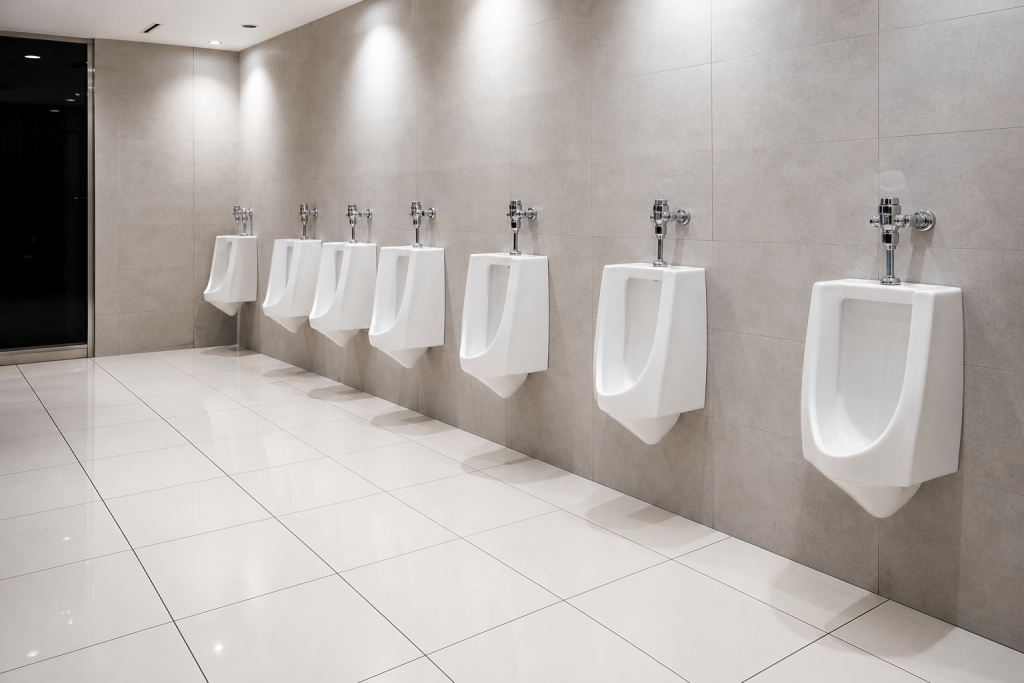
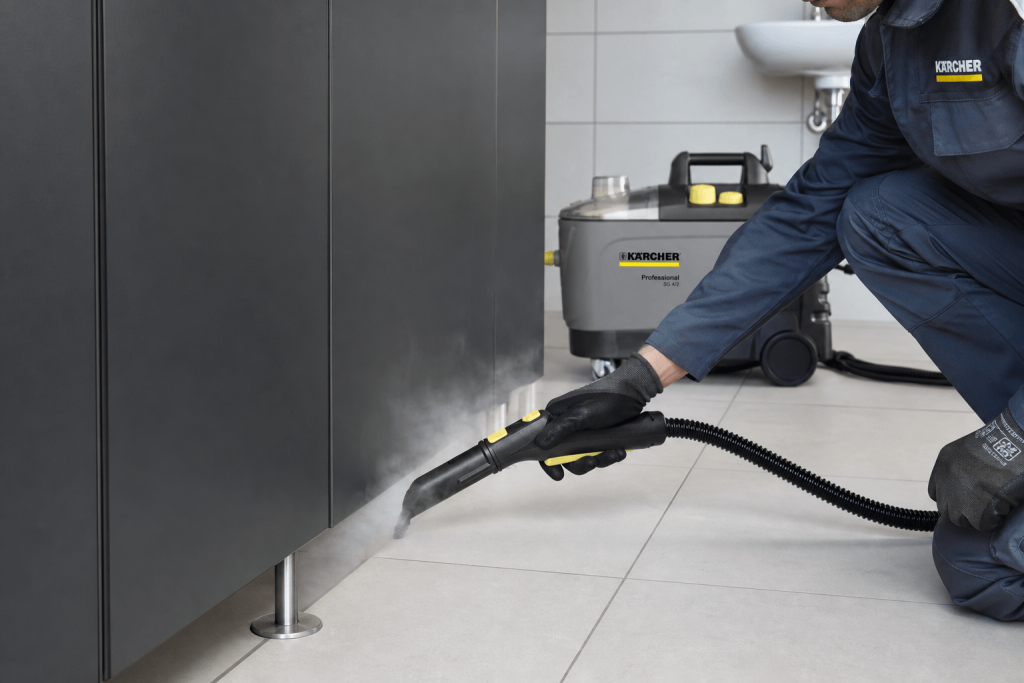
Equipment: Kärcher BR 30/4 C (floor), SG 4/2 steam cleaner (partition bases and fixture exteriors)
The urinal zone generates the most concentrated biological contamination in the restroom and is the primary source of ambient odour in male restrooms. The Kärcher SG 4/2 is the correct tool for partition bases and the external surfaces of urinal fixtures — 155°C steam physically disrupts biofilm that liquid disinfectants can’t penetrate.
Fixture interiors: Efflorescence and Scale Cleaner applied inside urinal bowls handles the limescale and uric scale mineral deposits that accumulate inside the drainage path. 5-minute dwell, brush, flush. This is the step that removes the yellow-brown staining that conventional bowl cleaners mask rather than remove.
Partition bases and floor-wall junction: SG 4/2 steam pass at 155°C. The combination of temperature and pressure disrupts the biofilm matrix that forms at these junctions — the same biofilm that generates persistent odour even after the floor tile has been chemically cleaned.
Floor: Same two-stage enzyme + EcoClean Floor Deep Cleaner protocol as cubicle floors, with higher enzyme concentration (1:5 instead of 1:10) given the heavier uric acid load in this zone.
Passive between-cycle treatment: Enzyme odour gel blocks in urinal trap housings and floor drain surrounds. Replace monthly. These run continuously between cleaning cycles, preventing the uric acid build-up that makes the active cleaning protocol necessary at increasing frequency.
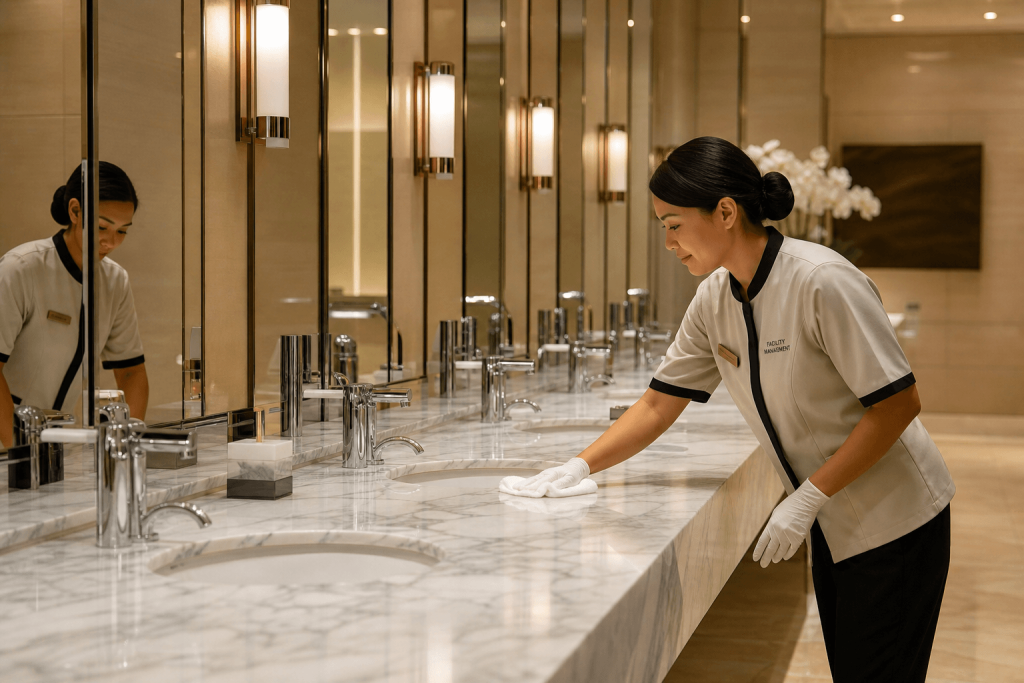
Equipment: Kärcher SG 4/2 (metal surfaces), microfibre + disinfectant spray (plastic surfaces)
Door handles, flush buttons, tap handles, hand dryer buttons — these surfaces carry the highest cross-contamination risk in the restroom but are the easiest to clean when the protocol is consistent.
Daily closing deep clean:
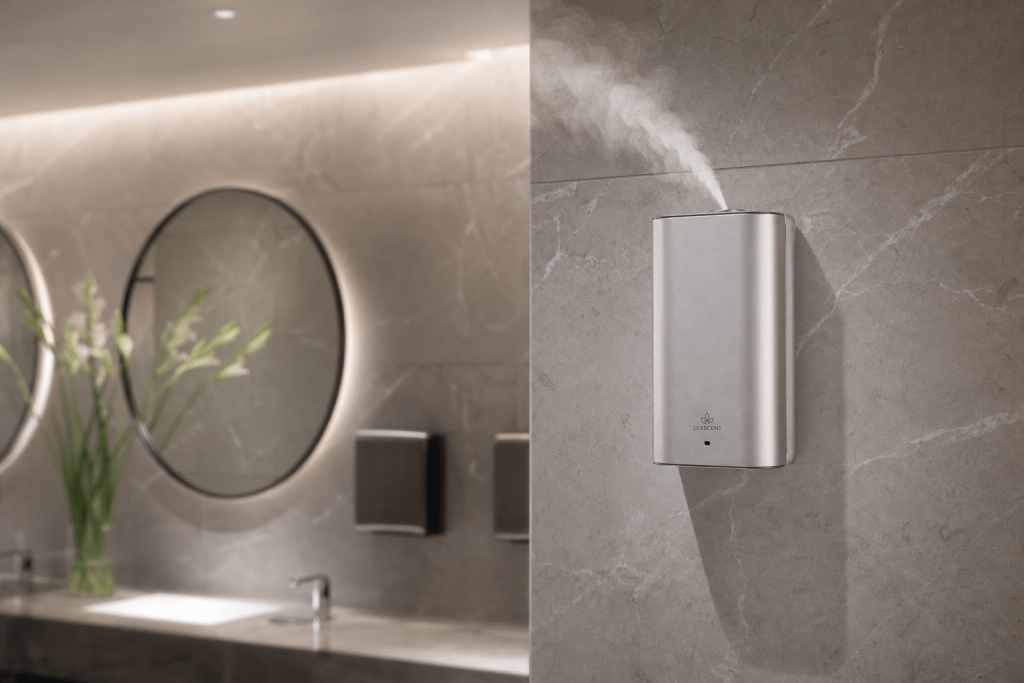
A premium restroom that smells of disinfectant has failed the guest experience standard, regardless of how clean the surfaces are. Fragrance diffusion is the last layer of the programme — it only works if the preceding chemical layers (enzyme treatment, disinfection) have already eliminated the malodour sources. Apply fragrance on top of existing odour and guests detect both: the perfume and the problem underneath it.
Programme: Ultrasonic cold-mist diffuser with water-soluble aroma concentrate. Light citrus or aquatic profiles work best in commercial restrooms — they read as “fresh” rather than “perfumed.”
Calibrate output so the scent is detectable at the entry threshold and fades into background within 2 metres. If guests can identify the specific fragrance, the output is too high.
| Zone | Kärcher Equipment | Primary Chemical | Supporting Chemical |
|---|---|---|---|
| Entry corridor | BD 50/50C, AB 28 | EcoClean Neutral Cleaner 1:100 | Floor Deep Cleaner 1:80 (maintenance) |
| Vanity / mirrors | WV 5, BR 30/4 C | EcoClean Neutral Cleaner 1:50 | Scale Cleaner (limescale — manual) |
| Cubicle floors | BR 30/4 C | Enzyme 1:10 pre-treatment | Floor Deep Cleaner 1:60 |
| Toilet bowls | Manual brush | Scale / Acid Bowl Cleaner | — |
| Urinal zone | BR 30/4 C, SG 4/2 | Enzyme 1:5 + Scale Cleaner | Floor Deep Cleaner 1:60 |
| High-touch surfaces | SG 4/2 | Steam (metal) | Disinfectant spray RTU (plastic) |
| Air quality | Fragrance diffuser | Aroma concentrate | — |
For a 150 m² premium restroom operating 12 hours/day, 30 days/month:
| Product | Monthly Usage | Source |
|---|---|---|
| EcoClean Neutral Cleaner | ~2L concentrate | kinghomechemicals.com |
| EcoClean Floor Deep Cleaner | ~2.5L concentrate | kinghomechemicals.com |
| Enzyme odour eliminator | ~1.5L concentrate | kinghomechemicals.com |
| Efflorescence and Scale Cleaner | ~500mL | kinghomechemicals.com |
| Odour gel blocks | 8–12 units | kinghomechemicals.com |
We clean every 2 hours but the male restroom still smells within 30 minutes. What’s the actual fix?
The enzyme pre-treatment step on cubicle and urinal zone floors. You’re likely cleaning surfaces with disinfectant, which kills surface bacteria, but leaving the uric acid crystal substrate intact in the grout. Uric acid off-gasses ammonia continuously regardless of surface cleanliness. Add a 5-minute enzyme soak (1:5 in the urinal zone, 1:10 in cubicles) before the BR 30/4 C pass at every deep clean. Within 5–7 days, the embedded crystal load decreases enough that ambient odour between cleans extends from 30 minutes to 2+ hours.
The marble counter started showing a white haze after we changed cleaning products. What removed the protective layer?
Almost certainly an alkaline cleaner — pH above 8 strips crystallization treatments and sealers from polished marble on repeated contact. Identify which product was introduced, replace it with EcoClean Neutral Cleaner, and restore the counter surface with MR Marble Gloss Restorer before resuming maintenance cleaning.
Is the SG 4/2 steam cleaner necessary, or can we achieve the same disinfection result with chemicals alone?
For floor areas: chemical protocol is fine. For partition bases and urinal fixture exteriors: the SG 4/2 is doing something chemicals cannot — physically disrupting established biofilm, not just killing organisms on top of it. If you’re running a budget-constrained programme, the SG 4/2 is the last item to cut. Chemical disinfection on top of intact biofilm is a surface-level intervention; steam penetration is structural. The difference shows up in odour control, not in visual cleanliness.
 English
  Spanish