WELCOME TO KINGHOME
Get A Free Quote
We will get back to you within 8 hours

WELCOME TO KINGHOME
We will get back to you within 8 hours

Choosing the wrong floor cleaner costs more than chemical inefficiency—it costs facilities thousands in emergency restoration work. Last year, a luxury hotel in Southeast Asia learned this lesson when housekeeping staff mistakenly used an acid-based grout cleaner on their Carrara marble lobby. Within minutes, the acid had etched permanent dull spots across 400 square meters of polished stone. The restoration bill exceeded $45,000, not counting lost brand reputation during the two-week repair period.
This scenario plays out regularly in commercial facilities where maintenance teams lack clear protocols for matching cleaner chemistry to stone composition. The technical reality: stone flooring falls into two fundamental categories—calcium-based (marble, limestone, travertine) and siliceous (granite, slate, basalt)—and these require opposing chemical approaches. Calcium-based stones react catastrophically with acids, while alkaline cleaners leave problematic residues when improperly rinsed on any surface.
For procurement managers evaluating stone care programs, the central question extends beyond “acidic or alkaline” to encompass the entire decision framework: How do you structure maintenance protocols that protect assets while controlling costs? This technical analysis draws on documented industry standards, performance testing data, and field experience to provide actionable guidance for commercial stone floor care programs.

Walk through any commercial building and you’ll encounter marble in the lobby, granite in high-traffic corridors, and limestone in executive suites. Each material presents distinct chemical vulnerabilities that dictate compatible cleaning formulations.
Calcium-based stones—marble, limestone, travertine, and onyx—consist primarily of calcium carbonate (CaCO₃), the same compound found in seashells and chalk. This composition creates inherent reactivity with acids. When acidic solutions contact calcium carbonate, a dissolution reaction occurs immediately. The acid literally eats into the stone structure, destroying the polished surface and creating dull, rough patches called etching. This isn’t surface contamination that cleaning can remove—it’s permanent material loss that requires mechanical re-polishing to correct.
The etching reaction happens fast. Coffee spills (pH 4.85), wine (pH 2.9-3.9), and even citrus juice (pH 2.0-2.6) begin dissolving marble surfaces within seconds of contact. Commercial cleaning products containing phosphoric acid, hydrochloric acid, or citric acid inflict the same damage, only across larger areas. A maintenance worker applying acid cleaner to marble creates hundreds of square feet of damage in a single mopping pass.
Siliceous stones present different chemistry. Granite, slate, and sandstone contain primarily silica-based minerals—quartz, feldspar, and mica—with significantly higher resistance to acid attack. Granite’s composite hardness (Mohs 6-7, compared to marble’s 3-4) allows it to tolerate mild acidic formulations for specific applications like mineral deposit removal. However, even acid-resistant stones perform optimally with pH-neutral maintenance protocols.
The distinction matters because commercial buildings frequently feature multiple stone types across different zones. A single universal cleaning program—defaulting to pH-neutral chemistry—eliminates the risk of chemical misapplication that destroys calcium-based surfaces while maintaining effective cleaning across all stone types.
Acidic cleaning formulations excel at one thing: dissolving mineral deposits. The chemical mechanism works through targeted reactions with inorganic salts, making acidic cleaners indispensable for specific contamination types.
Hard water scale, calcium deposits, efflorescence (white crystalline salt deposits), grout haze from tile installation, and rust stains all respond effectively to acid treatment. In facilities with high-mineral water or buildings experiencing moisture migration through subfloors, these deposits accumulate progressively. Acid cleaners dissolve these minerals through controlled chemical reactions, whereas neutral or alkaline formulations cannot break the ionic bonds holding mineral deposits to surfaces.
The application window is narrow. Acidic cleaners work safely only on non-calcareous stones: granite, slate, basalt, ceramic tile, and porcelain stoneware. Even on these acid-resistant materials, test applications in inconspicuous areas remain essential protocol before treating visible surfaces. Different granite varieties exhibit varying mineral compositions—some contain enough calcium-bearing feldspars to show minor etching from strong acids.
The prohibition list is absolute and non-negotiable: Never apply acidic cleaners to marble, limestone, travertine, onyx, or terrazzo containing marble chips. The damage timeline progresses with alarming speed. Within 3 seconds of acid contact, the dissolution reaction begins at the molecular level. By 10-30 seconds, visible dulling appears. After 1-5 minutes, the surface develops rough texture—permanent damage complete.
One facility manager documented this error in an online forum: “An acid-based grout cleaner containing phosphoric acid was mistakenly used on our new limestone floor during final construction cleanup. When the sealer dried, etch marks remained as obvious as on unsealed areas. The product label clearly stated ‘Do not apply to calcareous natural stone,’ but this warning was overlooked during the rush to complete the project”. The subsequent restoration required diamond grinding to remove the damaged surface layer, then progressive polishing through eight grit levels to restore the original finish—work that cost more than triple the original installation labor.
The broader principle: acidic cleaners belong in specialized applications under controlled protocols, not in daily maintenance programs where rushed staff might apply them to incompatible surfaces. Facilities housing any calcium-based stone should default to pH-neutral programs and reserve acidic formulations exclusively for trained technicians addressing specific problems on acid-resistant surfaces only.
Alkaline cleaning chemistry attacks organic compounds through saponification—the chemical process that converts fats and oils into water-soluble soaps. This mechanism makes alkaline formulations the preferred choice for facilities battling grease, protein residues, body oils, wax buildup, and general ground-in dirt from foot traffic.
Unlike acidic cleaners, alkaline solutions work safely across all stone types, including acid-sensitive marble. This universal compatibility creates operational advantages in mixed-stone facilities where staff need effective heavy-duty cleaners that won’t catastrophically damage any surface. Commercial kitchens, hospitals, retail environments, and high-traffic lobbies rely on alkaline chemistry to remove the organic soils that accumulate despite daily maintenance.
The performance advantage comes with operational requirements. High-pH cleaners (typically pH 10-12 for commercial applications) leave alkaline residues when allowed to air-dry without thorough neutralization rinsing. These residues create a progressive dirt-attraction cycle. The alkaline film remaining on the surface after incomplete rinsing has slightly sticky properties that actively attract new dirt and dust particles. Grout lines and porous stone zones accumulate these residues most visibly, eventually appearing dark and dirty despite frequent cleaning attempts.
Field observations across hundreds of commercial installations reveal a consistent pattern: facilities using alkaline cleaners for daily maintenance without proper rinsing protocols report that floors appear dirty within 2-4 hours after cleaning, requiring re-cleaning in a perpetual cycle that wastes labor and chemicals. The root cause isn’t insufficient cleaning—it’s inadequate rinsing. The solution requires a two-step protocol: alkaline cleaning followed immediately by neutralization with pH-neutral rinse solution, extracted thoroughly using wet vacuums or autoscrubbers to prevent residue formation.
Temperature enhancement significantly improves alkaline cleaner performance. Warm water (40-50°C) increases degreasing efficiency by approximately 40% compared to cold water application, reducing required dwell time and chemical concentration. In commercial kitchens where heavy grease accumulation challenges maintenance teams, warm alkaline solutions combined with mechanical agitation deliver results that cold-water mopping cannot achieve.
The practical framework: alkaline cleaners serve best as periodic deep-cleaning solutions (weekly or monthly depending on facility use) rather than daily maintenance products. This approach maximizes their degreasing power while minimizing the labor burden of constant thorough rinsing. For daily maintenance, pH-neutral chemistry eliminates residue concerns entirely while delivering adequate soil removal for most commercial environments.
pH-neutral cleaners represent the intersection of safety and effectiveness. Formulated to 7.0-7.5 pH range, these solutions clean without introducing acidic or alkaline compounds that require neutralization. The chemistry ensures compatibility with every natural stone type—zero risk of etching calcium-based stones, zero risk of residue formation on any surface.
Performance data from facilities transitioning from alkaline-heavy programs to pH-neutral maintenance protocols shows consistent operational improvements. One 12,000-square-meter retail facility in Shanghai documented 42% labor time reduction after switching to pH-neutral spray-and-microfiber application, eliminating the progressive dirt accumulation that required constant re-cleaning under the previous alkaline program. The facility reported that floors maintained visual cleanliness for 8-10 hours instead of 2-3 hours, despite identical foot traffic patterns.
The application method matters as much as the chemistry. Traditional mopping—cotton mop heads dunked in bucket solutions—spreads contamination and introduces excessive water that penetrates grout lines and porous stone. Professional stone care protocols now favor spray-and-microfiber techniques where pH-neutral solution is lightly misted directly onto floor surfaces, allowed brief dwell time (30-60 seconds), then wiped with clean microfiber flat mops. This method uses 88-94% less water than bucket mopping, significantly reducing moisture-related issues like efflorescence and grout deterioration.
The microfiber component provides mechanical cleaning action that complements chemical effectiveness. Properly manufactured microfiber splits fibers into microscopic filaments that physically capture and hold dirt particles rather than merely spreading them across surfaces. The critical operational detail: change microfiber pads frequently—typically every 40-60 square meters—and never flip pads to use “clean” sides, which merely redistributes captured contamination.
Commercial autoscrubbers utilizing pH-neutral chemistry achieve cleaning rates of 38,000 square feet per hour with 50% less water consumption compared to manual methods. For large-format facilities, this equipment investment delivers rapid payback through labor efficiency gains while maintaining stone surfaces without the chemical risks inherent in acidic or alkaline programs.
Stone floor maintenance operates within measurable economic frameworks. Industry data establishes baseline costs across different service categories: basic cleaning runs $0.25-$0.40 per square foot, honing costs $2.25-$3.25 per square foot, and complete polishing/restoration ranges from $3.25-$5.00 per square foot. Annual maintenance for natural stone floors averages $1.00-$3.00 per square foot depending on traffic levels and maintenance protocol quality.
These numbers reveal the cost leverage in prevention. A 5,000-square-foot marble lobby maintained with proper pH-neutral protocols costs approximately $750-1,500 annually in chemical and labor expenses. The same lobby suffering acid damage requiring restoration jumps to $16,250-$25,000 for complete re-polishing. Even partial damage affecting 30% of the surface area still exceeds $5,000 in restoration work—costs that proper chemical selection would eliminate entirely.
Facilities extending floor lifecycles through appropriate maintenance protocols realize substantial avoided replacement costs. Professional maintenance programs demonstrably extend stone floor service life by 40-70% compared to inadequate care. For a commercial installation where replacement costs $25-35 per square foot installed (labor plus materials), a 5,000-square-foot floor represents $125,000-175,000 in avoided capital expense when proper maintenance delays replacement from a 15-year to 25-30 year cycle.
Labor efficiency provides additional ROI. Facilities optimizing maintenance methods—pH-neutral spray-microfiber techniques or autoscrubber deployment—report 40-52% reductions in time required for routine cleaning compared to traditional bucket mopping. On a 10,000-square-foot facility requiring 4 hours weekly maintenance, a 45% efficiency gain saves 2.08 hours weekly or 108 hours annually. At $25/hour loaded labor cost, this equals $2,700 annual savings from method optimization alone, independent of chemical cost reductions.
The economic argument compounds when combining chemical optimization, method improvement, and lifecycle extension. Total cost of ownership analysis over 10-year periods consistently demonstrates 60-78% cost reduction for properly maintained stone floors versus inadequate programs that trigger recurring restoration needs.
Etching presents as dull, cloudy patches with rough texture that don’t respond to cleaning attempts. The surface feels noticeably different to touch—the smooth polish gives way to slightly rough or pitted texture. This distinguishes etching from surface staining, which maintains intact surface structure beneath contamination.
The damage results from acid exposure—whether from improper cleaning products, food and beverage spills, or airborne acid deposition in certain industrial environments. Coffee, wine, fruit juices, carbonated beverages, and many cleaning products contain sufficient acidity to etch marble within seconds of contact. Once etching occurs, the damage is permanent at the molecular level. Cleaning cannot reverse it; only mechanical intervention restores the surface.
Minor etching affecting surface gloss without deep texture change responds to marble polishing powders—typically calcium carbonate compounds that repolish the compromised surface through buffing action. Application involves creating a paste with water, applying to affected areas, and buffing with lamb’s wool pads on floor machines running 175 RPM. This approach achieves 60-80% gloss restoration for shallow etching, sufficient for areas where perfect appearance isn’t critical.
Moderate to severe etching requires professional diamond polishing. Technicians progress through successive diamond pad grits—typically 400, 800, 1500, and 3000—each removing microscopic surface layers while progressively refining the scratch pattern until mirror polish returns. The work demands skill; excessive grinding removes too much material, potentially creating depressions or valleys across the floor plane. Professional restoration costs $7-15 per square foot depending on damage severity and regional labor rates.
Prevention remains far more cost-effective than repair. Facilities must implement: (1) pH testing of all floor cleaning products, discarding any formulations below pH 6 when used on calcium-based stones; (2) color-coded chemical storage systems where green containers indicate universal-safe products and red containers signal prohibited formulations for marble zones; (3) mandatory staff training with written competency verification; and (4) immediate spill response protocols for food and beverage accidents.
Grout lines darkening progressively despite regular cleaning typically indicates alkaline residue accumulation rather than true embedded dirt. The diagnostic test: touch grout surfaces when completely dry. Slight tackiness or a sticky feel confirms residue presence. pH indicator strips provide definitive evidence—residue-affected grout tests at pH 8-10 rather than neutral.
The condition stems from alkaline cleaners used without adequate neutralization rinsing. As cleaning solution water evaporates, dissolved alkaline compounds remain as a film. This film attracts dirt particles, creating progressive darkening that worsens with each incomplete cleaning cycle. The trapped organic material eventually supports bacterial growth, producing characteristic musty odors that persist even after aggressive cleaning attempts.
Correction requires breaking the residue cycle through deep alkaline treatment (paradoxically using the same chemistry that created the problem, but with proper rinsing protocols). Heavy-duty alkaline formulations at pH 11-12 applied with 10-15 minute dwell time dissolve the accumulated residue films. Mechanical agitation—nylon brush scrubbing or oscillating floor machine work—helps lift the residue from grout pores. The critical step follows: thorough extraction using wet vacuums, then multiple rinses with pH-neutral solution until pH test strips confirm recovered water measures at 7.0.
Prevention shifts daily maintenance to pH-neutral chemistry. Facilities making this transition report grout lines maintaining their cleaned appearance for 18-24 months before requiring deep cleaning interventions, compared to 6-12 month cycles under alkaline-heavy programs. The labor savings compound over time—less frequent deep cleaning reduces both direct service costs and operational disruption.
White powdery deposits appearing on stone or grout surfaces signal efflorescence—soluble salts (sodium sulfate, calcium carbonate, potassium carbonate) carried to the surface by moisture migration. The deposits brush off easily but return within days or weeks, frustrating facilities teams who repeatedly clean without addressing the underlying cause.
Efflorescence is a symptom, not a standalone problem. The salts originate from stone, mortar, concrete substrates, or groundwater, transported to surfaces by moisture movement. Until facilities identify and correct the moisture source, efflorescence will recur regardless of cleaning frequency or chemical selection.
Diagnostic moisture testing precedes any treatment protocol. The plastic sheet tape test provides quick assessment: tape 30cm × 30cm plastic sheeting tightly to the floor, seal edges completely, wait 24 hours. Condensation forming on the underside indicates active subsurface moisture migration. Electronic moisture meters quantify the issue—readings above 6% in stone indicate active moisture problems requiring source correction.
Common moisture sources include plumbing leaks (often hidden in walls or subfloors), HVAC condensation, exterior water intrusion through walls or failed waterproofing, poor subfloor drainage, and capillary moisture rise in below-grade installations. Facilities must locate and repair these sources before addressing the visible efflorescence. Otherwise, chemical cleaning provides only temporary cosmetic improvement while moisture continues introducing new salt deposits.
Once moisture issues are corrected and the substrate has dried (typically requiring 7-14 days), efflorescence removal proceeds based on stone type. Acid-resistant stones like granite and slate tolerate mild acidic solutions that dissolve salt deposits—phosphoric acid or citric acid formulations at pH 4-6 achieve 95%+ removal effectiveness. Application requires care: spray only affected areas, allow 3-5 minutes dwell time, light brush agitation, thorough water rinsing.
Calcium-based stones cannot tolerate acid treatment. For marble and limestone installations, efflorescence removal relies on dry brushing with soft nylon bristles and vacuum extraction, achieving 60-75% removal—adequate for most applications. If efflorescence has deeply penetrated surface pores, diamond polishing may be necessary to restore appearance completely.
Post-treatment protection involves applying penetrating sealers that block 95%+ of water penetration, preventing future salt migration while maintaining vapor permeability. The sealer application requires completely dry substrates—applying sealer while moisture remains in the stone traps moisture beneath the surface, potentially causing worse problems than the original efflorescence.
Crystallization represents a chemical alteration of marble surfaces to increase hardness and gloss while improving stain resistance. The process uses magnesium hexafluorosilicate (MgSiF₆) solutions applied to marble under heat and friction generated by steel wool pads on weighted floor machines.
The chemical reaction creates a new compound bonded to the marble surface. Magnesium hexafluorosilicate reacts with calcium carbonate (the primary marble constituent) to form calcium hexafluorosilicate (CaSiF₆), which exhibits superior hardness and stain resistance compared to untreated calcium carbonate:
CaCO₃ + MgSiF₆ + 2HCl → MgCl₂ + CaSiF₆ + CO₂ + H₂O
The resulting calcium hexafluorosilicate layer bonds permanently to the marble, creating surfaces that maintain high gloss (70-85 gloss units) under commercial traffic, resist common staining agents, and require only clear water for daily maintenance. The process increases surface hardness from marble’s natural Mohs 3-4 to approximately 4-5, providing measurable improvement in abrasion resistance.
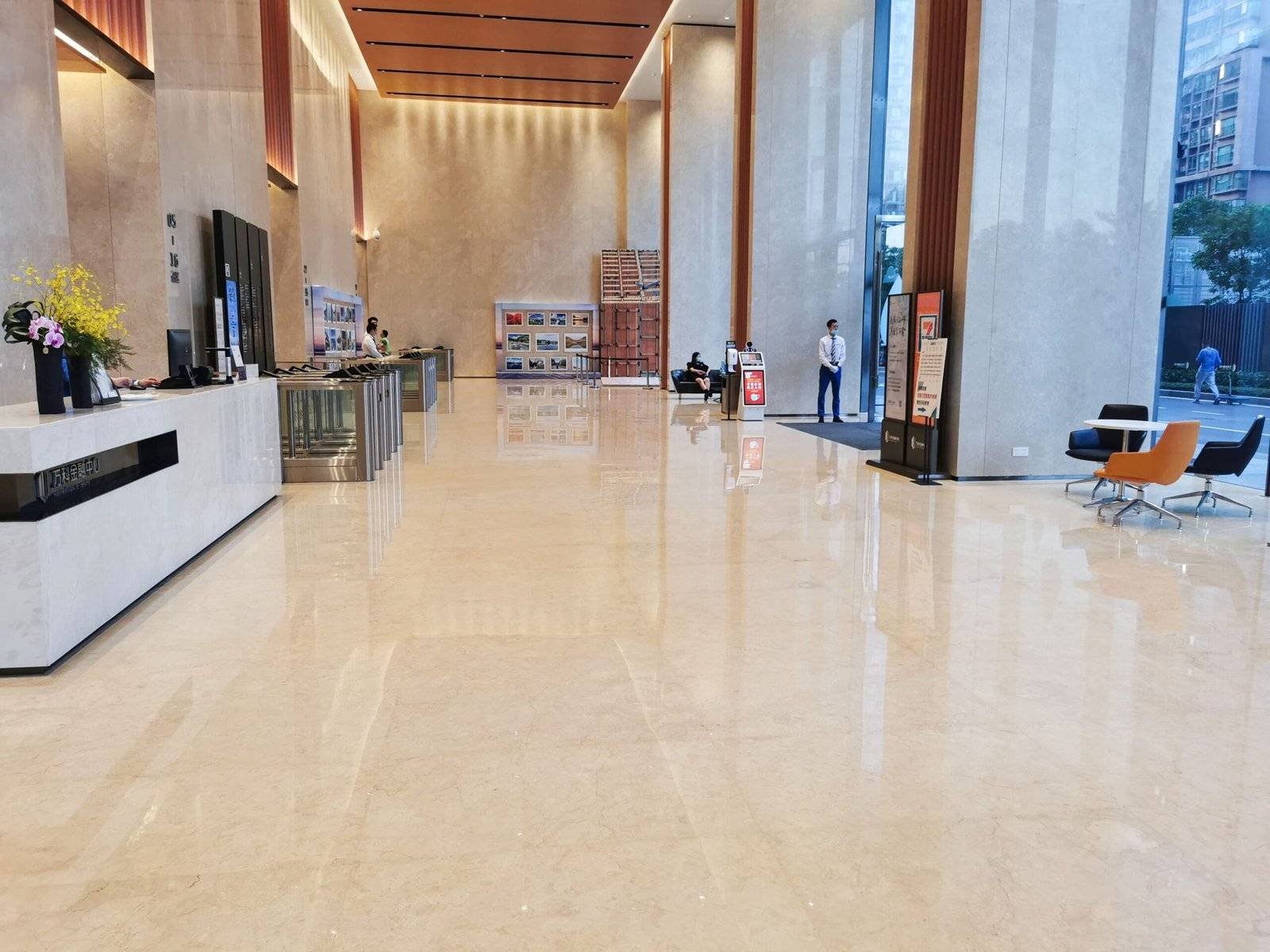
Crystallization suits high-traffic commercial installations—hotel lobbies, retail corridors, office building entrances—where marble’s aesthetic appeal is desired but natural softness presents maintenance challenges. The treatment can be localized to high-wear areas or applied across entire floors depending on budget and performance requirements.
The permanence factor matters. Crystallization irreversibly alters stone chemistry—reversal requires diamond grinding to remove the crystallized layer, essentially destroying the treatment to expose original marble beneath. This makes crystallization inappropriate for historically significant marble or installations where reversible treatments are mandated. For modern commercial applications without historical restrictions, crystallization delivers practical performance benefits that reduce lifecycle maintenance costs.
Penetrating sealers (also called impregnating sealers) work below the surface rather than forming surface films. These formulations contain small-molecule silicones or fluoropolymers that absorb into stone capillaries, filling microscopic voids while allowing vapor transmission. The sealer molecules chemically bond to mineral surfaces inside the stone, creating water and oil repellency without changing surface appearance or texture.
The technology suits porous stones—limestone, sandstone, travertine—where subsurface stain protection is critical but appearance alteration is unacceptable. Water-based stains (coffee, wine, fruit juices) and oil-based stains (cooking oils, motor oils) bead on sealed surfaces rather than penetrating, providing time for cleanup before permanent staining occurs. Performance testing demonstrates 99%+ water repellency on properly sealed porous stone, with service life ranging 5-7 years interior applications and 3-5 years exterior exposures.
Application requires dry substrates—stone moisture content must be below 4% measured with electronic moisture meters. Attempting to seal damp stone traps moisture beneath the sealer layer, potentially causing clouding, delamination, or efflorescence formation. Application involves flooding surfaces to saturation (the “refusal method”), allowing 10-15 minutes penetration time, then removing excess before the sealer reaches tack point. Cure schedules vary by formulation: solvent-based sealers typically allow light traffic after 24 hours with complete cure in 72 hours; water-based formulations often require 48-72 hours before traffic.
The breathability factor—maintained vapor permeability—distinguishes penetrating sealers from topical films. Stone can release internal moisture as vapor without building pressure beneath the sealer, preventing the moisture-trapping problems that plague topical coatings. This makes penetrating technology appropriate for below-grade installations, exterior applications, and anywhere moisture management is crucial.
Topical sealers create continuous films (15-50 microns thick) on stone surfaces, providing physical barriers against contamination. Modern formulations utilize urethane, acrylic, or epoxy chemistries to deliver high-gloss finishes, scratch protection, and enhanced stain resistance. The trade-off: topical films alter appearance (adding gloss, often darkening stone 1-2 shades), require periodic reapplication as traffic wears through the coating, and trap moisture if subsurface dampness exists.
Topical systems suit high-traffic commercial environments where appearance maintenance justifies the reapplication burden—typically every 12-18 months, sometimes 6-9 months in extreme traffic areas. Retail entrances, airport terminals, hotel lobbies with 50,000+ daily visitors utilize topical sealers to maintain showroom appearance despite punishing foot traffic that would rapidly degrade untreated soft stones like marble.
Application requires pristine surface preparation. The stone must be thoroughly cleaned, completely dry, and pH-neutral verified before applying topical coatings. Contamination beneath the film—alkaline residues, wax buildup, embedded dirt—will prevent proper adhesion and appear as cloudy or mottled areas once cured. Multiple thin coats (typically 2-3 applications) outperform single heavy coats, providing better leveling and film strength.
The maintenance commitment distinguishes topical from penetrating systems. Topical films degrade under traffic, developing worn paths that detract from appearance. Once traffic patterns become visible, complete stripping and reapplication becomes necessary—partial repairs rarely blend invisibly with surrounding areas. Stripping protocols involve alkaline strippers or chemical strippers specific to the coating chemistry, mechanical removal of all residue, thorough neutralization, and complete drying before recoating.
Chemical compatibility requires attention. Topical films degrade when exposed to strong acids or alkalines—facilities must commit to pH-neutral maintenance chemistry exclusively once topical sealers are applied. Using incompatible cleaners dulls the finish, may cause clouding or discoloration, and shortens the recoating cycle by accelerating film degradation.
Establishing functional stone care protocols requires moving beyond product selection to comprehensive system design. Three phases structure successful implementations: assessment, training, and monitoring.
The assessment phase identifies stone types by location, documents existing damage requiring restoration before maintenance begins, tests current cleaning product pH levels, and calculates baseline costs for comparison against optimized programs. Visual inspection supplemented with simple acid sensitivity testing (applying pH 4 solution to inconspicuous areas and observing for fizzing reactions that indicate calcium-based stones) creates facility stone inventory maps. These maps become operational tools—color-coded zone indicators showing which cleaning formulations are compatible with each area’s flooring.
Training separates functional programs from paper policies. Staff must understand why chemical selection matters, not merely what products to use. Training curricula should cover stone composition fundamentals (calcium-based versus siliceous), pH scale concepts, etching versus staining differentiation, proper dilution ratios, application technique demonstrations, and safety protocols. Competency verification through written tests (80% minimum passing scores) and supervised practical demonstrations ensures comprehension. Quarterly refresher sessions reinforce critical concepts and address observed protocol deviations.
Monitoring systems track performance metrics: chemical consumption rates, labor hours per square meter maintained, surface condition assessments (annual gloss meter readings at standardized test locations), incident reports documenting any damage or problems, and total cost of ownership calculations. These metrics identify emerging issues before catastrophic failures occur. Rising chemical consumption may indicate improper dilution practices. Increasing labor hours might reflect progressive residue buildup requiring corrective deep cleaning. Declining gloss readings signal inadequate maintenance or incompatible chemical use.
The monitoring cycle includes quarterly management reviews analyzing trends and implementing corrective actions—immediate retraining for protocol violations, chemical substitutions if products underperform, equipment upgrades when ROI analysis supports investment. Documentation captures lessons learned, updating standard operating procedures to reflect field experience and prevent recurring problems.
Technology integration enhances program effectiveness without requiring extensive capital investment. pH meters ($30-80) provide objective verification that cleaning solutions fall within specified ranges. Gloss meters ($200-500) quantify surface condition changes over time, distinguishing normal wear from chemical damage. Moisture meters ($100-300) diagnose efflorescence root causes and verify substrate dryness before sealer application. Simple test strips for pH verification ($10-20 per 100 strips) enable frontline staff to confirm proper chemical dilution.
Stone care chemicals and maintenance protocols operate within regulatory and quality frameworks that impact specification decisions and liability exposure. Understanding applicable standards helps facilities managers make informed choices while managing risk.
OSHA regulations govern chemical safety in commercial applications. Facilities using floor cleaning chemicals must provide appropriate personal protective equipment (chemical-resistant gloves, eye protection for pH extremes), maintain current Safety Data Sheets accessible to all staff, ensure adequate ventilation in enclosed cleaning areas, and document staff training on chemical hazards and emergency response. Acidic and high-alkaline formulations trigger more stringent PPE requirements than pH-neutral products—a practical factor favoring neutral chemistry when performance differences are marginal.
VOC (volatile organic compound) content affects indoor air quality and regulatory compliance. Many regional authorities limit VOC levels in cleaning products used in occupied buildings. GREENGUARD Gold certification indicates VOC content below 0.01 g/L, meeting strict standards for schools and healthcare facilities. Facilities pursuing LEED certification earn points for specifying low-VOC cleaning products, making chemical selection directly relevant to building sustainability ratings.
ISO 9001 certification for chemical manufacturers indicates quality management systems meeting international standards—documented production processes, continuous improvement programs, supplier quality control, and customer satisfaction measurement. While ISO certification doesn’t guarantee superior product performance, it signals organizational commitment to consistent quality. For facilities specifying stone care programs, manufacturer quality certifications reduce supply chain risk.
Slip resistance testing presents evolving standards landscape. ASTM C1028 served as the primary slip resistance test for stone and tile for decades, but criticism regarding test reliability led to recommendations for alternative methods. The test measured static coefficient of friction—a limitation since actual slip incidents involve dynamic conditions. Current best practice combines multiple testing approaches: ASTM C1028 for texture measurement, British Pendulum Test for dynamic wet surface assessment, and Tortus testing for comprehensive slip resistance characterization. The practical implication: cleaning protocols and sealers that alter surface characteristics must be evaluated for slip resistance impacts, particularly in wet areas.
For stone crystallization specifically, no universally adopted performance standard exists. The technology remains somewhat specialized, with manufacturers providing proprietary formulations and application protocols. Facilities considering crystallization should request documented case studies, performance data from comparable installations, and clear specification of expected service life before recrystallization becomes necessary.
Foshan Jinjinghong Environmental Technology Co., Ltd. (operating as Kinghome) has developed integrated stone care solutions combining proprietary products with international brand partnerships. The company’s approach—”Product + Service + Training”—reflects industry evolution toward comprehensive support rather than chemical-only sales.
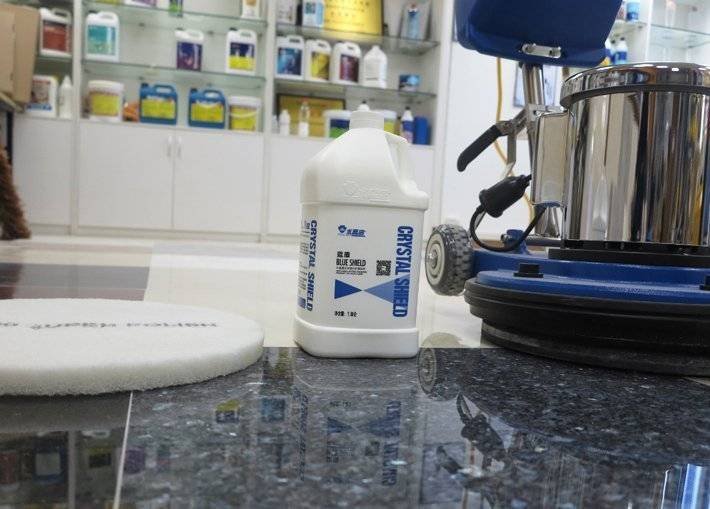
Kinghome’s proprietary lines include Crystal Shield and Revontulet stone care series plus Ecoclean formulations. Simultaneously, the company serves as agent for European and American brands including Klindex, Federchemicals, Rubbermaid, 3M, and Cambro in the Chinese market. This dual model provides access to both locally-manufactured products optimized for regional conditions and international brands with established performance records.
The company positions itself as supplier and service provider for landmark projects globally, offering technical support, training courses, and after-sales service beyond product delivery. For facilities managers evaluating stone care programs, this integrated service model addresses a common industry challenge: chemical manufacturers typically provide products but limited guidance on proper application, while service contractors deliver labor but may lack deep technical expertise on chemical selection. The integrated model attempts to bridge this gap.
Product awards from China Chamber of Stone Industry and Commerce, China Stone Media Alliance, China Clean Expo, and Guangdong Stone Industry Association provide regional industry recognition, though awards should be evaluated in context of actual field performance data and customer references.
For facilities specifying stone care programs, the key evaluation factors transcend brand selection: Do proposed protocols match stone composition to compatible chemistry? Does the service provider demonstrate technical competency through documented training and certification? Are performance metrics clearly defined with consequences for non-achievement? Will the program deliver measurable cost reductions and lifecycle extension? These fundamental questions determine program success regardless of specific product brands specified.
Stone floor maintenance operates at the intersection of chemistry, economics, and operations management. The technical reality—calcium-based stones require pH-neutral protocols to prevent irreversible etching, while alkaline cleaners demand thorough rinsing to avoid residue formation—establishes non-negotiable constraints that facilities ignore at significant cost.
The documented economic impact of proper chemical selection is substantial. Facilities maintaining natural stone with appropriate chemistry realize 60-78% cost reductions compared to programs triggering recurring restoration needs. For a typical 10,000-square-foot commercial installation, this translates to $67,000-134,000 avoided costs over ten-year periods. The payback timeline on protocol optimization runs 4-6 months, primarily through elimination of emergency restoration work.
The decision framework simplifies to three core principles: (1) Default to pH-neutral chemistry for all routine maintenance across all stone types—this eliminates the etching risk that destroys calcium-based stones while providing adequate cleaning performance for most commercial soiling; (2) Reserve alkaline cleaners for periodic deep cleaning applications where their superior organic soil removal justifies the labor investment in thorough neutralization rinsing; (3) Restrict acidic formulations to specific mineral deposit problems on acid-resistant stones only, applied by trained technicians following documented protocols that prevent misapplication on vulnerable surfaces.
For procurement managers building stone care programs, the critical question extends beyond “which products” to “which system.” Effective programs integrate compatible chemistry, appropriate application methods (spray-microfiber or autoscrubber deployment versus traditional mopping), staff training with competency verification, performance monitoring through quantifiable metrics, and continuous improvement cycles that capture field experience. This systems approach delivers sustainable results that product selection alone cannot achieve.
The cost of inadequate stone care programs—measured in emergency restoration work, premature replacement, and operational disruption—far exceeds the investment required for proper protocol implementation. The question for facilities is not whether to implement appropriate stone care chemistry, but whether they can afford the $6,000-13,000 annual penalty and accelerated asset degradation that improper pH selection guarantees.

