WELCOME TO KINGHOME
Get A Free Quote
We will get back to you within 8 hours

WELCOME TO KINGHOME
We will get back to you within 8 hours

Selecting industrial floor polishing equipment requires evaluating three interconnected specifications—rotational speed (RPM), working diameter, and power consumption—against your stone type, facility square footage, and operational budget. For marble and travertine crystallization, low-speed machines (175-300 RPM) activate chemical reactions without thermal damage; granite maintenance demands mid-range speeds (300-800 RPM) for mechanical polishing; while high-speed burnishers (1,500-2,000 RPM) create mirror finishes on sealed surfaces. This technical comparison guide examines how these specifications translate to measurable performance outcomes including productivity rates, energy costs per square foot, and equipment lifecycle value based on Kinghome’s 18 years of stone care expertise across commercial, hospitality, and institutional installations.
Choose an industrial floor polishing machine by matching RPM, working width, motor power, and pad system to the floor material and facility size. Marble and travertine crystallization normally need controlled low-speed equipment, concrete and terrazzo preparation need heavier grinding or planetary systems, and large sealed-floor areas benefit from wider machines that reduce passes and labor time.
| Facility need | Machine priority | Best fit |
|---|---|---|
| Marble or travertine crystallization | Stable low-speed rotation and chemical compatibility | 175-300 RPM single-disc or stone care machine |
| Terrazzo, concrete, or uneven stone prep | Torque, weight, diamond tooling, and dust or slurry control | Planetary grinder or heavy-duty floor polishing system |
| Large VCT or sealed-floor maintenance | Working width, productivity per hour, and easy pad changes | Industrial burnisher or wide-area floor polisher |
| Mixed-use facility maintenance | Dual-speed flexibility and practical energy consumption | Multi-purpose floor machine with matched pads and chemicals |
For related selection steps, compare floor polishers for industrial facilities and the floor grinder vs concrete polisher guide before specifying equipment.
Searches for industrial floor polishing machines often mix product comparison, market research, and practical equipment selection. A facility manager may search floor polishing machine market size or market trends before asking a simpler question: which machine will actually maintain marble, terrazzo, concrete, VCT, or mosaic floors at the required speed and cost? Treat market data as context, then specify the machine by floor material, finish target, RPM range, working width, motor power, and compatible pads or chemicals.
| GSC search intent | Practical equipment direction | Selection check |
|---|---|---|
| Industrial floor polishing machines | Compare low-speed polishers, high-speed burnishers, and grinder-polisher packages | Confirm whether the work is routine gloss maintenance, crystallization, honing, or deeper restoration. |
| Floor polishing machine market size or trends | Use market terms to benchmark machine categories, not to choose a machine alone | Ask for application proof, pad compatibility, service support, and expected coverage per hour. |
| Stone floor polishing machine | Choose stone-safe speed control, pad pressure, water or slurry handling, and marble or terrazzo chemistry | Separate stone polishing from coated-floor burnishing; the wrong speed or pad can create haze or scratches. |
| Commercial floor polishing machines | Match machine width, power, weight, and operator workflow to facility area | Check storage, training, edge work, noise, battery or power access, and maintenance downtime. |
The safest purchase path is to define the work package before comparing models. A compact floor polishing machine may be right for rooms, edges, and stone-care technicians, while a larger industrial floor polisher is better for malls, factories, airports, hotels, and wide corridors. If the floor has scratches, unevenness, coating failure, or deep traffic-lane wear, include grinding, honing, or restoration equipment in the plan instead of expecting a polishing machine to solve every condition.
Related planning paths: compare industrial floor polisher choices by facility type, review professional marble floor maintenance planning, and use floor grinder vs concrete polisher guidance when surface preparation or restoration is part of the job.
Industrial floor polishing machine searches often mix several different jobs: maintaining a finished VCT floor, burnishing a coating, crystallizing marble, polishing stone, or preparing concrete and terrazzo for a separate restoration sequence. The correct machine path depends on the surface system and the operating window available to the facility.
| Surface system | Machine selection signal | Operating-window check | Support items to confirm |
|---|---|---|---|
| Finished VCT or resilient commercial floor | Match polishing or burnishing speed to the finish system and maintenance schedule. | Confirm whether work happens during open hours, after-hours, or in phased zones. | Pad color, finish thickness, dust control, dry time, and scrub-and-recoat plan. |
| Polished marble, terrazzo, or natural stone | Separate routine gloss maintenance from crystallization, honing, grinding, or restoration. | Confirm noise limits, water access, test-area approval, and safe reopening timing. | Stone type, chemical compatibility, pad sequence, slurry or residue removal, and edge detail. |
| Concrete or terrazzo restoration preparation | Do not substitute a maintenance polisher for grinding or heavy restoration equipment. | Plan around dust/slurry control, power supply, and disposal rules. | Diamond tooling, grinder weight, vacuum path, operator training, and scratch-depth target. |
| Large industrial or logistics space | Prioritize working width, maneuverability, operator repeatability, and service access. | Confirm dock access, battery or cord plan, traffic separation, and shutdown constraints. | Spare pads, maintenance parts, cable management, and cleaning before polishing. |
For a practical recommendation, send the floor type, existing coating or finish, area size, available work window, power access, traffic restart needs, and whether the task is maintenance gloss or restoration prep. Related resources include the floor polish vs sealer guide, industrial floor polisher comparison, and floor grinder vs concrete polisher guide.
Industrial floor polishing machines should be shortlisted by job type before model names are compared. GSC visibility around floor polishing tools, floor polishers, floor grinder searches, marble polishing machine, and stone polishing machines shows that buyers are often deciding between maintenance polishing, stone crystallization, single-disc work, and heavier grinding or restoration. Product photos help make that decision clearer when each machine is tied to a real floor condition.


| Job type | Machine direction | Related product or guide path |
|---|---|---|
| Mixed daily maintenance, uneven floors, or operator-effort reduction | Choose a hybrid or orbital floor polishing machine when controlled movement, lower fatigue, and multi-surface maintenance matter. | HG Hyper Orbit Hybrid and best floor polishers for industrial facilities. |
| Single-disc scrubbing, pad work, crystallization support, or controlled polishing | Use a single-disc floor machine when the technician needs pad pressure, chemical compatibility, and predictable handling. | Karcher BDS 43/175 C, professional marble floor maintenance, and marble crystallization powder. |
| Stone restoration, concrete preparation, leveling, or deep scratch refinement | Move from a polisher to a floor grinder package when the floor has damage that simple gloss maintenance cannot remove. | Klindex LEVIGHETOR 650 and concrete polishing machine vs floor grinder. |
| Facility-wide cleaning plus polishing workflow | Separate daily cleaning machines from polishing and grinding equipment so each task has the right pressure, pad, and recovery method. | stone floor cleaning machines for the cleaning layer before polishing. |
A practical shortlist should answer four questions before purchase: is the work cleaning, polishing, marble crystallization, or grinding; which floor material is involved; how large is the area; and what finish result is expected. This keeps industrial floor polishing machines, floor polishing tools, and floor grinder packages in the right lane instead of treating every machine as a general-purpose solution.
Low-speed machines operating at 175-300 RPM serve as the primary technology for crystallization—a chemical process that converts the top 0.8-1.2mm of calcium-based stone (marble, limestone, travertine) into a harder, glossier, more durable surface. The controlled rotational velocity generates precise thermal energy (145-165°F) that activates chemical compounds without exceeding the 185°F threshold where calcium carbonate begins degrading.
Technical Performance Parameters:
Kinghome’s Green Shield and Golden Shield crystallization compounds demonstrate optimal performance at 250-280 RPM, where pad friction activates pH 8.2 formulations designed specifically for calcium-based stone surfaces. Field performance data from commercial installations shows these formulations deliver 8,000-12,000 square feet coverage per pound with VOC content below 50 g/L, meeting stringent California CARB environmental standards.
Best Applications:
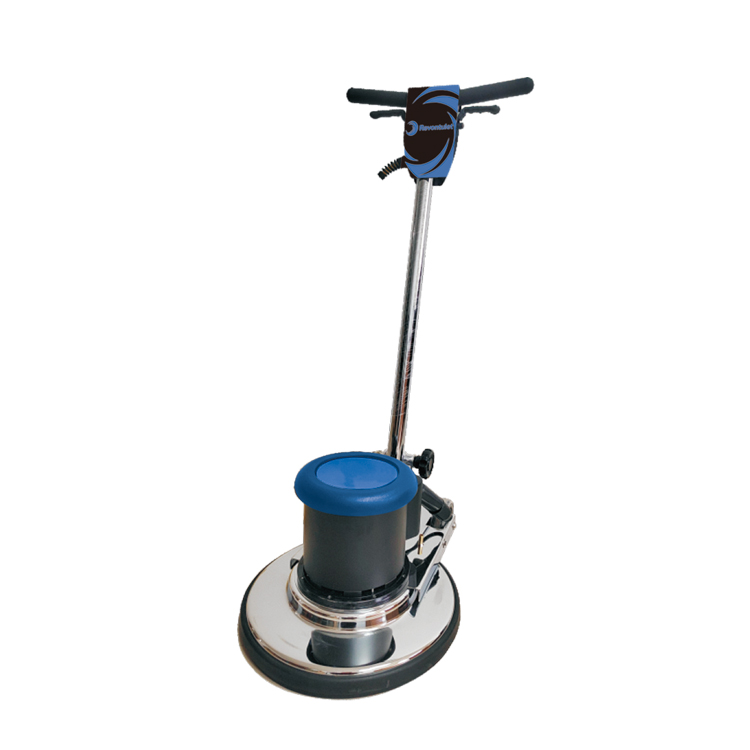
Machines operating at 300-800 RPM bridge the gap between chemical crystallization and mechanical polishing, providing versatility for facilities with multiple stone types or mixed maintenance requirements. The Revontulet GS-20D dual-speed single-disc scrubber exemplifies this category, offering 180 RPM for crystallization and wax applications plus 310 RPM for spray-buffing and general maintenance.
Dual-Speed Operational Advantages:
For granite and engineered quartz surfaces with higher hardness ratings (Mohs 6.5-7), the 600-800 RPM range enables mechanical polishing using resin-bonded diamond pads. This speed range generates sufficient friction for abrasive cutting action while maintaining operator control and equipment stability.
Best Applications:
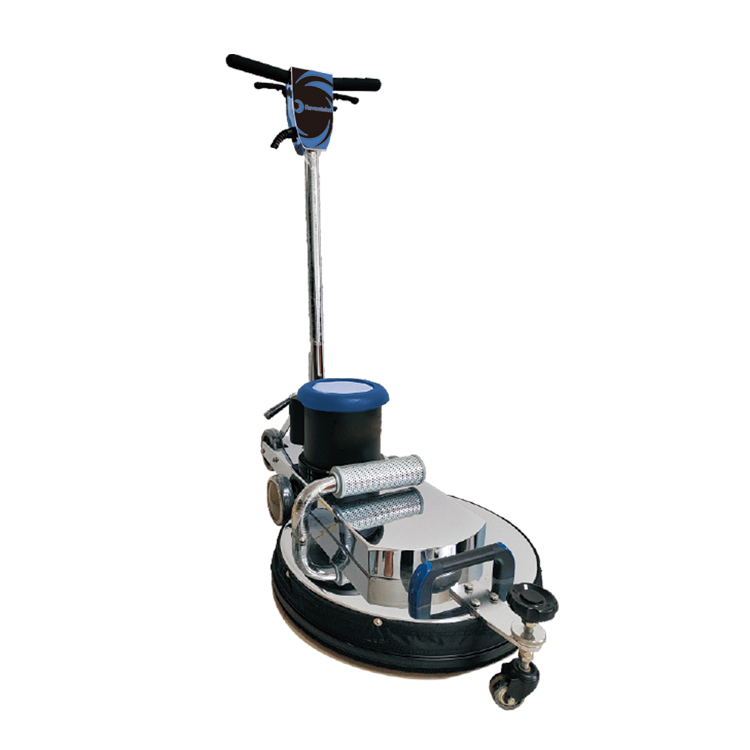
High-speed polishers operating at 1,500+ RPM create ultra-high gloss finishes (85-95 gloss units) through mechanical friction that densifies topical finishes and sealers. The Revontulet 20H High-Speed Polisher demonstrates professional-grade burnishing capability, designed specifically for floor waxing and as the final polishing step after crystallization treatments.
Critical Application Distinction: High-speed equipment modifies topical finishes rather than stone substrate chemistry. Direct application on unsealed natural stone causes thermal damage, surface crazing, and accelerated wear. Proper protocols require crystallization or sealing before high-speed operations.
Technical Specifications:
Field performance data from hospitality installations shows that high-speed burnishing extends crystallized marble maintenance intervals from 7 days to 14-21 days, reducing labor allocation by 50-67% through enhanced durability of the crystallized surface.
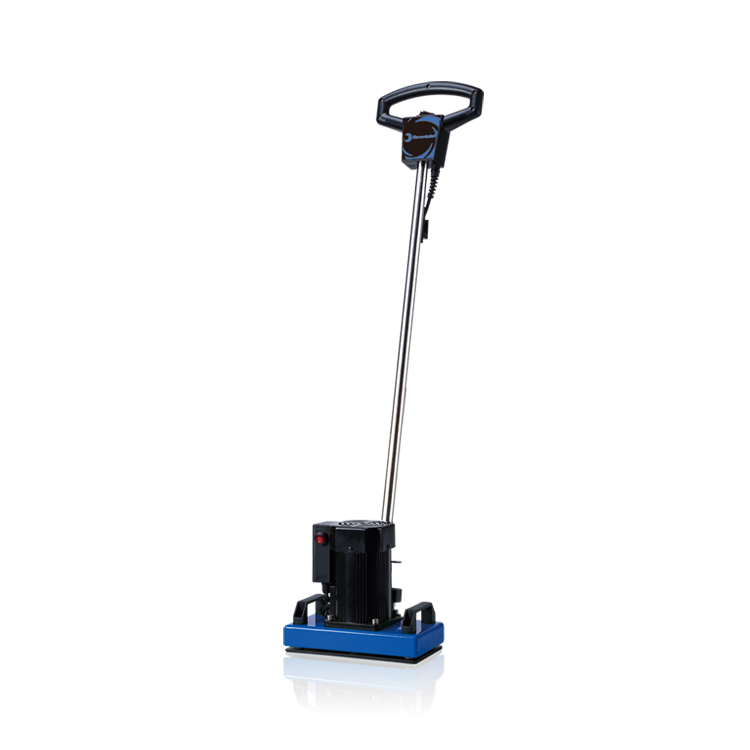
Compact floor polishers spanning 13-17 inches address specialized applications: confined spaces, detailed edge work, restroom facilities, and areas inaccessible to standard 20-inch equipment. The Revontulet Mini Polisher exemplifies this category, engineered specifically for cleaning small areas and hard-to-reach spots that standard machines cannot address.
17-Inch Machine Performance Profile:
Best Applications:
Twenty-inch machines dominate commercial floor care operations, representing the optimal balance of productivity, operator control, acquisition cost, and application versatility. Kinghome’s analysis across hospitality, healthcare, retail, and office installations confirms that 20-inch dual-speed configurations deliver superior cost-effectiveness for facilities spanning 10,000-100,000 square feet.
Performance Comparison: 17-Inch vs. 20-Inch
| Specification | 17-Inch Compact | 20-Inch Standard | Productivity Advantage |
|---|---|---|---|
| Hourly coverage (crystallization) | 1,500-1,900 sq ft | 2,100-2,600 sq ft | +35% for 20-inch |
| Daily coverage (8-hour shift) | 12,000-15,200 sq ft | 16,800-20,800 sq ft | +40% for 20-inch |
| Pad life expectancy | 4,000-6,000 sq ft/pad | 8,000-12,000 sq ft/pad | +85% for 20-inch |
| Labor cost per 1,000 sq ft | $1.89-2.40 | $1.37-1.71 | 28% lower for 20-inch |
| Equipment maneuverability | Excellent (confined spaces) | Good (open areas) | Application-specific |
Optimal Facility Types:
Industrial floor polishing systems featuring 48-62 inch working paths address large-format facilities where cleaning productivity requirements exceed 100,000 square feet per operational cycle: manufacturing plants, aircraft hangars, distribution centers, convention facilities, and transportation terminals.
Industrial System Specifications:
These ride-on configurations incorporate internal combustion engines (propane or diesel), traction-drive propulsion, and automated solution management systems. While acquisition costs of $35,000-68,000 position these units beyond most facility budgets, operations with sufficient square footage achieve compelling economics through labor displacement—one ride-on system replaces 4-6 walk-behind machines and operators.
Industrial floor polishing machines exhibit energy consumption patterns ranging from 1.1kW for compact single-disc units to 30kW for industrial grinding systems, with actual operational loads varying based on pad selection, substrate hardness, and operator technique.
Energy Consumption by Equipment Type:
| Machine Category | Motor Rating | Actual Draw | Energy per 1,000 sq ft | Cost per 1,000 sq ft |
|---|---|---|---|---|
| 17″ Compact Single-Disc | 1.1-1.5 kW | 0.88-1.43 kW | 0.18-0.26 kWh | $0.029-0.042 |
| 20″ Dual-Speed Commercial | 1.5-2.5 kW | 1.20-2.38 kW | 0.15-0.22 kWh | $0.024-0.035 |
| 20″ High-Speed Burnisher | 1.5-2.0 kW | 1.20-1.90 kW | 0.12-0.18 kWh | $0.019-0.029 |
| 20″ Industrial Grinder | 10-15 kW | 8.00-14.25 kW | 1.20-2.10 kWh | $0.192-0.336 |
| 48″ Ride-On System | 11-19 kW | 9.50-18.05 kW | 0.24-0.45 kWh | $0.038-0.072 |
Energy costs calculated at $0.16/kWh industrial electricity rate based on field testing productivity rates
Critical Insight: Direct energy costs represent just 2-4% of total operational expenses when labor, chemicals, and pad consumption are factored into comprehensive cost analysis. Productivity-normalized energy consumption reveals that large ride-on systems deliver 35-48% lower energy cost per square foot than compact walk-behind units due to dramatically higher coverage rates.
Battery-powered floor polishers eliminate cord management challenges and enable operations in occupied spaces without extension cord trip hazards, but introduce battery acquisition costs, cycle life limitations, and charging infrastructure requirements.
Battery-Electric System Considerations:
Cord-Electric System Advantages:
ROI Decision Framework: Facilities with daily floor care requirements exceeding 3 hours favor cord-electric configurations, where predictable utility costs and elimination of battery replacement cycles reduce 5-year total cost of ownership by 22-34%. Battery-electric systems optimize for applications under 20,000 square feet with sporadic usage patterns, occupied-space constraints, or multi-floor layouts where cord management consumes excessive setup time.
Marble, limestone, and travertine—all calcium carbonate-based stones—demand low-speed operations at 175-300 RPM to prevent thermal etching while activating crystallization chemistry. Field application data from Kinghome’s commercial installations demonstrates that 250-280 RPM generates optimal surface temperatures (145-165°F) for chemical penetration without exceeding the 185°F threshold where calcium carbonate degradation begins.
Crystallization Process Technical Parameters:
Kinghome’s crystallization compounds exemplify proper formulation design for low-speed applications, featuring pH 8.2 chemistry that activates at 250-300 RPM with steel wool pads while maintaining VOC content below 50 g/L for environmental compliance.
Application Protocol:
Granite (Mohs 6.5-7) and engineered quartz surfaces (Mohs 7) require variable-speed capability spanning 300-1,200 RPM, where higher rotational velocities generate sufficient friction for mechanical polishing without chemical intervention. Unlike marble crystallization that relies on chemical reactions, granite maintenance depends on mechanical abrasion using resin-bonded diamond pads at elevated speeds.
RPM-Application Pairing for Granite:
Pad Selection by RPM Range:
Field performance data from Kinghome’s hotel and retail installations demonstrates that variable-speed machines reduce granite maintenance costs by 38-52% compared to fixed-speed equipment, primarily through optimized pad life and productivity improvements.
Terrazzo restoration and concrete polishing demand high-torque low-speed configurations delivering 175-300 RPM with motor capacities of 10-30kW to support multi-stage diamond grinding sequences. Unlike single-disc polishers for maintenance, terrazzo grinding requires planetary head designs with 3-7 satellite discs distributing cutting force across broader contact areas.
Industrial Grinder Specifications:
Professional terrazzo restoration requires systematic progression through diamond grit sequences, with each stage removing scratches from the previous level while preparing the surface for finer abrasives. This labor-intensive process demands specialized industrial grinders distinct from standard maintenance equipment.
| Facility Size | Primary Stone | Recommended Equipment | RPM Range | Motor Power | Expected Productivity |
|---|---|---|---|---|---|
| Under 10,000 sq ft | Marble/travertine | Single 17″ dual-speed | 180/310 RPM | 1.1-1.5kW | 12,000-15,000 sq ft/shift |
| Under 10,000 sq ft | Granite/quartz | Single 20″ variable-speed | 300-1,200 RPM | 2.0-2.5kW | 16,000-22,000 sq ft/shift |
| 10,000-50,000 sq ft | Marble/limestone | Two 20″ dual-speed | 175/320 RPM | 1.5-2.0kW | 30,000-40,000 sq ft/shift |
| 10,000-50,000 sq ft | Granite/quartz | Two 20″ variable-speed | 300-1,400 RPM | 2.0-2.5kW | 32,000-44,000 sq ft/shift |
| 10,000-50,000 sq ft | Mixed stone types | Two 20″ variable + one 17″ compact | 175-1,400 RPM | 1.5-2.5kW | 35,000-48,000 sq ft/shift |
| 50,000-150,000 sq ft | Marble/travertine | Three 20″ dual-speed | 175/320 RPM | 1.5-2.0kW | 50,000-70,000 sq ft/shift |
| 150,000+ sq ft | Any stone type | Walk-behind + ride-on combination | 175-470 RPM | Variable | 80,000-120,000 sq ft/shift |
Healthcare Facilities: Infection Control and Occupied-Space Operation
Hospitality: Appearance Standards and Multi-Stone Environments
Retail and Commercial: Productivity and Cost Control
Educational Institutions: Durability and Multi-Operator Use
Kinghome Environmental Technology brings 18 years of stone care formulation expertise and equipment knowledge to the commercial floor maintenance industry, supporting over 3,000 clients across more than 50 countries. This extensive field experience informs product development, technical support, and application protocols optimized for real-world commercial installations.
Comprehensive Stone Care Solutions:
Floor Polishing Machines: Kinghome’s equipment portfolio includes professional floor grinders, polishers, and cleaning machines designed specifically for stone care applications. The Revontulet product line features:
Stone Care Chemicals: Specialized formulations developed for calcium-based and silicate-based stone surfaces:
Technical Support and Training: Kinghome provides on-site operator training covering machine handling, chemical application techniques, safety protocols, and maintenance procedures. Technical support includes substrate analysis for product selection, troubleshooting assistance, and program optimization guidance extending beyond initial installation.
Industry Partnerships: Strategic collaborations with Klindex (Italian grinding equipment) and Rubbermaid (facility maintenance products) ensure access to best-in-class complementary technologies for comprehensive stone care programs.
RPM Determines Application Capability:
Machine Size Affects Productivity and Facility Fit:
Energy Costs Are Minor Compared to Productivity:
Stone Type Dictates Speed Requirements:
Professional Support Maximizes Investment Value:
For comprehensive equipment specification assistance, crystallization protocol development, or facility-specific recommendations, contact Kinghome’s technical support team for complimentary consultation and application guidance.
 English
  Spanish