WELCOME TO KINGHOME
Get A Free Quote
We will get back to you within 8 hours

WELCOME TO KINGHOME
We will get back to you within 8 hours
Most bad granite stain-removal advice fails because it treats granite like ceramic tile, glass, or metal. Before using vinegar, bleach, abrasive powders, solvent cleaners, or a poultice, identify whether the problem is an oil stain, organic stain, rust mark, hard-water deposit, dye transfer, sealer haze, or acid etch. The wrong method can turn a removable stain into etching, discoloration, dullness, or deeper absorption.
| Common advice | Why it fails on granite | Safer next step |
|---|---|---|
| Use vinegar, lemon, or acidic descaler | Acid can dull calcium-based minerals and damage nearby sealers or grout | Identify mineral deposit vs etch before treatment |
| Scrub harder with abrasive powder | Abrasives can create visible dull patches and uneven reflectivity | Use stone-safe cleaner and test a hidden area first |
| Apply one poultice for every stain | Oil, rust, dye, and organic stains need different chemistry | Match poultice chemistry to stain type and stone condition |
If the surface is already damaged, compare the correct granite chemical stain removal guide and KingHome stone care chemicals before trying another method.
If you have ever searched for how to remove a stain from granite, found a highly recommended solution, tried it, and ended up with a bigger problem than you started with — you are not alone, and it is not your fault.
The internet is full of stain removal advice that works perfectly well on ceramic tile, porcelain, or glass, and causes irreversible damage to natural granite. The problem is that most advice is not labeled by surface type. A tip written for cleaning a ceramic sink gets shared, copied, and republished until it appears everywhere — including in articles that have “granite” in the headline.
This guide identifies the most common destructive mistakes people make when treating granite stains, explains exactly why each one causes damage at the chemical level, shows you how to recognize when secondary damage has already occurred, and outlines the recovery path for each scenario.
If you have not yet treated your stain and want the correct removal methods, start here: How to Remove Chemical Stains from Granite
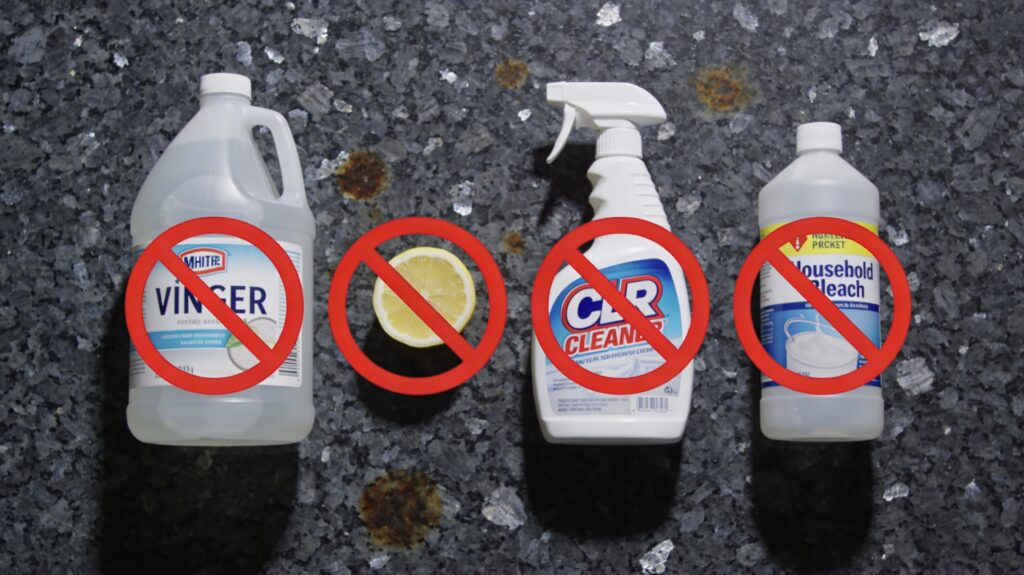
Why people do it: Hard water deposits are calcium and magnesium mineral buildup. Vinegar and lemon juice are weak acids. Acid dissolves calcium. The logic appears to be sound — and on ceramic tile, it works exactly as expected.
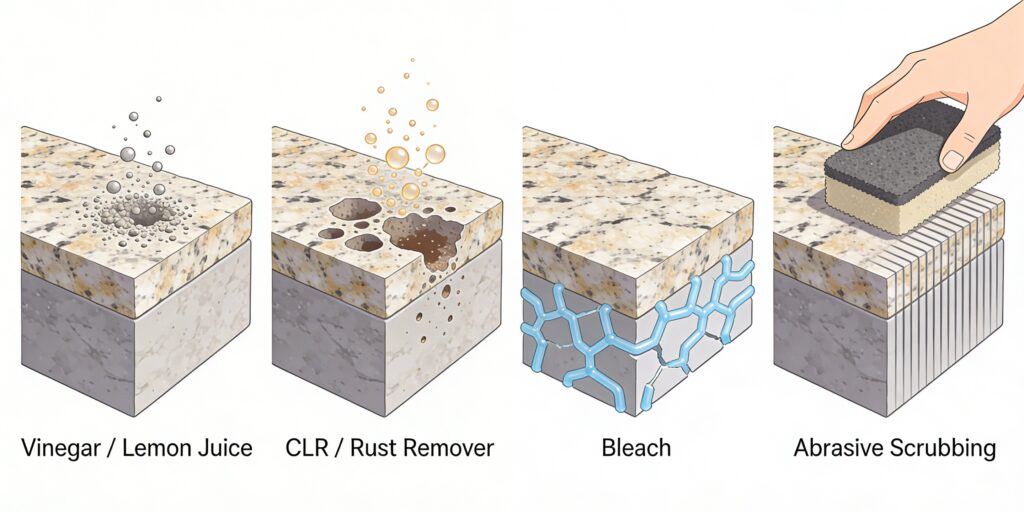
What actually happens on granite: Granite is not ceramic. It is a crystalline igneous rock containing feldspars, quartz, micas, and calcium-bearing minerals including calcite and feldspar variants. When acetic acid (vinegar) or citric acid (lemon juice) contacts the polished surface of granite, it does not selectively dissolve the hard water deposit — it reacts chemically with the calcium-containing minerals in the granite itself. The result is acid etching: the polished surface layer is chemically dissolved, leaving dull, lighter-colored spots or patches that cannot be wiped away because they are not a deposit on the surface — they are physical damage to the surface.
The compounding problem: Hard water deposits sit on top of the surface. Acid etching goes into the surface. After using vinegar on granite to remove hard water spots, you now have both the original deposit (partially dissolved but likely still present around the edges) and new surface damage beneath it. You have traded one cosmetic problem for a more serious structural one.
What to use instead: A purpose-formulated water spot remover that uses surfactants and chelating agents rather than acid to dissolve mineral deposits. See Stain Type 4 in our stain removal guide for the correct method.
Why people do it: CLR (Calcium, Lime, Rust remover) is one of the most widely available and effectively marketed rust removal products on the market. Its name implies it handles exactly the problem at hand. Naval jelly and similar rust converters are used successfully on metal surfaces. Both work by chemical reaction with iron oxide.
What actually happens on granite: The active mechanism in most generic rust removers — including CLR — is acid. Hydrochloric acid (HCl) is one of the strongest mineral acids and is particularly effective at dissolving iron oxide and calcium deposits. On granite, hydrochloric acid reacts aggressively with feldspar, calcite, and other minerals across the entire surface it contacts, not just the rust stain. The result is severe, rapid acid etching — a matte, roughened surface that cannot be restored without professional diamond re-polishing. In high concentrations or prolonged contact, HCl can cause permanent pitting that is beyond cosmetic repair.
The particular danger of this mistake: Rust stains are among the more difficult stains to remove from granite, which leads people to reach for the strongest product available. CLR works almost immediately — users often see the rust dissolving — and assume the product is working as intended. The damage to the surrounding granite is not always immediately visible. It becomes apparent as the surface dries, and by that point, the reaction has already completed.
What to use instead: A granite-specific rust remover formulated with chelating agents rather than mineral acids. Chelating agents (such as EDTA and similar compounds) bind to iron ions selectively, lifting the iron oxide without reacting with the granite minerals. See Stain Type 2 in our stain removal guide for the appropriate products and method.
Why people do it: Bleach (sodium hypochlorite) is the default disinfectant in most households. It removes mold, mildew, and organic staining from grout and ceramic tile effectively. In bathrooms and kitchens, the instinct to reach for bleach when something looks dirty and discolored is deeply habituated.
What actually happens on granite: Unlike acids, bleach does not immediately etch or visually damage granite. This is part of what makes it a more insidious problem — the damage is not visible right away, so the mistake gets repeated.
Bleach causes two types of harm to granite surfaces:
First, sealer degradation. Penetrating sealers protect granite by occupying the pores with a hydrophobic polymer barrier. Sodium hypochlorite is a strong oxidizing agent that degrades the polymer chains in most sealer formulations. A single bleach treatment will not completely strip a sealer, but repeated use over weeks or months progressively breaks down the protective layer. The stone begins absorbing stains more readily and the problem appears to “get worse over time” — which is attributed to the granite aging rather than the bleach treatments.
Second, potential discoloration on certain granite types. Some granites contain iron-bearing minerals that can react with bleach, producing localized color changes — typically a fading or lightening in the treated area. This is irreversible without re-polishing. Light-colored granites are more susceptible to visible discoloration than dark granites.
What to use instead: A pH-neutral stone-safe cleaner for routine cleaning, or a disinfectant specifically formulated for natural stone. For organic stains (mold, mildew, organic matter), a dilute hydrogen peroxide solution applied briefly and rinsed thoroughly is a safer alternative that does not carry bleach’s sealer-degradation risk with careful use.
Why people do it: When a stain does not respond to liquid treatment, the instinct is to increase mechanical force. Abrasive scouring pads, steel wool, scrubbing powders, and baking soda paste are all common escalation choices.
What actually happens on granite: Granite rates 6–7 on the Mohs hardness scale, but this refers to the mineral hardness of the stone itself. The polished surface is a result of progressively finer grinding — the mirror-like finish on a polished granite slab is achieved through grinding sequences down to 3,000 grit or finer. Many common abrasive household products — including most scouring pads, rough scrub brushes, and powdered cleansers — have an effective grit that is coarser than this. Scrubbing with them on polished granite creates fine scratches that scatter light, producing a progressively dull, hazy appearance across the treated area.
The specific risk of steel wool: Standard steel wool (grades 0 through 3) will visibly scratch polished granite. Fine steel wool (0000 grade) can be used cautiously on polished granite in very specific scenarios — but only on a polished finish, never on honed, leathered, or flamed surfaces, and only with very light pressure. Any coarser grade will leave marks.
Baking soda paste is sometimes recommended as a “gentle abrasive.” Baking soda (sodium bicarbonate) has a Mohs hardness of approximately 2.5 — softer than granite. However, baking soda paste frequently contains fine granules with irregular sharp edges. On a polished surface, even this relatively soft material can produce micro-scratching under pressure. Use baking soda only as an absorbent powder for oil stains — not as a scrub.
What to use instead: Nylon brushes for mechanical agitation on hard deposits. For polished surfaces, a soft cloth with chemical action is almost always preferable to mechanical scrubbing.
The root cause of most of the mistakes above is a single problem: stain removal advice is written and shared without distinguishing between surface types, and granite’s behavior is fundamentally different from the surfaces most DIY cleaning advice assumes.
Granite and marble are both called “stone floors.” So are ceramic tile, porcelain, limestone, travertine, and quartzite. These materials have radically different compositions, surface structures, and chemical sensitivities. Advice that applies correctly to marble — a calcium carbonate stone — is frequently wrong for granite. Advice written for ceramic tile — a fired, non-porous, acid-resistant surface — is wrong for both.
Vinegar and lemon juice are genuinely safe on ceramic tile and some porcelain surfaces. They are genuinely destructive on granite, marble, limestone, and travertine. When a popular cleaning website lists “natural stone” as a surface type and recommends vinegar as a safe cleaner, the person writing it likely tested the advice on their ceramic shower tile. The granite countertop owner reading it has no way to know this.
A very large volume of bathroom and kitchen cleaning content is primarily concerned with grout. Grout is highly alkaline, relatively porous, and prone to mold. The most effective grout cleaners are acidic or oxidizing — precisely the types of products that damage granite. When someone searches for how to clean their “granite floor,” a significant portion of the results they find were written primarily about cleaning the grout lines between the tiles, not about the granite tile surface itself.
Vinegar, lemon juice, baking soda, and salt are all labeled as “natural” cleaning alternatives. They are also all either acidic or potentially abrasive. The assumption that natural cleaning products are gentler than synthetic ones does not apply to natural stone. Acetic acid does not become less corrosive because it comes from a bottle of white vinegar rather than a laboratory.
If you have already used an incorrect product on your granite, the following visual and tactile signs indicate what type of secondary damage has occurred.
When granite stain removal advice fails, the next step is not a stronger household cleaner. Start by deciding whether the mark is absorbed oil, rust, mineral deposit, sealer damage, residue from the previous treatment, or acid stains from granite that are really surface etching. Acetone on granite, bleach, vinegar, abrasive powders, and random poultice recipes can all change the surface in different ways, so recovery should match the actual damage pattern.
| After bad advice, what changed? | Likely diagnosis | Safer next path |
|---|---|---|
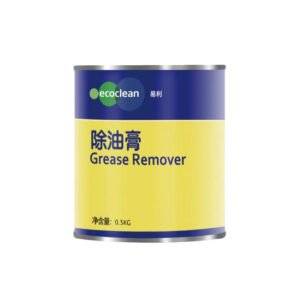
| The mark became darker or spread after acetone, soap, or a wet poultice | Oil stains from granite, trapped moisture, or solvent-moved contamination may still be active. | Let the stone dry, avoid sealing, and compare Grease Remover with the oil contamination guide. |
| The mark is orange, brown, or near metal furniture, screws, or fixtures | Rust or oxidation needs diagnosis before any acid, bleach, or abrasive method is used. | Use a rust-specific path such as Granite Rapid Rust Remover, then rinse and inspect the finish. |
| The area became pale, rough, or dull after vinegar, lemon, descaler, or acid cleaner | This may be acid etching, not a removable stain. | Stop stain-removal attempts and review chemical stains on granite before deciding whether refinishing is needed. |
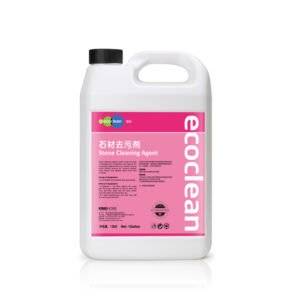
| The surface feels sticky, cloudy, or hazy after repeated cleaning | Cleaner residue, mineral deposit, or sealer haze may be sitting on top of the granite. | Compare Stone Stain Remover with seal-safe cleaning guidance in cleaning granite floors without damaging the seal. |
| The stain improves but returns after a few days | The granite sealer may be weak, or the stone may still contain moisture or oil. | Run a water-drop test only after the area dries, then follow how to re-seal granite after stain removal and Crystal Shield stone protection. |
| The issue covers a larger floor area rather than one spot | The stain problem may be part of poor machine recovery, wrong brush or pad choice, or residue spread across the floor. | Use granite and terrazzo floor cleaning machines before repeating spot treatment across the full area. |
The safer recovery order is simple: identify the stain type, stop the method that made it worse, test a small area, let the granite dry, then decide whether the next step is stain removal, refinishing, resealing, or protection. This keeps “how to remove stains from granite” work from becoming avoidable surface damage.
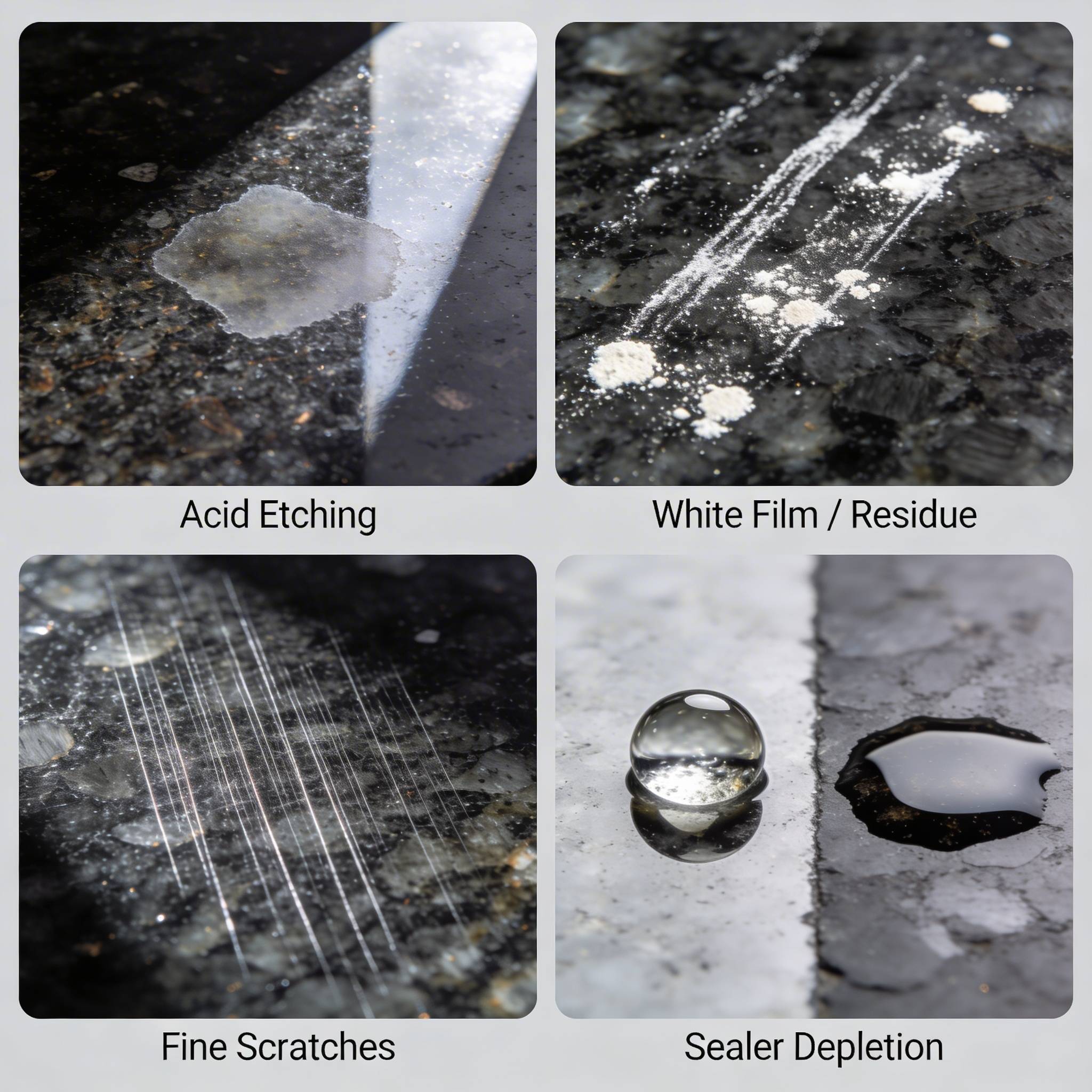
What it looks like: One or more areas of the granite surface appear noticeably duller than the surrounding stone. Under normal room lighting, the affected area may be subtle. Under raking light — a flashlight or phone torch held at a low angle parallel to the surface — the difference becomes clearly visible: the undamaged areas reflect the light sharply while the etched area appears hazy or matte.
Touch test: Run a clean fingertip slowly across the boundary between the dull area and the surrounding polished surface. Acid etching creates a subtle surface texture change — a micro-roughness or slight depression compared to the smooth polished surface. If you can feel the transition, the etching has penetrated the polished layer.
What caused it: Acidic products — vinegar, lemon juice, CLR, acidic bathroom cleaners, citrus-based degreasers, or any product not specified as safe for natural stone.
Severity assessment: Light hazing confined to a small area can often be addressed with a granite polishing compound or fine diamond polishing pad. Extensive hazing, deep pitting, or visible roughening across a large area requires professional diamond re-polishing equipment.
What it looks like: A white, chalky, or streaky film on the surface that was not present before treatment. In some cases it appears as a solid white patch; in others as irregular streaks following the direction of scrubbing or wiping.
How to distinguish residue from damage:
What caused it: Bleach leaving behind mineral salt residue, incompletely removed cleaning powders, hard water deposits formed during rinsing with unfiltered water, or poultice material that dried and re-entered the pores.
What it looks like: A pattern of fine, parallel or swirling lines on the polished surface, visible under raking light or at a low viewing angle. The scratches may cover the treated area uniformly if the scrubbing was applied in a consistent direction, or form a random pattern if circular scrubbing was used.
Touch test: Fine scratches from abrasive pads can sometimes be felt as a slight roughness when you draw a fingernail very lightly across the surface at a low angle.
What caused it: Scouring pads, abrasive powders, rough scrub brushes, steel wool of grade coarser than 0000, or any mechanical scrubbing applied directly to a polished surface.
Severity assessment: Very fine scratch patterns can sometimes be polished out with a granite polishing compound using a soft cloth. Deeper scratches require professional polishing equipment with progressively finer diamond grits.
What it looks like: Nothing — immediately. This is the most dangerous type of secondary damage because there is no visible indicator.
How to detect it: The water bead test. Place a few drops of water on the treated area and on adjacent untreated granite. Leave for five minutes. If water on the treated area absorbs or darkens the stone while water on the untreated area continues to bead, the sealer has been depleted by bleach, solvents, or repeated application of alkaline cleaners.
What caused it: Repeated bleach use, acetone used without subsequent resealing, strong alkaline cleaners applied frequently, or any solvent-based product used without subsequent sealer reapplication.
The consequence if untreated: The next spill — oil, wine, coffee, sauce — will penetrate the now-unsealed pores without the protective window that a healthy sealer provides. The resulting stain will be deeper and more difficult to remove than it would have been on a properly sealed surface.
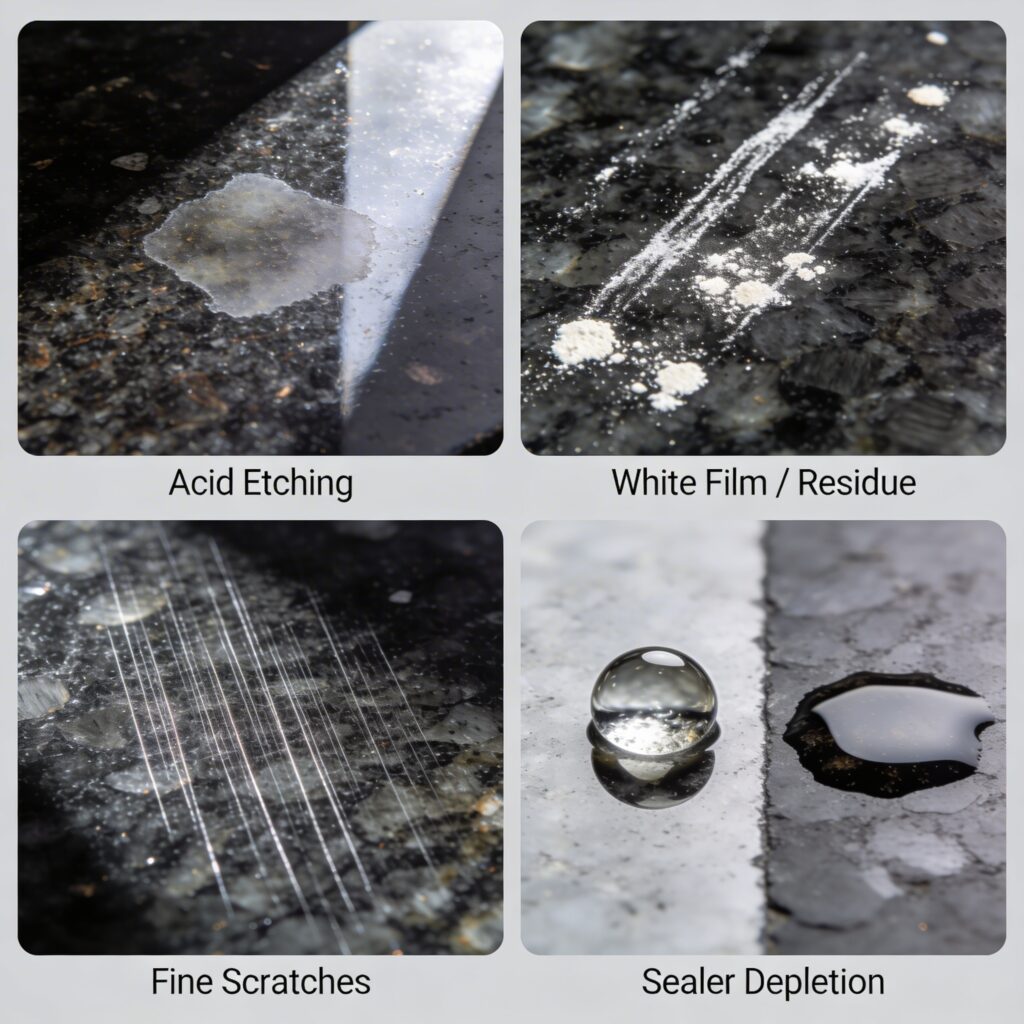
The right recovery path depends on which type of secondary damage you are dealing with. Use the identification signs above to determine your scenario, then follow the corresponding approach.
Acid etching cannot be removed — it can only be polished away by re-establishing a new polished surface. The approach depends on severity:
For detailed re-polishing procedures, see Stain Type 1 — Acid Etching in our stain removal guide.
This is the simplest recovery — but only because it has not yet produced a secondary stain.
Reseal the affected area immediately using a penetrating impregnating sealer appropriate for your granite’s surface finish. For the complete resealing procedure, see our guide: How to Re-Seal Granite After Stain Removal
Do not delay. The longer the granite remains unsealed, the higher the probability of a permanent stain during that window.
| Product | Mechanism | Effect on Granite | Safe to Use? |
|---|---|---|---|
| White vinegar | Acetic acid (pH ~2.5) | Acid etching — dissolves polished surface minerals | No |
| Lemon juice | Citric acid (pH ~2–3) | Acid etching — same as vinegar, faster at higher concentrations | No |
| CLR | Hydrochloric and other acids | Severe acid etching; can cause permanent pitting | No |
| Naval jelly | Phosphoric acid | Acid etching | No |
| Bleach (NaOCl) | Strong oxidizing alkali (pH 11–13) | Sealer degradation; possible mineral discoloration on some granites | No |
| Baking soda paste | Mild abrasive (Mohs ~2.5) | Micro-scratching on polished surfaces under pressure | Not as scrub — safe only as absorbent powder |
| Steel wool (grades 0–3) | Coarse abrasive | Visible scratching | No |
| Steel wool (0000 grade) | Fine abrasive | Safe only on polished finish, light pressure | Polished finish only |
| Acetone | Organic solvent | No etching — strips sealer; safe if followed by resealing | Yes, with resealing |
| pH-neutral stone cleaner | Neutral surfactants (pH 6–8) | No damage | Yes |
| Hydrogen peroxide (3%) | Mild oxidizer | Safe for brief contact; do not leave in prolonged contact | Yes, with care |
I used vinegar on my granite once. Is the damage permanent?
Light acid etching from a single brief vinegar contact can often be polished away with a granite polishing compound. The outcome depends on how long the vinegar was in contact with the surface, the concentration, and the specific minerals in your granite. If the affected area covers a small zone and the dulling is subtle, start with a polishing compound and assess the result. If you can still feel roughness after polishing, the etching is deeper and may need professional attention.
I have been cleaning my granite with bleach for months. What should I do now?
Stop using bleach immediately and switch to a pH-neutral stone cleaner. Test the surface with the water bead test to assess sealer depletion — if water absorbs into the stone rather than beading, reseal the surface. If no visible discoloration has occurred, the sealer can be restored and the granite will perform normally again. If you notice lighter patches or color changes in heavily treated areas, those may be permanent mineral alterations and would require professional assessment.
Can acetone damage granite?
Acetone does not etch or chemically damage granite minerals — it does not react with feldspar, quartz, or other granite components. Its risk to granite is indirect: it is an effective sealer stripper. After any acetone treatment — poultice-based or otherwise — the treated area must be resealed. Used with subsequent resealing, acetone is a legitimate tool for oil and dye stain removal. Used without resealing, it leaves granite temporarily unprotected.
My granite looks fine after I used the wrong product. Do I still need to do anything?
Possibly. If you used bleach or a solvent-based product, the visible surface may be unchanged while the sealer has been degraded. Run the water bead test on the treated area. If water absorbs into the stone, reseal immediately. Invisible sealer depletion is the most common type of secondary damage precisely because it produces no immediate visual warning.
Related guides:
 English
  Spanish